Manufacturing excellence meets the circular economy
Welcoming delegates, Thomas Armstrong, Managing Editor of International Cement Review, emphasised the importance of collaboration and innovation as cement producers respond to mounting environmental, economic and regulatory pressures.
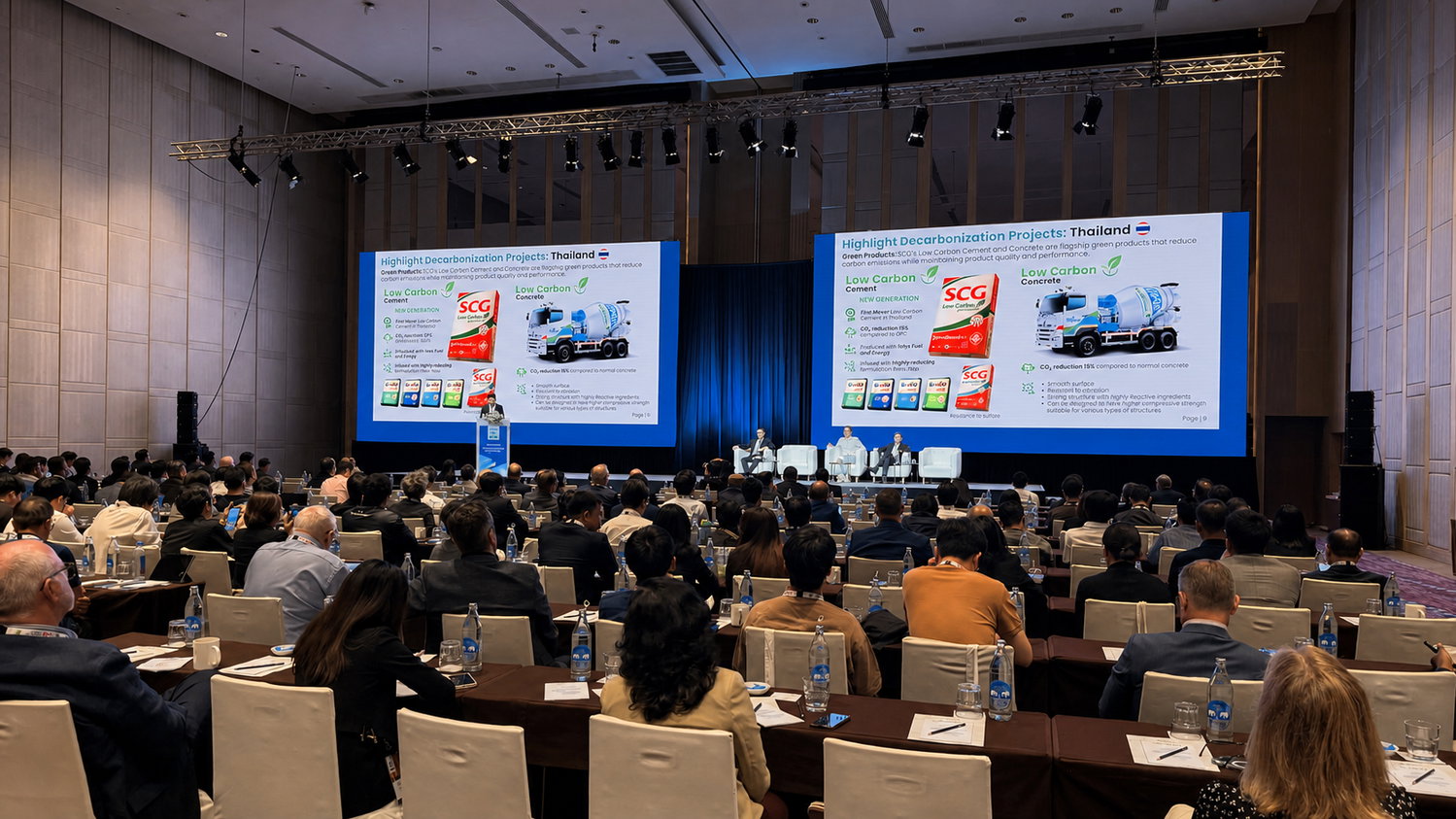
Surachai Nimlaor, President of SCG Cement Co Ltd, opened the technical programme by outlining SCG Cement's regional decarbonisation roadmap. In “Leading the low-carbon transition: SCG’s cement decarbonisation roadmap in Southeast Asia”, he showed how Thailand's largest cement producer is combining energy transition and efficiency, calcined-clay cement, carbon capture, utilisation and storage, and offsetting to reduce emissions while preserving competitiveness.
Sebastian Reiter of McKinsey & Co considered how the “cementitious revolution” is reshaping value, assets and competitive advantage. As supplementary cementitious materials become more strategically important, he argued that producers will need to secure supply, reconsider the role of existing assets and move further downstream towards differentiated construction solutions.
Harry Murphy Cruise of Oxford Economics placed these industry shifts within a volatile macroeconomic environment, examining the implications of conflict in the Middle East for construction activity, investment and energy costs. Further market updates from China, Bangladesh and Vietnam underlined the diversity of conditions across Asia, from structural overcapacity and export pressure to infrastructure-led demand and changing regional trade flows.
Ikram Ahmed Khan of Shun Shing Group profiled Bangladesh's import-dependent cement market, where substantial effective production capacity serves demand shaped by pronounced seasonal peaks. His presentation, “Bangladesh cement industry update and regional SCM trade”, connected infrastructure-led demand with clinker imports and mapped changing Asian flows of slag, fly ash and other supplementary cementitious materials.
Alternative fuels then featured strongly in the programme. Presentations from KHD Humboldt Wedag, Fuller Technologies, UTIS and BEUMER examined combustion, dosing, storage and handling solutions designed to increase substitution rates without compromising kiln stability. In “Fuel flexibility reaches new heights”, Ning Shen Tan of Fuller Technologies showed how modular reception, weighing, reclaim and firing systems can help plants expand the range of fuels used while retaining dependable coal backup.
Lower-clinker cements move closer to scale
Supplementary cementitious materials (SCMs) and the performance of blended cements were central to the second day. Dr Raju Goyal of INSEE-Siam City Cement reported promising results from the use of nanosilica in blended cements. Tests showed faster setting and a substantial improvement in one-day strength, suggesting a route to retaining the CO2 benefits of a lower clinker factor without sacrificing performance. The full presentation, “Improving the performance of blended cement through the use of nano materials”, also addresses dispersion, safe handling and the commercial challenges of scale-up.
Following Dr Goyal in the programme, Alejandro Velez of Sika demonstrated how tailored admixture chemistry can address the water demand, workability and early-strength challenges associated with calcined clay. His presentation, “Enabling sustainable construction with calcined clay”, positioned the material as an implementation-ready option within a broader portfolio of lower-carbon SCMs.
Grinding systems must evolve alongside cement formulations. Kaushik Ghosh of Köppern explained how roller presses originally designed for conventional feeds can be adapted for finer, less dense or more abrasive SCM-containing materials. His presentation, “Target net zero – optimising roller press performances”, highlighted wear protection, choke feeding, hydraulic control and retrofit options capable of raising output while lowering specific energy demand.
Strong exhibition and networking programme
Alongside the conference, an extensive exhibition brought producers into direct contact with suppliers of grinding, combustion, materials handling, refractories, process control, emissions reduction and digital solutions. The exhibition remained a focal point during the event, allowing delegates to move from the strategic themes discussed on stage to practical conversations about plant implementation.
Coffee breaks, lunches and the Cemtech gala dinner created further opportunities to exchange ideas and develop new partnerships. The programme reinforced Cemtech's role as a meeting place where regional producers and international technology specialists can build the relationships needed to turn decarbonisation strategies into operating projects.
Smarter plants and greater fuel flexibility
Digitalisation was presented as an equally practical lever for better performance. Ioannis Sandis and Tejas Maru of CemAI demonstrated how predictive maintenance can detect abnormal behaviour across connected equipment and how a real-time optimiser can adjust plant setpoints within hard operating constraints. Their presentation, “Real-time optimisation at the cement plant”, included a kiln case in which adaptive oxygen control increased throughput, reduced heat consumption and avoided an estimated 3000t of CO2 emissions per year.
Closing the published sequence of technical presentations, Hans Jorgen Nielsen of LV International examined the operating cost and process implications of chloride recirculation. In “Reducing operating costs with a chlorine bypass”, he explained how a purpose-designed bypass can recover heat and convert bypass dust into a highly reactive cement constituent, turning a kiln build-up problem into a lower-carbon material opportunity.
These examples were supported by further sessions on AI-based process control, machine availability, predictive logistics and decarbonisation case studies. Together, they showed that lower-carbon operation is increasingly being delivered through the integration of process knowledge, reliable equipment and better use of plant data.
Looking ahead
Cemtech Asia 2026 demonstrated that the region's decarbonisation agenda is moving from ambition towards implementation. Lower-clinker cements, alternative fuels, efficient grinding and digital optimisation are already capable of delivering meaningful emissions reductions, but their success will depend on local raw materials, robust plant engineering, supportive standards and a clear commercial case.
International Cement Review would like to thank all delegates, speakers, sponsors, exhibitors and partners for contributing to another successful Cemtech conference and looks forward to welcoming the industry again at future Cemtech events.
Exclusive visit to SCG Cement's Ta Luang plant
The conference concluded with a technical visit to SCG Cement's Ta Luang plant. Delegates gained first-hand insight into the process optimisation and decarbonisation measures being implemented by the event's Platinum Sponsor and saw how the strategic themes discussed during the conference are being translated into operational practice.