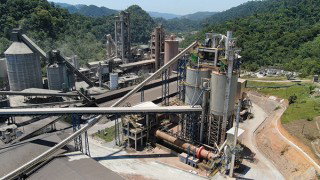
The release on bail this week of the former Lafarge executives convicted in France over payments made to armed groups during the Syrian civil war is a reminder of how deeply the cement industry became entangled in Syria’s collapse. But more than a decade after Lafarge’s Jalabiya plant became one of the conflict’s defining corporate scandals, Syria’s cement sector is returning to international attention for very different reasons.
That transition gathered pace this month when the European Union restored the full application of the EU-Syria Cooperation Agreement, ending a suspension first imposed in 2011. While sanctions and financial restrictions remain complex, the agreement signals a gradual reopening of Syria to regional and international trade.
Syria faces immense reconstruction requirements across housing, transport infrastructure, utilities and industry. Years of conflict, sanctions and underinvestment have meanwhile left much of the country’s cement capacity damaged, inefficient or idle. Domestic producers continue to struggle with unreliable electricity supplies, damaged infrastructure and exceptionally high fuel costs.
Many facilities still operate outdated production lines with poor thermal efficiency. Importing cement or clinker from neighbouring countries have therefore become central to maintaining domestic cement supply, with Syrian cement consumption estimated at around 6.5Mta according to the forthcoming 16th edition of the Global Cement Report. Imports are thought to account for around one third of this figure.
Türkiye in particular has emerged as the main external beneficiary of Syria’s cement deficit. Turkish producers possess substantial surplus capacity, established logistics networks and direct access into northern Syria, allowing it to export over 1Mt annually. Saudi suppliers have also expanded their presence, particularly in clinker exports and industrial cooperation initiatives, while Egypt has also emerged as a key supplier of cement.
In March, the state-owned Syrian General Company for Cement and Building Materials, OMRAN, announced the arrival of clinker shipments from Egyptian company Cisco under a new supply agreement intended to support local cement production and stabilise prices. Meanwhile, OMRAN is continuing its rehabilitation work at several existing plants, including Tartous, Hama and Adra, while pursuing upgrades aimed at improving grinding efficiency and reducing energy consumption.
Last month’s agreement between Syria’s Al-Hassan Holding Group and China’s Jiangsu Pengfei Group points to a more ambitious phase of industrial reconstruction. The proposed Raqqa plant is designed for around 2.3Mta of cement capacity and approximately 1.6Mta of clinker production, placing it among the largest projects announced in Syria since the start of the civil war. Syrian reports suggest construction could be completed within two years, with a Chinese technical delegation expected in Raqqa to begin implementation discussions.
The project’s scale is notable given how much of the country’s installed capacity remains damaged, inefficient or idle. A modern dry-process facility of this size would significantly alter the balance between imports and domestic production if completed.
The Raqqa announcement also coincides with growing foreign interest elsewhere in the Syrian cement industry. In March, OMRAN stated that 12 Arab and international companies had submitted applications to invest in the Adra and Al-Muslimiyah cement plants. Rehabilitation work is already underway at Tartous through the UAE-based QBZ Group, while Iraq’s Vertex Group is involved in upgrading the third production line at Hama Cement.
China’s interest in Syria increasingly appears tied to longer-term industrial positioning rather than short-term cement exports alone. Chinese engineering groups including Sinoma, BITEC and Jiangsu Pengfei have all now held discussions with Syrian authorities regarding plant rehabilitation, technical cooperation or new capacity projects over the past year.
As long as the political situation remains stable then Syria's cement industry could have a promising future.
Handpicked stories, in your inbox
Our editors pick the top news delivered to your inbox. Sign-up today!