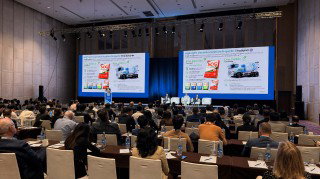
San Antonio, Texas, was the site for the IEEE-IAS/PCA 54th Cement Industry Technical Conference held between 13-17 May 2012. Nearly a 1000 delegates listened to dozens of presentations on the state of the industry, energy saving, emissions reduction, regulatory management, greater efficiency, sustainability and safety, as well as the latest technologies. Rob Roy of ROI Economic Consulting samples the atmosphere.
The IEEE-IAS/PCA industry Technical Conference in San Antonio attracted a record number of delegates
San Antonio is both lovely and historic. Home to the Alamo, it is renowned for its downtown River Walk area and colourful Spanish and Republic of Texas heritage. About 10 miles north of downtown is the picturesque Hill Country where the IEEE meeting was held at the vast JW Marriott complex, which includes two tournament player golf courses. While the outdoors was tempting, the 933 delegates and 140 exhibitors came to listen and learn and to meet others in the cement industry.
Tuesday’s opening remarks came from Steve Coppinger (IEEE-IAS CIC chair and CalPortland), Corinne Fields (conference chair and GE Energy/Air Filtration) and Ted Richardson (IEEE-IAS CIC vice chair and EDG Inc). Richardson introduced Ed Sullivan, PCA chief economist and keynote speaker, who gave a spirited and incisive presentation on the current state of and the outlook for the US cement industry.
Ed Sullivan captivated his audience despite the loud Texas thunderstorms raging outside. He opened his presentation by stating he had good news, for a change. While 2012 cement demand growth at 4-7 per cent would be abnormally low for the early stages of recovery from a severe recession, there would be steady improvement in 2013 and 2014. After 2014, cement demand was forecast to significantly increase as the fiscal and monetary problems plaguing the US economy, construction markets, and cement industry since 2006 subsided. The structural imbalances would be gone. By 2016, Sullivan predicted American cement consumption would grow by 30Mt to 100Mt. His cement outlook to 2030 was outright bullish as he suggested that favourable long-term demographic trends and much improved cement intensity would drive demand to 150Mt, compared to the previous peak of 122Mt. He even questioned whether US cement producers could match supply with expected high demand, speculating that domestic production would ‘max out’ at 85Mta, given NESHAP and other regulatory constraints, leaving 65Mt to imports. However, America currently has only 42Mta of import terminal capacity. Sullivan believed satisfying the additional US cement demand would require either, 21 new domestic cement kilns, 18-20 import terminals, or (most likely) some combination of the two. The decision would not be easy or simple for cement companies since neither imports nor new kilns are inexpensive or straightforward to obtain.
After a short break following Sullivan’s well-received presentation, the delegates listened to a full day of technical papers.

The downtown River Walk Area in San Antonio
Wednesday began with short presentations about the two cement plants to be toured on the Thursday. Clifton Stapleton (TXI) discussed the unusual expansion of the Hunter plant in New Braunfels. Started in 2007, TXI stopped the expansion as the recession’s depth became apparent. Construction was restarted in 2009 and is still underway. Situated 60.9m (200ft) from the existing kiln, the new line uses both FLSmidth and Polysius equipment, including a 112.7m (370ft) preheater tower.
Jimmy Rabon, plant manager of the Cemex Balcones, gave the history of the facility beginning as General Portland Inc in 1980, then Lafarge in 1994, and finally Cemex in 1994. A new kiln line came online in 2008 after two years of construction.
Then Rick Bohan (PCA) introduced Franz-Josef Ulm, professor of engineering at MIT. Dr Ulm is supervising the Concrete Sustainability Hub at MIT, which is doing groundbreaking scientific research on life cycle cost analysis for long-lived construction projects and the nanomechanics of concrete, among other work.
Dr Ulm discussed his group’s latest research, particularly deflection and roughness in concrete and asphalt pavements as it relates to vehicle fuel efficiency. Ulm averred that 20 per cent of US CO2 emissions come from transport and found that concrete and asphalt pavements are insignificantly different with respect to roughness, but concrete has the advantage in terms of deflection. Asphalt needs to be 25-60 per cent thicker than concrete pavement to achieve equal efficiency.
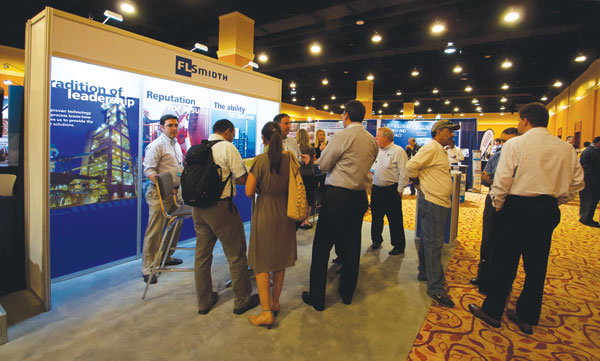
Delegates network and discuss industry matters in the exhibition area
Using Monte Carlo simulations, he found that concrete uses an expected 13,500 gal/mile/year versus 17,000 for asphalt, a 20 per cent saving for concrete. This advantage of concrete over asphalt applies regardless of cost considerations. Ulm stressed that proper design and maintenance of pavement is critical to fuel efficiency and therefore environmental sustainability. Proper design can reduce pavement’s environmental footprint by 80 per cent. Heavy trucks face greater deflection issues than normal vehicles. Ulm found that 20 per cent heavier trucks yield 44 per cent more deflection. Highway departments should consider special truck lanes made of concrete pavement, especially more efficient continuous concrete. While some people might believe greater roughness means greater traction, Ulm found that roughness does not affect traction, but weather conditions affect pavement efficiency. Temperature is an important parameter in Ulm’s research. His conclusion was that one per cent of total US fuel consumption is wasted due to roughness/deflection imperfections. Given America’s massive transport usage, these imperfections result in substantial gasoline (petrol) waste and unnecessary emissions.
Aris Papadopoulos, CEO of Titan America LLC and current PCA board chair, gave a speech about the high level of uncertainty facing cement producers, both economic and regulatory, and the need for industry personnel to be politically engaged at all levels of government: national, state and local. He singled out permit and production cap uncertainty and advised against dependence on imports to fulfill local cement demand since import supplies are unreliable both in price and availability.
Following their speeches, Dr Ulm and Mr Papadopoulos took questions. When asked about practical uses of MIT Concrete Sustainability Hub research, Dr Ulm said the industry should try to influence the President’s Office of Management and Budget (OMB) to sway federal, state and local transportation agencies to take a more scientific and statistical approach to infrastructure spending. State DOTs should also be approached directly. He would like to involve a ‘data-savvy’ state in his research. Aris Papadopoulos added that he wants a public debate about the ‘best’ materials to use.
Technical papers
There were 29 technical papers presented on Tuesday and Wednesday covering six broad areas: automation, drives, environmental/energy/sustainability, general practices, maintenance/safety, and power distribution. The three best presentations are recognised at the Awards Banquet. “Cement and CO2, A Victim of Success!” by John Kline and Laurent Barcelo of Lafarge Canada was rated the best presentation at the conference (see p65).
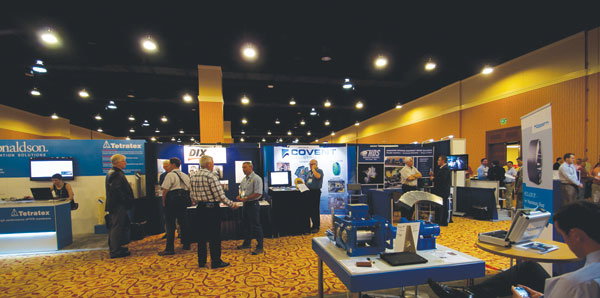
The technical conference was supported by a
major exhibition of cement industry equipment suppliers
“Processes for Activation and Manufacturing of Supplementary Cementitious Materials” by James Ballan and Peter Paone of FLSmidth was the next highest-rated presentation. Supplementary cementitious materials such as fly and slag have long been used to increase the cement produced from a given amount of clinker. They can also enhance the cement’s chemical properties, reduce energy and CO2 consumption, and make good use of ‘waste’ products. Up to 10-15 per cent substitution is fairly common and 30 per cent may be possible. The problem is mainly quality control. Supplements need to have the same level of quality control as Portland cement clinker. This paper reports on pilot programmes to produce fly ash and synthetic pozzolans of high and uniform quality. Both use the traditional calciner found in cement manufacture.
Additionally, care must be taken to remove heavy metals such as mercury and cadmium and other impurities from the fly ash. Synthetic pozzolans suffer from colour contamination as well as quality issues. Procedures for disagglomeration and drying are also needed for both fly ash and synthetic pozzolans to insure good and uniform consistency. Results from the pilot testing have been encouraging.
Due for implementation in 2013, NESHAP concerns pervaded the conference. For the first time, there will be fixed targets on hazardous emissions from cement production, including mercury, particulate matter (PM), hydrochloric acid (HCI), and total hydrocarbons (THC). Many IEEE papers focused on NESHAP, especially new technologies to meet the standards. The stakes are high. The EPA estimates implementation of the standards will cost the cement industry US$350m per year, but the PCA puts the cost at US$3.4bn a year. “A Fixed Bed Gas Remediation Solution for Mercury Control” by John Knotts, Jeff Kolde, Chris Polizzi and Stephen Stark of WL Gore & Associates Inc was the third-highest rated paper. This presentation covered a new technology using fixed sorbent beds that was highly effective in pilot testing at meeting the emissions standards with good longevity and low costs.
There were many other interesting papers presented at the conference including “A Review of Energy Efficiency and CO2 Emissions in the US Cement Industry” by Mohammad Rahim Vaseghi of the Islamic Azad University, Iran, and Ali Amiri and Alireza Pesaran of the University of North Dakota; “Quality of Clinker Related to Preheater Performance” by Pedro Montes de Oca, ATEC; “Cost Effective Energy Information System for Cement Manufacturers” by Fabio Mielli, Schneider Electric; “A Systemic Approach to Increased Alternative Fuel Utilisation” by Peter Paone and Brian Stustman of FLSmidth; and “Successful Integration of a Facility Wide Energy Management System in a Cement Plant” by Hurchel Young, Ash Grove Cement, Bruce Newell, Ash Grove Cement and David Durocher, Eaton Corp.
Tutorials and workshops
Monday was given to all-day tutorials on four main topics: automation, drives, general practices, and power generation. Don Harrold and Mike Wood of OSISoft gave an automation tutorial on real-time data infrastructure systems. They used Cemex as an example of a company that successfully implemented an enterprise-wide Process Information Management System (PIMS). The challenge is to remove intracompany communications barriers, standardise measurement and reporting, and have an interface that is compatible with all legacy systems.
The drives tutorial was given by Ashok Amin of Bosch Rexroth Corp who compared the relative merits of electrohydraulic and electromechnical drives. The general practices tutorial benefited from Michael Keyssner, Kaarl-Heinrich Zysk and Bernhard Schröder of Loesche GmbH explaining vertical roller mill technology. The power generation tutorial was presented by Daleep Mohla, DCM Electrical Consulting, who covered new electrical safety procedures, especially proper training.
Awards banquet
Each IEEE conference includes a grand banquet where awards for best presentation and meritorious service are given. Besides acknowledging the best papers, one of the evening’s highlights was the Meritorious Service Award given to John Sommers of Holcim (US) Inc. With his wife at his side, he received a standing ovation from the crowd.
During the banquet, the leaders of the current conference hand over the podium to the leaders of next year’s conference, who describe the upcoming venue and its attractions. The audience previewed a polished video promoting the 2014 conference in Orlando – ICR hopes to see you there.
The unabridged version of this artile was first published in International Cement Review, July 2012.
Handpicked stories, in your inbox
Our editors pick the top news delivered to your inbox. Sign-up today!