The 56th IEEE-IAS PCA Cement Industry Technical Conference was held at the Gaylord National Resort in National Harbor (MD), near Washington, DC, USA, between 13-17 April 2014. The conference provided a timely update on the recovery of US cement demand and highlighted some of the technology advances in the sector. By Rob Roy, USA.
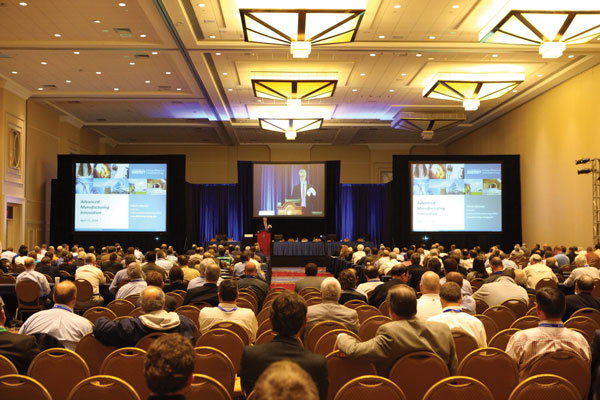
The 56th IEEE-IAS PCA Cement Industry Technical Conference updated delegates
on the status of the US cement market and industry innovations
As delegates and exhibitors acquainted themselves with the Gaylord National Resort on Sunday, 13 April, various IEEE-IAS CIC committees held meetings, followed by an evening reception in the exhibition hall which featured many leading equipment suppliers to North American cement producers.
Under the theme of ‘Sustainable strength through innovation’ this year’s conference programme explored a wide range of topics including safety, drives, power and automation.
Proceedings were complemented by a visit to Essroc’s state-of-the-art Martinsburg cement plant – a tour which proved highly popular with the Italcementi cement works having undergone significant upgrades over recent years (see ICR April 2014).
New to the conference this year was a concurrent training programme for new personnel to the cement industry.
US demand springs back
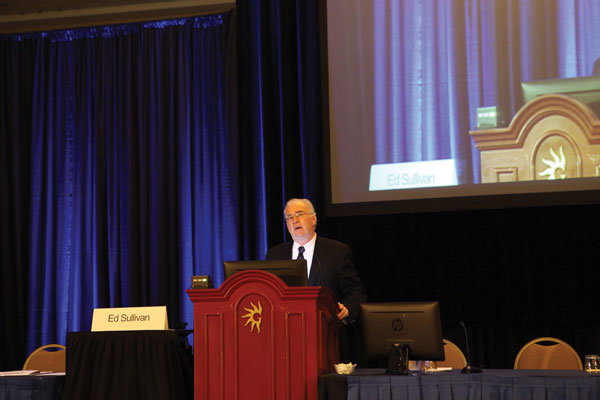
Ed Sullivan, PCA chief economist, expects a bounce-back
in US demand following a seasonally-affected
slow first-quarter performance
After an opening address by Ted Richardson, IEEE-IAS CIC chair, Derek Nicholls of Essroc Cement, who led the local organising committee, welcomed all delegates to Washington, DC. Jeffrey Nagel of Resco Products and IEEE-IAS CIC vice chair introduced the first speaker of the conference, the PCA’s chief economist, Ed Sullivan.
Discussing the current status of the US market, Sullivan highlighted how the unusually-wet and cold winter throughout much of the country had recently held back economic growth, construction activity and cement demand. Now that spring had arrived, he predicted a solid economic bounce-back and, following a slow first quarter, forecast cement demand to be much stronger. Overall, he anticipated market growth of eight per cent this year.
While the Great Recession had severely harmed the economy, construction and cement sector, Sullivan pointed out that it has also created huge pent-up demand for houses, offices, infrastructure, etc. With household debt levels now at a 30-year low, job growth averaging 175,000 per month and far fewer distressed home sales combined with historically-high (but declining) affordability, Sullivan forecast that strong new home sales would help lift cement demand. After 1.1m housing starts in 2013, he predicted 1.3m and 1.6m starts, respectively, in 2014 and 2015.
The outlook for non-residential construction was also much improved although public construction remained weak with no help coming from federal spending. However, he did see some recovery of state and local spending which accounts for two-thirds of total public construction.
Sullivan’s long-term economic outlook was relatively optimistic, though he stressed that it was based on conservative assumptions. By 2035, the country’s cement demand would range between 160-180Mta. If he is correct, the industry will have a difficult time supplying enough cement to satisfy demand given the current level of domestic production and import capability. Currently, the US has about 100Mta and 40Mta of cement and import terminal capacity, respectively. A ‘tipping point’ between cement supply and demand is expected around 2020, according to Sullivan’s estimations.
Technology game-changers
Mr Sullivan’s informative talk was followed by Mark Johnson, director of the Department of Energy’s Advanced Manufacturing Office. While his background is in semiconductors rather than cement, he offered some interesting thoughts about future technologies that could significantly affect the whole economy, including cement. In essence he observed:
• Fracking is a game changer. America now has a relative cost advantage in fuels (natural gas) that should be exploited as soon as possible.
• New power semiconductors with wide band gap will radically alter electricity transmission.
• New composite materials continue to transform construction and manufacturing.
• 3D printing, or ‘additive manufacturing’, will greatly reduce the time and cost of R&D to create new products. Working prototypes and mockups can be fabricated in-house.
• Alternative energy costs are falling rapidly. In a decade they will be as low or lower than fossil fuels.
• Sensors and computers are so cheap now that ‘smart’ manufacturing is possible.
During the Q&A session, Johnson pointed out that it will be hard to make cement manufacturing more efficient because it is already super-efficient. Ed Sullivan commented that the time to invest is now, while capital costs remain low.
A paper entitled ‘The world’s first vertical roller mill with driven rollers’ by Thomas Schmitz of ThyssenKrupp Industrial Solutions contrasted the simplicity of the VRM concept to the technical difficulty of implementation. A traditional VRM drops raw material onto a large rotating disk. There are several rollers resting on the disk which rotate with it and crush the raw material. The paper showed a different approach: a passive disk with motorised rollers, significantly cutting down friction. This modification is more efficient and also allows the operation to continue even when some of the roller motors are not working. There are now two installed RDVRMs with a third under construction. Results are very promising.
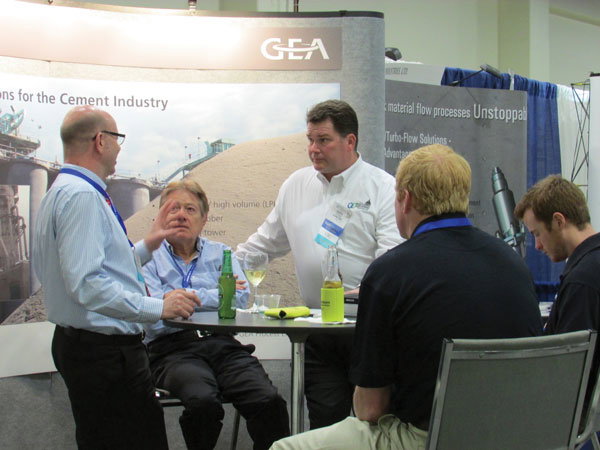
A 150-stand exhibition provided plenty of opportunity
to discuss the latest technological advances
Nick Sutherland of Solex Thermal Science also gave an interesting presentation about applying high-efficiency indirect cooling technology to cement production. Unlike conventional cooling of finished cement, the Solex method keeps water sealed off from the external environment in vertical banks of hollow steel plates. The water is pumped upward and the product (cement) falls using gravity between the plates. Heat is exchanged from the cement to the water without any direct contact. The indirect method is expected to be more efficient than conventional cooling, using less water, with “lower maintenance costs, operational costs, and lower emissions from the plant,” according to Solex.
Cary Cohrs, PCA chairman, informed the audience about the latest activities of the association and the cement industry. Special mention was given to the CSHub@MIT which started in 2009. Dr Franz Josef-Ulm, professor at MIT and one of the lead researchers of the CSHub@MIT, presented the latest research about ‘Quantitative sustainability & resilience for infrastructure decisions’.
Sustainability
John and Charles Kline of Kline Consulting presented a paper on: ‘Cement and CO2: what’s happening’ in which they catalogued the various ways to reduce CO2 emissions in cement plants, discussing the pros and cons of each method and highlighthing those of particular merit. The Klines concluded that carbon capture for utilisation or sequestration will ultimately be required for substantial reductions in CO2 emissions. Using the CO2 to make products would be preferable to sequestration. “Additional breakthroughs in technology will be required before any technology can become mainstream. Incentives to find solutions, either through taxes and/or grants will most likely be required to maintain and increase momentum,” they said.
Betsy Dutrow of the Environmental Protection Agency’s Energy Star programme guided delegates through the Energy Star certification process, explaining procedure and criteria. Currently 20 cement plants have been awarded this distinction.
The issue of safety was touched upon by Joe Main, a senior official of the Department of Labor’s Mining Safety and Health Administration (MSHA). He discussed how MSHA and the cement industry have worked together over the past several decades to sharply reduce injuries and deaths at US cement plants.
The PCA’s own Tom Harman discussed ‘Current regulatory issues affecting cement producers’.
Tutorial time
Kline Consulting also presented two tutorials: ‘CO2 and the impacts on the plants of the future’ and an SNCR workshop with Peter Paone of Bridge Gap Engineering LLC.
Coal-to-natural-gas conversions were also given attention in a tutorial by Barry Hilchey of Phoenix Process Engineering, Syed Suhail Akhtar of Holcim US, Cinar’s Tahir Abbas and Louis Ricci of Fives-Pillard.
Further tutorials included:
• ‘Installation and application of IGBT adjustable speed drives: unintended consequences and their resolution’ by David W Schlegel, Gary Skibinsk and Russel Kerkman of Rockwell Automation
• MSHA refresher training by Joseph Mangan and Janet Jacobs of FLSmidth Inc.
Conclusion
The conference ended with its customary awards presentation, putting the following papers in first, second and third place, respectively:
• ‘Cement and CO2: what’s happening,’ by John and Charles Kline, Kline Consulting
• ‘CEMS strategy for Portland Cement Maximum Achievable Control Technology (PCMACT)’ by Andy Edwards and Scott Nielson of Ash Grove Cement
• ‘A systems safety approach to Occupational Electrical Safety’ by H Landis Floyd III of Dupont and the University of Alabama at Birmingham.
The 2015 IEEE-IAS PCA Cement Industry Technical Conference will be held in Toronto, Canada. See you next year!
Article first published in International Cement Review, June 2014.
Handpicked stories, in your inbox
Our editors pick the top news delivered to your inbox. Sign-up today!