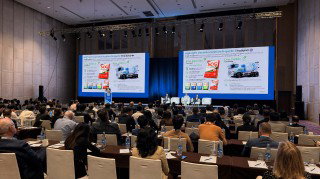
The 58th IEEE-IAS/PCA Cement Industry Technical Conference was held between 15-19 May 2016 at the Gaylord Texas Resort Centre in Grapevine, Texas, USA. Supported by a 176-stand exhibition, the event attracted more than 970 delegates from 28 countries and presented a wide range of technical papers as well as featuring panel discussions and tutorials. By ICR Research, UK.
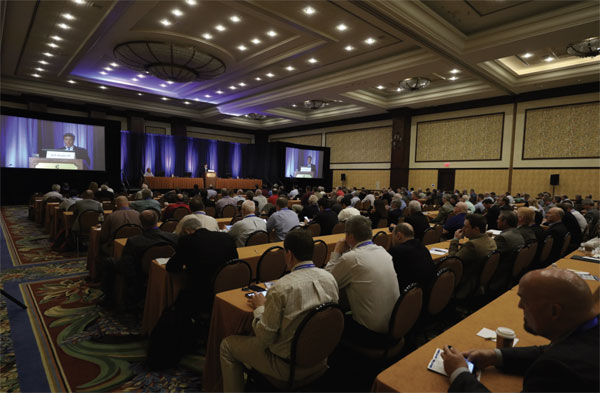
With 970 delegates from 28 countries, the IEEE-IAS/PCA Cement Industry Technical Conference
could draw on a wealth of international experience
The importance of Texas in the US cement industry was made clear by Conference Chair, Scott Nielson, at the start of the 58th IEEE-IAS/PCA Cement Industry Technical Conference. Cement plants in Texas produce 15Mta of cement, 13 per cent of total US cement output – more than Australia’s total cement production, he noted.
Jeff Austin III, commissioner of the Texas Transportation Commission, delivered the conference’s keynote presentation by highlighting the importance of the Fixing America’s Surface Transportation (FAST) Act in providing the country with funds for critical highway construction in the next three years, and Texan initiatives such as Proposition 7 which will authorise stable funding for transportation in the state.
US economy and cement
PCA Executive Vice-President and Chief Economist, Ed Sullivan, explained the reasons why the PCA’s forecast for economic growth has been revised down to take account of ‘structural forces’ that do not point to another recession, but do suggest that they are having a bigger impact on growth and stopping pent-up construction demand from being released.
While the US economy expanded by 8.7 per cent in 2014, growth decelerated sharply to 3.8 per cent the following year. At present, GDP is struggling to reach two per cent. However, four out of five analysts do not see another recession as likely. Several baseline factors indicate improving conditions. Firstly, the labour markets are seeing 200,000 new jobs created every month, although this rate is expected to slow and many of these jobs are part-time.
Increased consumer buying power, as employment and wages grow, is stimulating the economy at a time when interest rates and inflation remain low. People feel more secure about spending.

Jeff Austin III of the Texas Transportation Commission
delivered the conference's keynote speech
However, the US government has started to raise interest rates, which could have an adverse impact on the domestic construction industry.
In addition, the persistently-low oil price in the global market is expected to continue to restrict economic growth in the US. This causes some of the pent-up construction demand that cannot be released, said Mr Sullivan.
Looking ahead, as new jobs are being created, the crucial issue of affordability in the cyclical housing market is moving in the right direction. However, student debt is high and family formation is being delayed, impacting on housing demand. From the supply side, around 0.5m Mexican workers returned home, leaving the construction industry lacking skilled workers. Housing forecasts indicate a seven per cent rise in the run-up to 2020, which is still below the early boom rate in 2000.
Meanwhile, the non-residential sector is also expected to improve on the back of around 2.5m jobs created annually, while a recovery in rents and leasing rates is also envisaged. The major uncertainty hangs around oil and its volatility, said Mr Sullivan.
In terms of construction growth and cement demand, official government data from 2015 suggests that the construction market grew by 8.5 per cent, but Mr Sullivan believes the real growth in cement demand was only four per cent. In 2016 cement and construction are expected to fall back into line at 3.9 per cent growth, modestly accelerating to 4.1 per cent in 2017. Beyond 2017 the likelihood for robust growth is small and what there is will be linked to construction activity.
So while the US can still expect cement demand to grow between 3.5-4.5 per cent in the short term, the long-term forecast to 2040 indicates that the country will require more cement capacity with estimates ranging between 108-155Mta. This long-term prospect will be supported by a growth in population, which is estimated to be around 59m between 2015-40, increasing the need for housing, hospitals and schools.
Mercury emissions control
After the mid-morning break, Terry Kerby of Ash Grove Cement, Durkee, Oregon, focussed on the need to control mercury emissions at the cement works. Mercury emissions at the Durkee plant averaged 1121ppb and needed to be limited to 80ppb. Most of this mercury was found in the raw materials used and some measures of mercury control had been applied without success. For example, aqueous control and substituting part of the raw materials with shale were not effective to the extent required. Activated carbon injection was capable of reducing emissions by 85 per cent, but a better solution was needed. In 2010 the plant installed a pulverised active carbon (PAC) system and by November 2012, Durkee had cut its mercury emissions down to 55lb/t clinker, a 98 per cent reduction. The solution transformed the plant’s control of mercury emissions and included a PAC silo and injection into the calciner flow of gases which has seen the plant achieve three years of compliance and elimination of waste to landfill.
Prioritising plant efficiency
California has had some 20 years of experience in prioritising energy efficiency and Richard Sperberg of Onsite Energy Corp discussed the state’s accessibility to utility programme resources. He stressed the need for front-end testing of materials with online analysers to reduce costs at the back end of the production process. At a cement plant, the cement mills consume 43 per cent of energy costs and clinker production a further 30 per cent, while raw material processing accounts for nearly 22 per cent of total energy costs.
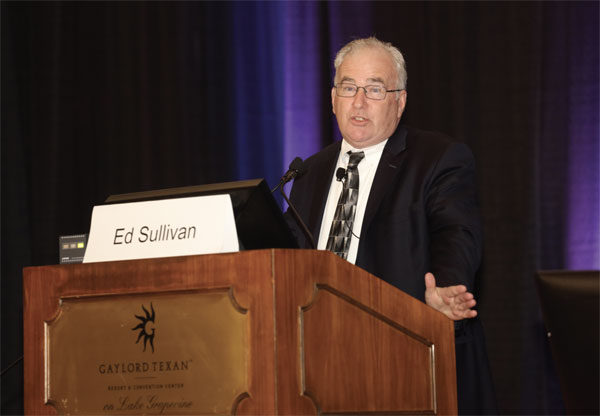
PCA Executive VP and Chief Economist, Ed Sullivan, looked
at what is in store for the US cement industry
Typical considerations include whether equipment should be pneumatic or mechanical, if upgrades are needed to improve process gas flow and sealing off ambient air from the kiln and mills, while implementing fan projects. Support systems are also key with compressed air and pumping systems.
Further papers included field evaluations of a multi-component FTIR CEMS, given by Stephen Gibbons of ABB, while David Shepherd, director of sustainable development at the PCA, spoke on environmental product developments.
Additive manufacturing
Richard Bohan, director of manufacturing technology at the PCA, started the afternoon proceedings with ‘Additive manufacturing using concrete: a bridge too far?’ He drew attention to the development of additive manufacturing, which is the term used for ‘3D printing” of concrete, ie building from the bottom up rather than producing buildings as a subtractive process. However, this places specific requirements on the concrete used. Richard explained that cement usually gains strength over time. This works fine in a subtractive process where formwork supports the concrete until it is solidified. However, in an additive process (without formwork) cement needs to be a material that solidifies immediately upon placement.
Therefore, research is looking at the physical ways to develop free-form concrete. Richard asked if gantries could be set up for building via contour crafting. While with gantry frames, the technology has arrived, it is not ready to take off yet. Software needs to be developed and there are no building code requirements at present. Standards also need to be developed for additive cement, especially for building large structures. He estimates that we are at least a decade away from having an agreed standard, but simple ornamental shapes and practical objects like benches have already been devised by additive manufacturing, where layers of concrete are built up one on top of another to form the final required shape. Constructing a large building in this way will not be a simple task.
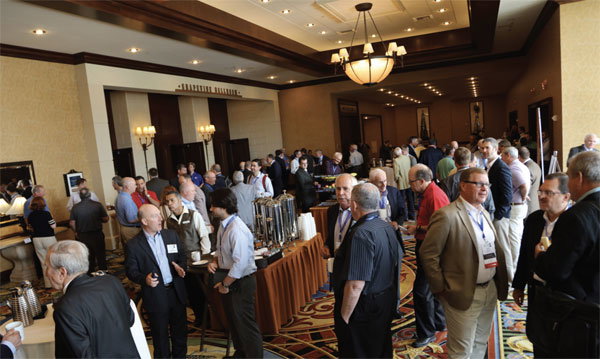
Time for more informal discussion during the coffee break
Dr Guillermo Etse, Saxum executive director, compared the cost of designing preheaters using steel rather than ready-mix concrete for different cement plant sizes ranging from 2200tpd to 2700tpd and 5300tpd. The standard of the soil was very important when it came to deciding which material to use, as for the 5300tpd plant there would be some difference in the cost of materials – US$10m for ready-mix concrete compared with US$13m for steel – and in terms of foundations – US$1.8m in the case of concrete and US$1.29m to accommodate the steel tower. Adding an extra stage to a preheater tower would also affect the relative costs with concrete cheaper when lower-capacity preheaters were required.
John Kline of Kline Consultants assessed the thermal performance of cement plants and told engineers that the temperature at the clinker vent usually tells the story of how efficiently plants are working. Coolers with a high output temperature usually point to an inefficient process. Preheater exit temperatures are also important, as are clinker depths for recuperation.
Safety and maintenance
In the adjacent hall, Josh Fredlake and Tom Spaits of ATD Pressure Gas System had spoken on best safety practices for preheater towers and Gerard Lynskey of SSI Consulting had added his presentation entitled ‘Too big to fall?’ as part of the maintenance and safety/power generation, distribution and related products session. These safety papers were followed by Derek Couse of Process Barron who detailed the ID fan upgrade project that was carried out at the Mitsubishi Lucerne Valley plant, California. The resulting build-up led to the team having to go back to CFD modelling to adjust the blades before the fan was re-installed (see ICR April 2015). Eaton’s Devon Jenkins and Bradford Morse ended the session with their paper called ‘Proper LED light fixture to enhance safety in hazardous environments’.
The final general practices session saw Nicholas Pivar and Ryan Hershey of Lehigh Cement, and Chris Polizzi of WL Gore explain PC MACT and compliance.
This was followed by Jean-Claude Paradis and Dave Calder of Stantec explaining the term ‘lean energy’ (tools for continuous improvement) and progress in reducing energy costs and greenhouse gas emissions using Kaizen workshops and energy management systems.
Louis Ricci of Fives completed the session on reducing NOx from existing cement kiln lines.
Sustainable cement production
Several papers highlighted the industry’s interest in sustainable cement production and use.
Roger Smith, PCA executive committee member from Clarkdale Phoenix Cement, gave an address on the PCA’s work with scholarships before MIT’s Franz-Josef Ulm focussed on the MIT concrete sustainability hub, which included lifecycle analysis and studies on materials used for roads and their impact on fuel consumption. He also highlighted the need for local champions to support the use of ready-mix in construction.
While giving a detailed account of the first 100 years of the PCA, the organisation’s Chairman and CEO, James Toscas, explained how cement is not just consumed, but also contributes to the wellbeing of generations.
Thomas Sullivan of Zephyr Environmental Corp provided a clear outline of how the 70ppb ozone standard would be implemented. The National Ambient Air Quality Standards (NAAQ5) have been revised from 0.75ppm in 2008 to 0.070ppm in late 2015. This looks at the lowest achievable emission rate (LAER) for plants and is expected to be implemented in June 2017.
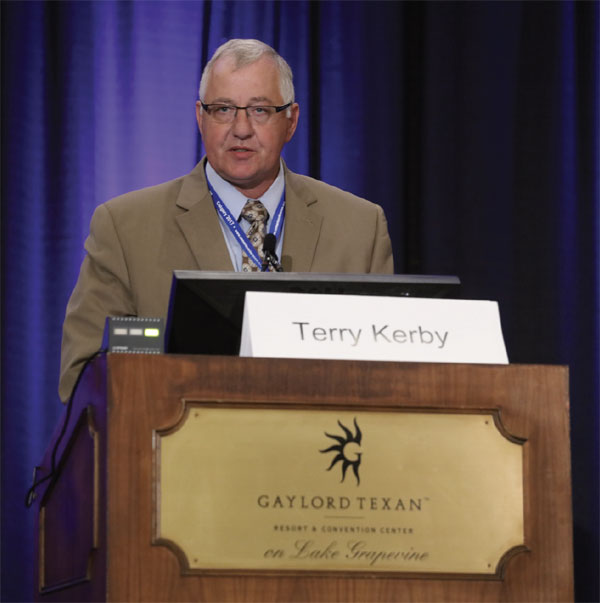
Terry Kerby of Ash Grove Cement presented a paper on
mercury control at the company's Durkee plant in Oregon
What many cement plant owners will have to challenge is the geography and topography of their facility, eg if they are downwind of other pollutant sources. Recommendations are to be sent to the US Environmental Protection Agency by October 2016.
Carrie Yonley of Trinity Consultants talked about the five-year compliance for Commercial/Industrial Solid Waste Incinerators (CISWI) as well as providing information on Maximum Achievable Control Technology (MACT).
Arron Heinerikson of Trinity Consultants distinguished regulation from permitting as well as describing compliance frameworks and audits. There were also discussions on the lessons learnt from NESHAP.
Data, automation and power
Adam Rice, business development manager at Kespry Inc, detailed the importance of data gathering and interfacing, with drones providing a new way to track changes in stockpiles and typography on site including inside silos.
The Cemex Lyons cement plant was up next for discussion with April Montera of Sabia reporting on how prompt gamma neutron activation analysis (PGNAA) technology had helped the plant improve its ability to supply OPC, low alkali and oil well cement from two raw mixes.
Andrew Rieland of FLSmidth completed the automation session with a presentation on burner management systems.
The concluding session featured a round-up of power generation, distribution and related products. Giorgio Carboni of GEA Process Engineering began with energy recovery and heat transfer by thermal oil circuits as well as NOx reduction with clinker cooler heat recovery. Extra information on turning heat-to-horsepower was provided by Bill Hunter of ProcessBarron before the final papers on insulated bus bars and voltage transformers.
In the evening of the second day, an awards banquet was held.
Concluding the old, looking ahead to the new
On the final day, there was an organised plant tour to Ash Grove Cement’s Midlothian plant in Texas. Visitors could see how the company had successfully realised the expansion project as explained by Ash Grove’s Andy Edwards the previous day. As the event concluded, delegates could start looking forward to the next IEEE-IAS/PCA conference, which will be held in Calgary, Alberta, Canada, between 21-25 May 2017.
Article first published in International Cement Review, July 2016.
Handpicked stories, in your inbox
Our editors pick the top news delivered to your inbox. Sign-up today!