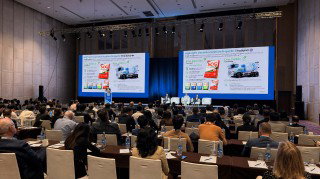
The 8th International VDZ Congress 2018 was held at the Maritim Hotel, Düsseldorf, Germany, between 26-28 September 2018. The congress drew more than 600 international delegates who listened to two days of presentations from renowned speakers on digital measures, climate change, environmental protection, grinding technology, pyroprocessing and low-CO2 cement and concrete.
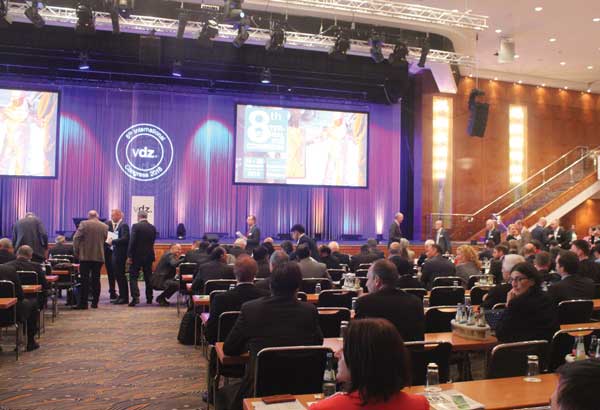
The 8th International VDZ Congress 2018 was held at the Maritim Hotel, Düsseldorf, Germany
Christian Knell, VDZ president, welcomed delegates to the 8th International VDZ Congress and assured the audience that cement will continue to have a bright future. However, he also stated that the cement industry needs to “actively manage” that future as companies, employees and members of society. “We have to do our best to improve our processes, lower our emissions and increase safety at work to create a sustainable future for our products and for us,” he added. “We should not be afraid to think out of the box. Challenges for our industry are high and we certainly have to rethink and probably push even what we have proven many times.”
Dr Martin Schneider, VDZ’s CEO, then introduced the first keynote speaker, Dr Albert Scheuer, board member of HeidelbergCement, who spoke on ‘the cement plant of the future – innovation and technical trends in cement production’. He stressed that the need to lower CO2 emissions was a key driver for innovation. Using the WBCSD CSI IEA Roadmap 2050, he demonstrated that the CO2 reduction targets could only be met in the EU by a combination of levers – carbon capture and storage/utilisation (CCS/U), clinker substitution, alternative fuels and energy efficiency. “We must be open to all means for a low-carbon future,” Dr Scheuer said. However, there is no single easy solution. “CCS and CCU are obviously not a magic bullet,” he warned.
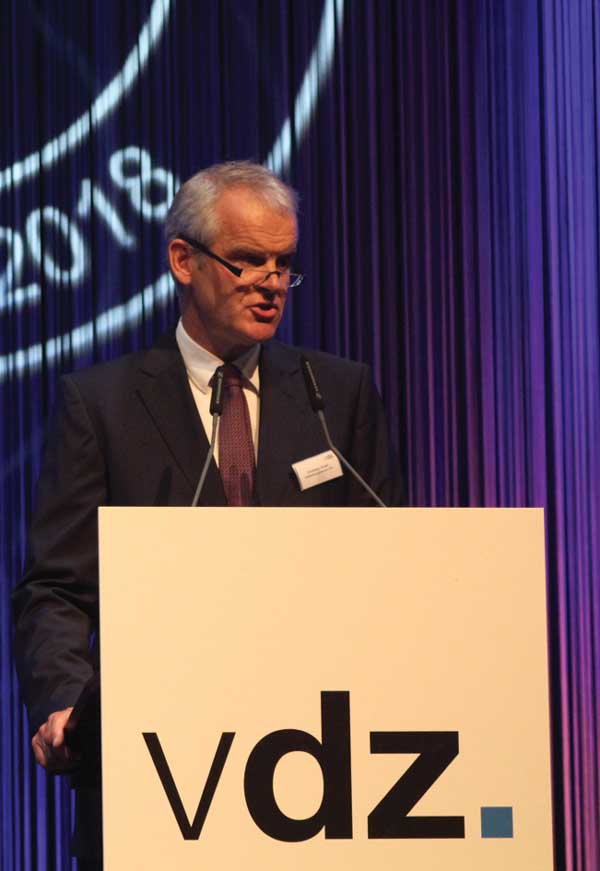
VDZ President, Christian Knell, challenges the
industry to think out-of-the-box
HeidelbergCement is working on a large number of projects to reduce CO2 worldwide. The CCS technologies underwent first testing at the Brevik plant in Norway in 2014 to trial different processes to separate CO2 from exhaust gases. The amine technology was found to be the most reliable and the Norwegian government’s investment decision will allow for a full chain demonstration to capture 0.4Mta of CO2 in 2020-21.
HeidelbergCement is also pioneering the low emission intensity lime and cement (LEILAC) CO2 separation project in Lixhe, Belgium. “The LEILAC process has a lot of advantages in my opinion,” said Dr Scheuer.
CO2 enrichment (oxyfuel) is also being tested at HeidelbergCement’s Colleferro plant in Italy and at the LafargeHolcim Retznei plant in Austria.
In terms of costs, amine technology costs EUR17/t, Oxyfuel EUR45/t and LEILAC less than EUR20/t (excluding transport costs).
HeidelbergCement is also working on a step-by-step approach to develop smart cement factories with further automisation, self-learning and autocorrecting of performance parameters.
Jérome Stubler, chairman of VINCI Construction, highlighted the technical trends and innovation in the construction sector. He mentioned new techniques such as the use of liquid stone and the need to build above and increasingly below ground. He also informed delegates that construction companies will look towards paying a premium for using ‘less cement’ to improve the company’s own sustainable image.
Professor Robert J Flatt of the Institute for Building Materials in Zurich, Switzerland, talked about ‘concrete and its digital fabrication’. He demonstrated how construction workers will work on future construction sites in harmony with robots to create added value in structures.
Dr Martin Schneider gave an overview of a low-carbon future. He pointed towards new binding materials and carbon capture as the breakthrough technologies, while waste heat technology and alternative fuels will be required to reduce CO2 emissions. Carbon storage is a further option as it will provide additional mitigation potential through CO2 utilisation in the chemical industry. He also stressed the need for clinker efficiency to be viewed along the value chain with less clinker in cements and concrete.
Delegates were then introduced to the Global Cement and Concrete Association by Acting CEO, Frank Rossini.
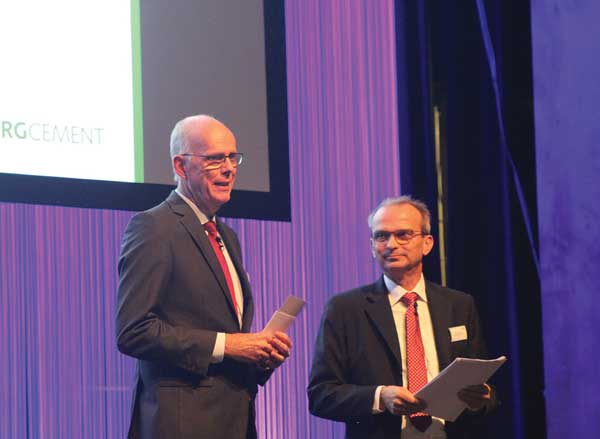
Dr Martin Schneider, VDZ, introduces Dr Albert Scheuer, HeidelbergCement,
who provided delegates with an insight into the future cement plant
Sustainability and climate change
Professor Albrecht Wolter of TU Clausthal delivered his presentation on ‘max captive power and clinker production’. He argued that we need to think differently to improve processes that we think are the best we have ever had. Suggestions might include a Low-Profile Process (LLP) instead of a preheater, which could have a process interfacing unit, above the calciner, to remove dust from exhaust gases and excess heat used to turn a steam turbine. A solution to remove the dust in the exhaust gases could be a moving bed of clinker or a circulating clinker bed boiler. Capturing CO2 for reuse might also be attempted with limestone leaching, gypsum decomposition and fuel addition with LPP processing, reducing CO2 emissions by 50 per cent.
Phil Hodgson presented the background to Calix involvement in the LEILAC project. The company has already gained experience in CO2 separation at its Bacchus March magnesium plant in Victoria, Australia. LEILAC will use counter-current flow processing and the pilot plant is currently being constructed with operations and testing to run from April 2019 through to December 2020. A big challenge will be to understand the corrosion in the reactor tube, scale risk and the development of mitigation strategies.
Stefano Consonni of Politecnico di Milano, Italy, added to the session by speaking on the verification of the potential of integrated calcium looping for low-CO2 cement. The Ca-looping (Cleanker) technology involves capture of diluted CO2 by reacting it with CaO to form CaCO3. Highly-concentrated CO2 is released by oxyfuel calcination at 950˚C and liquid CO2 for storage is obtained by purifying the flow generated in the calciner. The same CaO continues to loop across the carbonator and the calciner. Sorbent purging is necessary as limestone is highly active towards SO2 co-absorption by forming CaSO4. The project began in 2017 and aims to demonstrate integrated Ca-looping in an industrial environment.
Remi Chauvy of Mons University, Belgium, explored the conversion of CO2 and its utilisation. He identified the best CO2 pathways for commercial use. These showed that methanol had the highest potential for CO2 reduction. The Brevik plant could turn 2230tpd of captured CO2 into 1500tpd of methanol. Renewable energy is required to make it viable, but the mitigation potential is about 50 per cent of original emissions.
Kurt Wagermann of dechema provided insight into low-carbon energy and feedstock for the European chemical industry. He stressed the need for industrial activities to start now and that alternative carbon feedstock will gain importance.
Meanwhile, Carlos Abanades of Consejo Superior de Investigaciones Cientificas (CSIC), Spain’s national research council, highlighted the myths and facts of CO2 emission reduction by using CO2 from the cement industry. CCU is not currently included in any climate policy and there is a perhaps a lack of renewable energy for CCU. He concluded that the cement industry can only approach zero emissions by deploying CO2 capture and permanent storage of CO2. CCU processes cannot avoid CO2 process emissions from a cement plant, he said.
Environmental protection measures
A series of papers addressed environmental protection measures with Rüdiger Matheis, Dyckerhoff, providing an account of a successful NOx reduction project using HD-SCR at the company’s Goellheim plant. Jurgen Thormann described the emissions reductions measures at Schwenk Zement’s Allmendingen plant. A DeCONOx system was installed to reduce NOx, ammonia, volatile organic carbon and CO emissions, while a drying plant for sewage and bio-sludges was installed to supply combustibles for the clinker burning process as well as ammonia for NOx reduction, to create a highly synergic solution.
Digitalisation
A full morning was dedicated exploring the digitalisation and ‘big data’ analytics in the cement industry.
Fokion Tasoulas, Titan Cement Group (Greece) argued that the data available in a cement plant is a goldmine, but it needs to be correctly structured and exploited. The company has successfully conducted a proof of concept application for real time VRM optimisation and failure detection in a raw mill, showing how big data and advanced analytics with artificial intelligence algorithms can elevate plant performance to levels far beyond fuzzy logic or traditional ‘advanced process control’.
Georg Locher, ThyssenKrupp (Germany), performed a demonstration of remote plant control, via the company’s INDIGO (Industrial Digital Governance) platform, using the example of a roller mill. Using an augmented reality interface, an expert operator is able to view a mill in real time, regardless of its location worldwide, and take corrective action to solve a range of operational problems, remotely and in a timely manner.
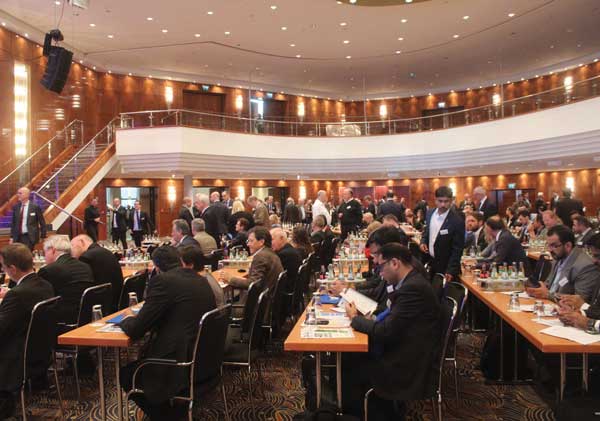
More than 600 international delegates settle down for two days of presentations by renowed speakers
Grinding technology
Philip Fleiger provided a detailed report of VDZ’s working group investigation into installed cement grinding technology in Germany. There are 105 ball mills operating in the country and only 24 vertical roller mills (VRM). This is accounted for by few new installations and concerns over the impact on product quality. Moreover, VRMs are used mainly for slag grinding only and their complexity requires training and experience. Vibrations in operating VRMs also added to the challenges of this technology. In addition, there are also 20 high-pressure roller presses operating in Germany, while most ball mills are operating with third-generation separators. The main control system in use is the PID controller. VDZ will release a code of practice on comminution, but the industry needs real practical tools to work from before moving to ongoing digitalisation and support of AI.
Dr Caroline Woywadt of Gebr Pfeiffer then shared the operational results of MVR mills in a wide range of applications. MVR mills were developed by Gebr Pfeiffer in 2006 and have a multiple drive system and up to six 18MW drive units with capacities up to 12,000tpd.
Winfried Ruhkamp of Loesche followed with a talk on grindability investigations of innovative cement composite materials in VRM grinding plants’ before Ilker Avci of Nuh Çimento presented a KHD roller press upgrade at Nuh Çimento in Turkey. The system includes two comflex grinding units with roller press technology. Cement production was increased from 220tph at 4000Blaine to 432tph at 4000Blaine, and the project was commissioned in May 2018.
Philip Fleiger of VDZ completed the round of grinding technology papers with ‘Separate (ultra-) fine grinding of cement’, highlighting the significant energy savings and a reduction of product changes.
Pyroprocessing
Florian Trela of LafargeHolcim gave a first case study presentation regarding five years operational experience with the prototype thyssenkrupp Industrial Solutions’ Prepol-SC at the Holcim (Deutschland) Lägerdorf plant, which uses semi-wet processing. Kiln No 11 has been modified with the Prepol-SC that initially had 75 nozzles to blast material before being reduced to 70 nozzles and having 14 steps in the step combustion chamber, which has a retention time of 20min for AF use.
This was followed by Mads Nielsen and Anders Skærlund Petersen of FLSmidth, who delivered a presentation explaining capacity boosts and energy savings achieved with the company’s counter-current heat exchanging cyclone (CCX). JSC Ivano-Frankivsk installed the CCX at its plant in Ukraine to reduce net heat consumption and a five per cent capacity increase. The preheater was fitted with a new down draft cyclone (DDX), enabling a lower weight on the structure and bigger cyclone, while the CCX was fitted as the second-top cyclone to change material flow and reduce the pressure drop further as well as increase heat exchange. Start-up of the first CCX was in April 2015 and capacity increased from 2600tpd to 3150tpd. In December 2015 clinker capacity rose further from 3150tpd to 3400tpd. A second reference at the plant was fitted in November 2017 with just a single CCX.
Cement and concrete
Professor Karen Scrivener, École polytechnique fédérale de Lausanne (EPFL), introduced ‘LC3 – limestone and calcined clay concrete’ – a breakthrough technology to reduce CO2 emissions from cementitious materials. It is a solution well-suited for developing countries where calcined clays are abundant. Calcination of kaolinite produces metakaolin, which helps workability and gives similar properties to OPC. But the EU CEM II C certification does not yet include LC3.
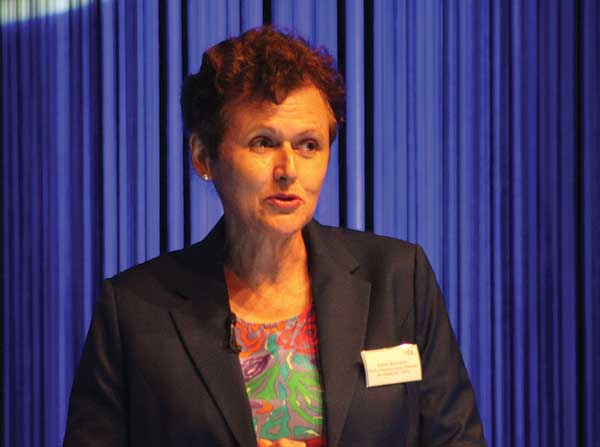
Professor Karen Scrivener, EPFL, introduced LC3,
limestone and calcined clay concrete
Wolfgang Dienemann of HeidelbergCement then talked about ‘Recarbonation of concrete – climate benefit and environmental issues’. In particular, he spoke on a belite yeélimite cement, Ternocem, developed by HeidelbergCement.
Sui Tongbo of Sinoma reporting on CSA cements in China. The low-carbon cements in China include CSA, HBC and BCSA. CSA is used mainly for precast structures, HBC for hydroelectric dams and BCSA for decorative finishes such as floors.
Christoph Müller rounded off the congress with his presentation about performance-based specifications for concrete.
This article was first published in International Cement Review in November 2018.
Handpicked stories, in your inbox
Our editors pick the top news delivered to your inbox. Sign-up today!