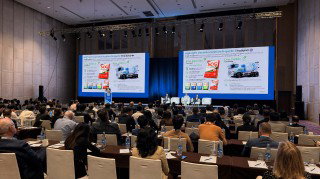
A summit for the Indian cement industry, “Concreatech 2018 – Sustain to Gain”, was held at the ITC Maurya, New Delhi, on 29 November 2018. Organised by the Cement Manufacturers’ Association (CMA), industry leaders and over 400 delegates met to discuss the cement sector’s role in national development and commitment to low-carbon industrial development.
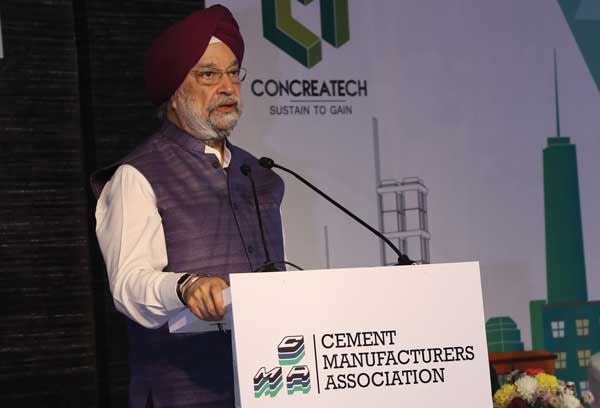
Shri Hardeep Singh Puri, Minister of State of Housing and Urban Affairs, delivers the conference’s keynote address
The Indian cement sector is committed to growth that is sustainable and underpinned by ambitious carbon reduction targets as it plans to meet the huge additional cement demand that is expected over the coming decades. This was the key message from industry leaders at the recently-concluded Concreatech 2018 meeting in New Delhi.
India’s leading role
In his opening address, Dr Shailendra Chouksey, president, Cement Manufacturers’ Association (CMA), outlined the progress made by the Indian cement industry. It has seen the country rise to be the second-largest cement-producing nation in the world, with a cement capacity of over 500Mta and now accounts for eight per cent of global installed capacity.
Domestic demand is accelerating and is expected to grow by 12-14 per cent in 2018. Sustainable growth is a cornerstone for the industry, which is committed to a 40 per cent reduction in CO2 emissions by 2050.
The keynote address to delegates was delivered by Shri Hardeep Singh Puri, Minister of State of Housing and Urban Affairs. He explained that India had played a leading role in shaping the Sustainable Development Goals adopted by the UN in 2015. Mr Puri argued that economic expansion and responsibility towards the climate can no longer be seen as mutually exclusive, particularly in the context of India’s high-growth emerging economy. “We have to get over this zero-sum mindset which pits development against our responsibility towards the climate,” he said.
On India’s current development agenda, Mr Puri highlighted the current administration’s achievements, notably delivering on major sanitation programmes throughout the country, including the construction of 6.7m toilets by October 2019. Other investment initiatives include 2400 projects worth INR740m (US$10.33m) under the Atal Mission for Rejuvenation and Urban Transformation (AMRUT) programme, and the construction of 11m homes by 2020 under the PMAY affordable housing initiative. “What is most important about this mission is that each home will be built under the highest standards of sustainability. Each home that we construct will be green and resilient,” he stated.
Sustaining growth
Over the course of the one-day programme, Concreatech featured five high-level panel discussions covering topics ranging from national development, leadership and the role of sustainability in the cement sector.
Opening the panel discussions, Thomas Armstrong, managing editor of International Cement Review, provided a global industry overview, highlighting the sharp downturn in Chinese consumption in 2018, which will see global demand fall by four per cent. Meanwhile, demand in other Asian markets remains strong, with India set to trend at seven per cent annual growth over the medium term, supported by strong urbanisation and high levels of investment in infrastructure and affordable housing.
KK Maheshwari, managing director of UltraTech Cement Ltd, India’s largest cement producer, noted how the Indian cement sector has continued to build new capacity on the expectation of continued demand growth, resulting in the accumulation of significant overcapacity. Producers should be prepared to weather further swings in the pace of growth as India develops, but utilisation levels should gradually improve.
Building sustainability
An entertaining panel session exploring the role of leadership was hosted by Navika Kumar, managing editor of Times Now. With India’s cement industry set to more than double in the long term, good leadership is essential to ensure balanced industry expansion that combines stewardship of the environment with healthy company profitability. Effective leaders must have vision and credibility and the ability to act quickly and decisively, argued Puneet Dalmia, managing director of Dalmia Group. According to HM Bangur, managing director of Shree Cement, rapid decision making is a strength – and one that will enable smaller companies to outrun the giant multinationals – but it relies on leaders who are willing to empower all levels of management to participate in the decision-making process. This can produce a conflict of views but will ultimately lead to better quality and more rapid decision-making. Ajay Kapur, managing director and CEO of Ambuja Cement, echoed this viewpoint and argued for the creation of an ‘I can’ corporate culture, which encourages strategic rule breaking to find new solutions. However, a good leader will also ensure that ethical boundaries are never broken and that rules in areas of health and safety or financial auditing are always protected.
The logistics challenge
A further panel session focussed on the role of logistics and supply chains in supporting India’s rapid infrastructure growth and cement deliveries of around 300Mta. According to Dr Anjan Chatterjee, chairman, Conmat Technologies Pvt Ltd, rail and road remain the most popular forms of transportation for the cement sector, although capacity remains under pressure, with ongoing requirement for investment to improve utilisation rates. Switching more volume to bulk transportation would help reduce costs for producers. Alok Ranjan, Inland Waterways Authority of India, explained that the country’s vast river network remains greatly underutilised, accounting for less than one per cent of goods transportation. However, investment into the river network over the last five years to 2018 has now exceeded the amount spent over the previous three decades combined. Therefore, cement producers should explore opportunities for tapping into this new logistical resource.
Dalmia’s Mahendra Singhi appointed president of CMA |
|
Dalmia Cement (Bharat) CEO, Mahendra Singhi, has been appointed as the new president of India’s Cement Manufacturers Association (CMA). Mr Singhi will take over the position from the outgoing Shailendra Chouksey, Whole Time Director, JK Lakshmi Cement. In addition, Mr Singhi was recently appointed Chairman of the National Council for Cement and Building Materials (NCB) by its Board of Governors on 2 August 2018. Read an extended interview with Mr Singhi here. |
Low-Carbon Roadmap progress
The conference concluded on a high note with the publication of the “Low-Carbon Roadmap for the Indian Cement Sector: Status Review 2018” by the Cement Sustainability Initiative (WBCSD). The detailed report compares the progress made by the industry since the initial CO2 emission reduction commitments were made by the industry in 2010.
The report confirms that direct CO2 emission intensity has fallen by 32kg CO2/t cement to 588kg CO2/t cement in 2017, representing a five per cent reduction compared to the baseline year of 2010. The sector has achieved the 2020 performance objective for emissions intensity reduction three years ahead of schedule.
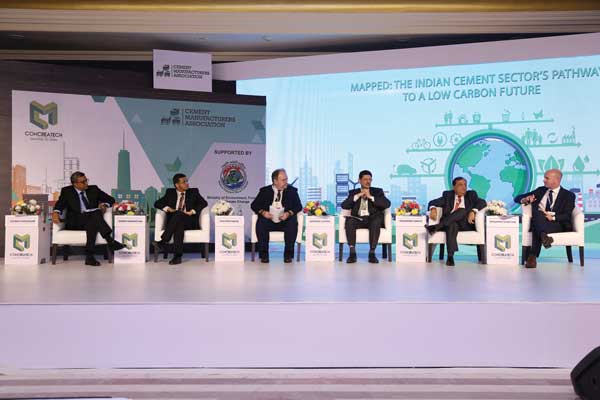
The event’s panel session discussed sustainable industry growth and progress to date
The road ahead
Going forward, India’s low-carbon roadmap projects a reduction of direct CO2 emissions intensity to 350kg CO2/t cement in 2050, about 45 per cent lower than 2010 levels, representing a saving of between 212-367Mt CO2 in 2050 compared to a business-as-usual scenario.
In his forward to the report, Philippe Fonta, managing director of the Cement Sustainability Initiative, praised India’s cement manufacturers: “By adopting state-of-the-art technological interventions, innovative production techniques and climate-resilient resource optimisation measures, cement manufacturers in India are integrating sustainability within their growth aspirations. The sector…is now being recognised globally as one of the most energy-efficient and sustainable markets for cement.”
Commenting on the report, Mahendra Singhi, vice president, Cement Manufacturers’ Association of India and CEO, Dalmia Cement (Bharat) Ltd, acknowledged the great progress made by the Indian cement sector but argued that there is potential to make progress that goes beyond the agreed industry targets. He called upon cement business leaders to take a more ambitious approach to CO2 reduction, arguing the sector should aim to surpass carbon neutrality and ultimately target carbon negativity for cement production. This can only be achieved, he conceded, with the support of other industries to develop cost-effective carbon capture and valorisation technologies.
This article was first published in International Cement Review in January 2019.
Handpicked stories, in your inbox
Our editors pick the top news delivered to your inbox. Sign-up today!