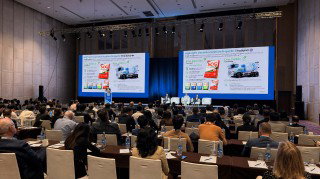
CEMBUREAU held its ‘Cementing Europe’s Future: Action Through Policy’ webinar on 12 October 2021. Two panel discussions looked at whether the cement industry was ‘Fit for 55 per cent’ carbon reduction by 2030 alongside considering the carbon neutral built environment and the role of concrete within it.
Is Europe’s cement industry Fit for 55 per cent carbon reduction by 2030?
Isidoro Miranda, CEO of Holcim Spain and CEMBUREAU president, opened the meeting stating that the “cement sector was on the move!” He announced that the Green Deal was a starting point of the race towards 2050 decarbonisation and that the cement industry wants to be a positive actor. “The cement industry is willing to work with the EU Commission, but let’s not forget world CO2 reduction. It’s not only Europe’s challenge to reduce CO2 emissions,” he added.
Carbon Border Adjustment Mechanism (CBAM)
Mette Quinn, who heads up the B2 unit of DG CLIMA, the EU’s directorate general (DG) for climate action, outlined that the overall objective of climate law must be to decarbonise by 2050, reducing CO2 emissions by 55 per cent by 2030 to achieve this.
While the EU Trading Scheme (EU ETS) has been an important tool, maritime transport has to be accounted for as do new targets for emissions from renewable energy. Ms Quinn explained that transition pathways are now required and carbon protection has to be eased. “The carbon border adjustment will provide a level playing ground locally and for imports,” she clarified.
The pilot phase of the Carbon Border Mechanism Adjustment System (CBAM) will operate from 2023 and implementation will happen in 2026, after three years of data collection. The EU Commission is also intent on avoiding double compensation, so free allocation allowances will be phased out to prevent double carbon leakage protection.
The EU envisages the CBAM as a component of the EU ETS, with its main purpose being to prevent carbon leakage by creating a level playing field for EU producers in sectors covered by the EU ETS. The CBAM is a replacement of the free ETS allowances.
Overall, the cement industry welcomes the ‘Fit for 55 package’ and the introduction of the CBAM. Jon Morrish, CEO of Western & Southern Europe, HeidelbergCement, said “The key point from the package is that CBAM works and is water-tight. CBAM needs to be designed and implemented well as our neighbours are watching this.” As such, Mr Morrish suggested the implementation period for CBAM was too slow and should be moved forward. He also admitted that the cement industry does not have great trade intensity, but it is increasing. “Industry positive demand as a central policy to greening Europe will pull in more imports before 2026, and our cost structure from CO2 and electricity costs leaves us vulnerable,” explained Mr Morrish.
Maria Spyraki, MEP, added that “Until CBAM is ready, emissions protection should not be withdrawn.” She also advocated a rebate for EU exporters.
Funding for innovation
Funding will be a crucial aspect of bringing new innovation for carbon capture, utilisation and storage (CCUS) technologies. Ms Quinn reported that announcements can be expected on this soon, with a second call of EUR1.3-1.5bn this coming spring for innovation such as CCS and CCUS projects.
Tomas Wyns, project researcher of Environment & Sustainable Development at Vrije Universiteit Brussel, argued that, “The next decade to 2030 will be crucial in relation to CCS being piloted and implemented commercially, or it will be an even bigger challenge to meet 2050 targets.”
Meanwhile, Mr Morrish implored the European Commission to give 4-7 years front-loading in the early years for innovation. There are a lot of significant projects ready to go. The industry has responded well to signals and they are waiting to go, so decisions need to be made now for results to be achieved in 2030-35.
Triangle of CO2 challenges
Mr Morrish also viewed the current period as a triangle of challenges with the implementation of Fit for 55 per cent, higher CO2 pricing and the strengthening of the EU ETS with the introduction of CBAM. Panellists agreed that cooperation and the need to work together was a requirement for success.
Mr Wyns added that it is important to understand how powerful EU standards are. He argued that “nationally, cement standards are too conservative and stifling innovation in construction. For alternative cements to develop, they need to have a market and if standards prevent you entering that market it will not work.”
Mr Morrish further explained that low-carbon cements and concretes have only seen small success in the marketplace. But the purchasing power of membership governments have the power to turn these markets around.
CEMBUREAU keynote speech: carbon leakage tops agenda |
|
Gerassimos Thomas, director general of the EU’s DG Taxation and Customs Union gave a keynote speech that stressed cement is an important product for EU energy transition goals up to 2030. The EU will spend some EUR550bn on climate actions between 2021-27, he stated. While the cement sector is viewed as an example of how industry can reduce CO2 emissions, he argued that there is little international trade in Europe compared to other sectors. The needs for the products and their structure around this deeper innovation wave will put a variety of pressures on the sector. “In our view, carbon leakage will become a bigger problem in the future, precisely because of the acceleration that we have for demand for the products and the speed by which the sector will need to react and deliver,” he added. Measures to deal with carbon leakage will come to the forefront. The next three years will give the EU time to engage in international diplomacy and ensure Europe complies with its WTO obligations, as well as engaging through the G20 and G7. Regarding phasing out free allocation allowances and double carbon leakage protection, Mr Thomas was keen to stress that free allocations have to be phased out, because the EU cannot have double leakage protection. “We have the current legislation in the Clean Energy for All package, reducing GHG emissions to 43 per cent by 2030, which entered into force in member states in March 2021. That is our legal situation now. We are producing new legislation, and when it is adopted it will oblige us to move from 43 per cent to 55 per cent. And so, it is not possible to have a free lunch. It is not possible to go there without any impact,” concluded Mr Thomas. |
The carbon-neutral built environment and concrete
CEMBUREAU’s second panel discussion concentrated on the carbon-neutral built environment and the role of concrete. Essentially, the panellists discussed how best to build tomorrow. The premise for the discussion was led by Florika Fink-Hooijer, director general of the EU’s DG Environment, who admitted while decarbonisation was the big challenge, the cement industry also needed to address how pollution and the extraction of essential resources like water and minerals can become less of a drain on natural resources.
Ms Fink-Hooijer emphasised that a code of conduct was required for the extractive industry. It was also useful to factor in nature and the impact on nature when considering the lifecycle of products. A holistic approach is needed when revising legislation for construction.
She explained that two important pieces of legislation are currently under revision. The Construction Product Regulation looks at the lifecycle, product and everything else. Meanwhile, the Sustainable Products Initiative aims to make products more recyclable and energy efficient, with a focus on reducing waste by design. From this framework a work programme is being drawn up, building on the Ecodesign Directive to look at the whole lifecycle of construction, because construction and demolition is one of the biggest waste streams in Europe.
While the EU is working with bodies like CEMBUREAU, architects and engineers to establish a standard for sustainable buildings, there are obstacles to developing a new pathway.
Improving innovation
Pernille Weiss, MEP, was concerned that Europe is lagging behind China and the USA in innovation. She called for a need for funding public and private infrastructure in the energy sector. It is also important to pay attention to and support the first movers whose business DNA is to innovate. These front runners are key partners in the dialogue with regulators and industry.
Another area of concern in the construction sector is having the skills necessary to build on innovation. “Whatever we do in the Green Deal, we must improve competitiveness and that is close to workforce training and skills,” said Ms Weiss. “The efforts and funding we have for green transition goes hand-in-hand with digital transformation.”
Domenico Campogrande, director general, European Construction Industry Federation, admitted that it is often difficult to find workers with the right skills. “Training and education – companies need the resources to meet the targets,” he said.
Standard upgrades
Mr Campogrande also noted that the construction industry has plenty of regulations. His concern was that the standardisation process is complex, and the process is perhaps not efficient, but industry would like to be a part of this process.
Onne Van der Weijde, president of Europe and Asia, CRH, added that contractors are often not allowed to deviate from standards that have been used for decades.
Recognising recarbonisation and incentives for low-carbon cements
Mr Van der Weijde stressed that the whole lifecycle of cement and concrete should be recognised in the way calculations are made for carbon sinks. Material neutrality should be viewed over the whole product lifecycle.
Governments can also improve the uptake of cement as they are responsible for 36 per cent of cement procurement in Europe, cited Mr Van der Weijde. He also advocated that the green policy advantages should be legislated for low-carbon cements and concretes.
This article was first published in International Cement Review in December 2021.
Handpicked stories, in your inbox
Our editors pick the top news delivered to your inbox. Sign-up today!