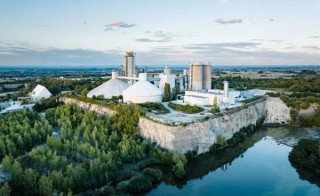
Over coming months, the Financiera y Minera cement factory in La Araña, Spain will soon be cleaner, more environment-friendly, more productive and more attractive to look at than before. Restructuring work on the site, which is expected to cost some Euro 84m, will be the biggest project of its type carried out by any private company in Malaga’s history, involving the replacement of most of the present buildings on the site with new ones, while making better use of energy, cutting down on toxic gasses and reducing noise levels. To achieve all this, the two present ovens will be replaced with a new one, and a new 110m high pre-heater tower will be built, aimed at reducing the amount of energy used in cement production, which is expected to increase dramatically as soon as the restructuring work is finished.
The Financiera y Minera, spokesperson, Francisco Bravo, said that “the best technology available will be used to save energy and minimise gas emissions” in the new factory. A new hermetic transport system will be used, and the amount of cement dust in the air will be reduced by a new high-technology storage system.
The two kilns currently in use will be demolished, to make way for a single, state-of-the-art kilns taking up less space and allowing for greater vehicle mobility in an area that will have numerous green spaces.
But the most spectacular changes to the old cement factory will be its appearance. When finished, this will be one of the most beautiful industrial structures in Malaga City. “It will be a permanent exhibition space,” says Bravo, “whose decoration will make reference to the principal cultural events of the capital, and which will attempt to be a support for Malaga’s ambitions to become a cultural capital.” Images will be mounted on part of the structure “in a permanent interchange with the people of the place and visitors to Malaga City,” he adds.
As far as the spokesperson for the Financiera y Minera company is concerned, the project will be a reference point in the relationship between industry and landscape, and it architectural elements will feature a range of colours that will reflect the nearby Mediterranean, reporters were told. There will be new access roads for lorries to the factory, and new green zones will be planted with native trees like olives, pines, palms and cork-oaks. Work on the project is expected to be finished by the middle of next year, and will involve the creation of 300 new jobs in the area, with a demand for 550 workers from Malaga while the building work is being carried out.