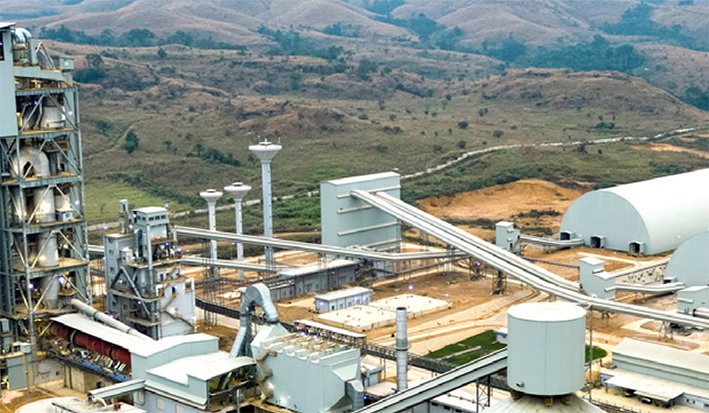
This week, Dangote Cement commissioned a new 3Mta grinding plant in Attingué, Côte d’Ivoire, marking a significant milestone for the country’s cement industry. The new facility expands national capacity by nearly 16 per cent, boosting Côte d’Ivoire’s total to around 18.85Mta. The plant, located 30km from Abidjan on a 50ha site, is the largest in the country, equalling Atlantic Group’s two 1.5Mta plants and Cim Metal Group’s 2.7Mta facility in Abidjan.
Costing approximately US$160m and a decade in development, the new plant is expected to create around 1000 direct and indirect jobs. With this launch, Côte d’Ivoire becomes the 11th African country to host a Dangote operation, taking the group’s total cement capacity to 55Mta.
Self-sufficiency drive
The project arrives at a time of rising domestic demand, driven by major infrastructure and road projects. Cement utilisation in the country has averaged 38 per cent, with output at about 6.95Mt in 2024, while imports are projected to decline sharply, according to the Global Cement Report XV edition (GCR15). Imports are expected to decline from an estimated 5.27Mt in 2024. Algeria, Turkiye and Egypt are the source countries of the majority of clinker imports. Dangote’s new plant will eliminate the company’s need for imports from Nigeria, enhancing self-sufficiency.
Dangote Cement Côte d’Ivoire CEO Serge Gbotta described the Attingué plant as “a symbol of confidence in the future of Côte d’Ivoire,” reaffirming the company’s goal to supply world-class cement locally at competitive prices. The plant will produce multiple grades, including CPJ 32.5R, CPJ 42.5N, and CPA 52.5. "This plant is more than an industrial unit - it is a symbol of confidence in Côte d'Ivoire's future, said Mr Gbotta. "Our goal is to provide Ivorians with world-class cement, produced locally and offered at competitive prices."
New plant's impact
The new plant’s impact could be fairly immediate. Côte d’Ivoire has suffered from high cement prices and occasional shortages. The new plant could well nullify this and help safeguard future cement supply. The price of cement will be monitored closely. In December 2024, the government lowered the price of a tonne of cement by XOF7000/t (US$11) in a decree. The maximum price of cement at the start of this year in Abidjan reached XOF95,000-99,000, supplied ex-works, while wholesale prices ranged between XOF97,000-101,000. Retail prices reached XOF102,000-106,250/t.
While the price of cement will be a deciding factor for customers there is increasing demand for cementitious cements. This is highlighted by Ciments de Côte D’Ivoire’s (CIMCI) plans for a greenfield 1200tpd (0.5Mta) calcined clay cement plant, announced in November 2024. Gebr Pfeiffer is supplying the MVR 3070 R-2 vertical roller mill for this project and CBMI is the general contractor for the project. Cimpor already produces DeHclay (CEMII/A-M (Q-L 42.5N and CEM IV/B (Q) 32.5N in Côte d’Ivoire with Oyak at its 0.24Mta Abidjan works.
A versatile grinding hub for West Africa
There are no integrated or clinker plants in the country, but a total of 14 grinding plants. Dangote Cement’s investment underlines the group’s desire to be at the centre of Africa’s cement development. As competition intensifies with projects such as CIMCI’s upcoming 0.5Mta calcined clay plant, Côte d’Ivoire is rapidly evolving into a regional hub for advanced, sustainable cement production. Lowering cement prices and increasing capacity utilisation will have a major impact on the speed of infrastructure works, once the road network is upgraded.
Handpicked stories, in your inbox
Our editors pick the top news delivered to your inbox. Sign-up today!