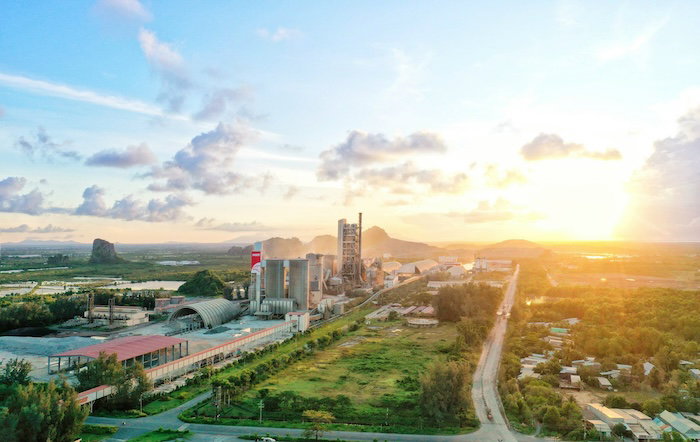
Vietnam’s cement industry has spent much of the last few years contending with excess capacity. Against this background, Siam City Cement Public Co’s (SCCC) plans for its Hon Chong cement plant are significant, involving a potentially substantial addition to the country’s clinker production base.
Through its INSEE Vietnam subsidiary, SCCC is progressing an expansion of Hon Chong in An Giang province. SCCC completed its acquisition of a 65 per cent stake in the former LafargeHolcim Vietnam business in February 2017, subsequently rebranding the operation as INSEE Vietnam. The existing Line 1 has clinker capacity of approximately 1.8Mta, while Lines 2 and 3 are also planned at around 1.8Mta each. The three-line project has registered investment of VND16.51trn (US$627m).
Company disclosures suggest Line 2 is the more advanced project. A construction permit issued in April 2025 covered a new clinker line of ~1.8Mta, while INSEE said in June 2026 that it was advancing procedures for construction of Lines 2 and 3. A subsequent company statement specifically referred to the procedures required to move Line 2 forward. Equipment suppliers for the new production line have not yet been disclosed publicly.
If both additions proceed, Hon Chong would therefore have total clinker capacity of ~5.4Mta, with Lines 2 and 3 adding ~3.6Mta to the existing operation.
However, additional production is only part of the reasoning behind the investment. Hon Chong is INSEE Vietnam’s only integrated clinker-producing plant, while the company also operates four grinding stations at Cat Lai, Hiep Phuoc, Nhon Trach and Thi Vai, clustered around Ho Chi Minh City and the southeastern industrial region.
Historically, this grinding network has had substantially more cement capacity than Hon Chong could support from its own clinker production. INSEE has previously highlighted the need to transport clinker over distances of 1600-1800km from northern Vietnam to its southern facilities. Increasing clinker production at Hon Chong could therefore reduce long-distance clinker movements while strengthening supply to SCCC’s existing grinding and distribution network in southern Vietnam.
An important source of potential demand is likely to be infrastructure. The Vietnamese government has identified 38 key transport projects for the 2026-30 period with combined investment of around VND5 quadrillion, with VND220trn allocated to these projects in 2026 alone. The government is targeting more than 5000km of expressways by 2030, alongside an additional 645km of railway, including 200km of urban metro. Major projects include Long Thanh International Airport, the planned Gia Binh airport, the North-South high-speed railway and new rail links connecting ports, airports and major industrial centres.
Exports meanwhile continue to provide an important outlet for Vietnam’s surplus production. Cement and clinker exports reached 25.5Mt in the first eight months of 2026, up around 10 per cent YoY. However, August shipments fell 11 per cent YoY to 2.95Mt, illustrating the continued variability of international demand.
But concerns about domestic overcapacity persist. Last month, Vietnam’s Politburo specifically called for the scale and structure of the cement industry to be regulated in line with market demand and for the problem of surplus production capacity to be addressed. It also called for the building materials sector to shift towards more modern, resource- and energy-efficient production, with energy-labelling requirements for energy-intensive construction materials, including cement, in development.
This makes the nature of the Hon Chong investment important. Vietnam may have more cement capacity than it currently requires, but this does not preclude investment in newer and more efficient production where there is a clear regional and logistical case.
For SCCC, Hon Chong’s position in southern Vietnam provides that rationale. Increased local clinker availability, lower transport requirements and prospective infrastructure demand could strengthen INSEE’s position in the southern market even while the national industry remains oversupplied.
Handpicked stories, in your inbox
Our editors pick the top news delivered to your inbox. Sign-up today!