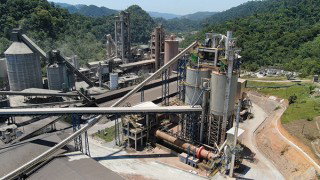
Nigeria’s three largest cement producers — Dangote Cement, BUA Cement and Huaxin Cement-owned Lafarge Africa — have all reported strong financial results for 2025, reinforcing the sector’s profitability at a time when producers are expanding capacity and accelerating export activity.
Dangote Cement reported profit after tax of NGN1.01trn (US$730m) for the year, more than doubling the previous year’s performance. Revenue reached NGN4.31trn while EBITDA rose to NGN1.98trn, representing a margin of roughly 46 per cent. BUA Cement also reported substantial earnings growth, with profit before tax reaching NGN465bn, while Lafarge Africa recorded revenue of NGN1.07trn and operating profit of NGN392bn. Combined profits across the three companies exceeded NGN1.6trn in 2025.
Alongside these results, Dangote Cement has announced a US$1bn engineering partnership with Sinoma International Engineering covering new plants and capacity expansions across Africa. The programme includes the long-planned Itori cement plant in Ogun state. The proposed 6Mta integrated facility, which will incorporate captive power generation, is scheduled for completion in 2028.
Once operational, Itori will increase Dangote Cement’s Nigerian capacity to about 41.25Mta. The project forms part of a broader strategy to position Nigeria as a clinker export hub for West and Central Africa. Dangote Group is also planning a large deep-sea port at the Olokola FTZ in Ogun state, intended to support bulk industrial exports.
Nigeria’s cement export volumes have begun to reflect this strategy. Data from the forthcoming 16th edition of the Global Cement Report projects exports of cement and clinker could reach approximately 1.5Mt in 2026. Around three quarters of that volume is expected to be clinker. Cameroon, Ghana and Sierra Leone are currently the main destinations. Dangote Cement accounts for most of these shipments through export terminals at Apapa and Onne.
Its competitors are also pursuing expansion strategies. BUA Cement continues to develop capacity at its Obu and Sokoto plants, while Lafarge Africa has announced expansion projects at its Ashaka and Sagamu facilities. Lafarge has also expanded its ready-mix network and launched lower-carbon products, such as ECOPlanet cement and ECOCrete concrete in Nigeria, as part of a broader sustainability strategy.
Pricing paradox
Despite expanding domestic production capacity — Nigeria now has well over 50Mta of installed cement capacity — domestic cement prices remain high. Retail prices for a 50kg bag have frequently exceeded NGN11,000 (US$7.93) in recent months, according to market reporting. In early March, the Real Estate Developers Association of Nigeria (REDAN) urged the federal and state governments to treat cement affordability as a national housing emergency.
Producers attribute these prices to several structural cost pressures and Dangote Group President Aliko Dangote has previously suggested high taxes and regulatory burdens have conspired to make his company's cement more expensive within Nigeria than outside.
Cement manufacturing in Nigeria remains energy-intensive and electricity supply from the national grid is unreliable, forcing producers to operate large captive power plants. Plants also rely on a mix of coal, natural gas and alternative fuels. Logistics costs are also significant. Cement distribution relies primarily on diesel-powered trucking, due to limited rail freight capacity and congestion at major ports.
Currency volatility has also played a role. The depreciation of the naira in recent years has increased the cost of imported equipment, spare parts and refractory materials used in kiln operations.
But at the same time, Nigeria’s highly concentrated cement market is clearly not without certain advantages for the dominant players. Dangote Cement accounts for the majority of installed capacity, with BUA Cement and Lafarge Africa making up most of the remainder. This triopoly reflects the capital-intensive nature of integrated cement production and the import-restriction policies introduced during the 2000s to encourage domestic investment in the sector.
Those policies successfully transformed Nigeria from a major cement importer into one of the largest producers in Africa. However, they also created a market with negligible competition from imports.
For Nigerian producers, the current emphasis continues to be regional expansion. Export growth allows companies to utilise surplus clinker capacity while earning foreign exchange. For Nigeria’s construction sector, however, the interaction between domestic pricing, market concentration and rising export volumes is likely to remain an area of scrutiny, as the industry continues to expand beyond its home market.
Handpicked stories, in your inbox
Our editors pick the top news delivered to your inbox. Sign-up today!