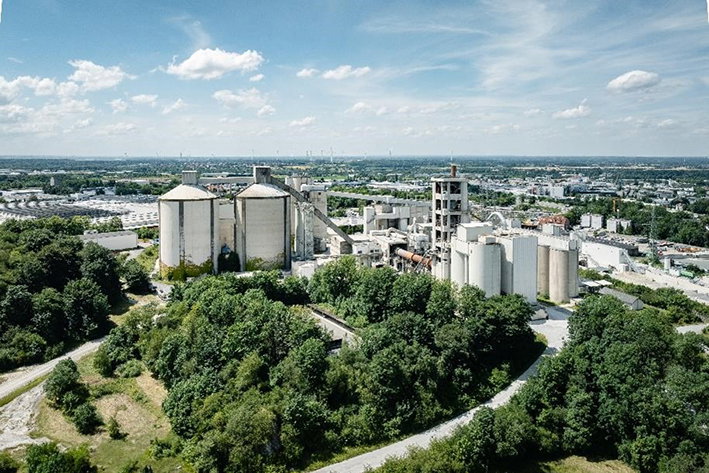
Following last week’s announcement that Heidelberg Materials will close its Paderborn cement plant, CemNet asks whether this is the start of an accelerating trend across Europe. Many more cement producers may yet close their less-efficient clinker production lines.
Heidelberg Materials cites a “significant decline in cement sales” for the closure, driven by weak construction demand in Germany in the current economic conditions. Further explanation from the multinational points to the company’s ongoing optimisation of its European production network. This would indicate that it may not be the last closure in Europe for the group. This is occurring at a time when the EU-ETS will further reduce free allocations of carbon allowances, and less efficient cement plants are expected to be phased out – even with the introduction of the Cement Border Adjustment Mechanism (CBAM). This will see the optimisation of low-carbon cement production with reduced clinker content and higher alternative raw materials and fuels.
Ternocem – an EvoBuild product
In some ways, the Paderborn cement plant has had a hand in its own demise. By serving as a trial-only facility for Ternocem® cement since 2022, Paderborn effectively transitioned out of commercial-scale Portland cement production.
Ternocem® cement has 50 per cent lower CO2 emissions than conventional Portland cement clinker. It is manufactured with Bauxite, sulphite sources and industrial by-products and kiln temperatures are restricted to 1250-1350°C. Ternocem® will be distributed under the company’s evoBuild ultra-low and low-carbon products. EvoBuild products operate within an emission range of 450-250kg CO2/t, starting with evoBuild20 and continuing to evoBuild70.
“Ternocem® is made with less limestone input by using alternative raw materials and lower burning temperatures, which also improves energy efficiency,” said Dr Dominic von Achten, Heidelberg Materials’ CEO.
The product reflects a broader shift towards low-clinker cements, which producers are increasingly positioning at the centre of their decarbonisation strategies. For von Achten, such products will be key to meeting his target of generating 50 per cent of Heidelberg Materials’ global revenue from sustainable products by 2030.
EvoZero – the ultimate cement
Arguably, a bigger group investment will be the scaling up of evoZero, which has near-zero CO2 emissions. Heidelberg Materials will have to manage these developments while reducing its OPC portfolio. By the end of 2026, approximately 350,000t of evoZero cement will be produced by Heidelberg Materials. But this will need to be scaled up to 1.35Mt by 2030. The Brevik and Padeswood plants in Norway and the UK will be central in achieving this goal. Approximately 20-25 per cent of the multinational’s concrete offering will be evoZero by 2030.
The most important cement plants in Germany for Heidelberg Materials will be those using carbon capture, utilisation and storage. The German cement plants that can be expected to survive and perhaps thrive in the group's new optimised European production network are: Lengfurt, Ennigerloch, Geseke and Mergelsletten.
Heidelberg Materials has been investing in carbon capture throughout Europe, and other plants expected to play a significant role in bringing EvoZero to the market, these include: Brevik (Norway), Devnya (Bulgaria), Slite (Sweden), Antoing (Belgium), Padeswood (UK), Airvault (France), and Rezzato (Italy). Further afield, in North America, Heidelberg Materials is also pushing CCUS at Edmonton (Canada) and Mitchell (USA).
European upswing forecast
Despite shareholders seeing Heidelberg Materials' shares decline by 20 per cent since the start of the year, Heidelberg Materials is confident of remaining profitable in Europe and expects a “demand rebound.” The company's recent results already showed a slight increase in revenue to EUR21.5bn. Moreover, stimulus programmes across Europe are primed to boost the European cement industry. This includes EUR65-100m in grid investment across Europe by 2030. Germany has a EUR500m stimulus plan to drive the local economy. In addition, Heidelberg claims, “We are making a step change in efficiency by continuing to redesign our asset base in Europe.”
Handpicked stories, in your inbox
Our editors pick the top news delivered to your inbox. Sign-up today!