Building new cement capacity is a complex process requiring finance, environmental regulations and infrastructure to align perfectly before a project can get off the ground. In Sabah, Malaysia, a partnership between the state government, Borneo Cement (Sabah) Sdn Bhd and Cement Industries (Sabah) Sdn Bhd (CIS) could provide a useful model for capacity additions in more remote locations, where raw material access and logistics are decisive.
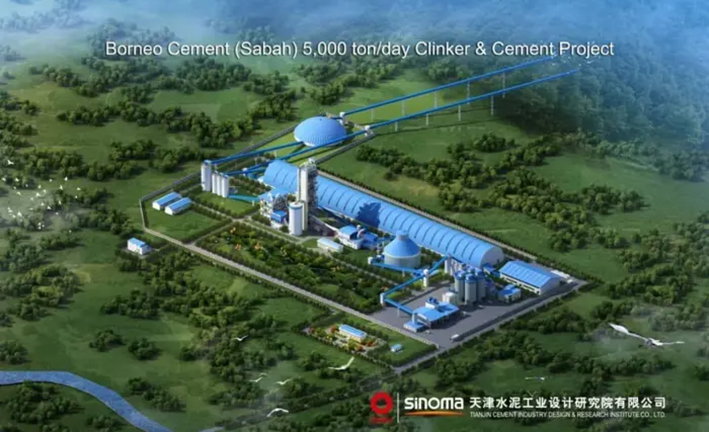
Borneo Cement Sabah’s plan to build a greenfield cement and clinker plant in the remote forests of Tongod is ambitious. The MYR1.1bn (US$276.6m) Kampung Kayawoi project, a joint venture between Sabah Economic Development Corporation (Sedco) and Sri Alam Setia Sdn Bhd is intended to reduce Sabah’s dependence on imported cement and strengthen local supply. It also highlights the balancing act facing cement producers: securing mineral resources while satisfying environmental and infrastructure requirements.
A foundation of cooperation
Sinoma Industry Engineering (Malaysia) Sdn Bhd is expected to build the plant, which will occupy part of a 200ha site, with around 80ha reserved for packaging, offices and workers’ quarters. The site is about 130km from Tongod town. Once completed, it is scheduled to produce 1.75Mta of cement, including 1.2Mta for CIS to package and distribute locally. The balance will be sold to other markets.
State Industrial Development and Entrepreneurship Minister Phoong Jin Zhe has stressed that Borneo Cement (Sabah) and CIS will collaborate rather than compete. This means logistics will focus on moving cement to CIS’s Sepanggar facilities for distribution. The arrangement is expected to lower cement prices by around five per cent and create up to 1000 local jobs.
Questions remain over project delivery. The remote forest location requires electricity, water and road access, while claims that investors had withdrawn were denied by the state government in April 2025. Preliminary works are continuing, including a 26km access road from Kampung Kayawoi to the main road at Kampung Matiku, Nabawan. Full construction is understood to depend on completion of the Environmental Impact Assessment process.
Most raw materials, including limestone, clay, sandstone and shale, will be sourced near the plant, although gypsum will be imported. Borneo Cement Sabah general manager Michael Kinsuan has said the facility will use modern digital systems, including a 300m roller conveyor linking the quarry and processing plant.
Construction recovery supports demand
Malaysia’s 13th Malaysia Plan allocates MYR430bn to federal development programmes for 2026-30, surpassing the MYR415bn under the 12th Malaysia Plan. The infrastructure pipeline should support cement demand following earlier project delays and periodic shortages of cement and aggregates.
Malayan Cement Cement Bhd, controlled by YTL Corp, is already benefiting from major infrastructure work, including the Penang LRT project. Analysts also see potential demand from Singapore projects, including Changi Airport Terminal 5 and the Marina Bay Sands upgrade.
YTL has also been consolidating downstream building materials. YTL Cement’s stake in Concrete Engineering Products Bhd rose to 70.22 per cent after its mandatory general offer closed at MYR2.60/share. This followed YTL Corp’s MYR215m acquisition of Hume Concrete Sdn Bhd in March 2026, as Hume Cement continued to divest non-core concrete assets.
The year ahead – rising prices and carbon tax?
Cement price pressure has continued. In January 2026 the unit price index rose by up to 1.7 per cent month-on-month, led by Selangor, Kuala Lumpur, Melaka and Negeri Sembilan, while the average price of a 50kg OPC bag reached MYR25.30. In February, the average price edged up to MYR25.35, while annual price index increases ranged from 0.8-5.9 per cent. These increases remain moderate, but they are material for contractors already managing higher labour, financing and infrastructure costs.
One cost that all Malaysian cement producers are likely to have to account for is the introduction of a carbon tax from 2027. Revenue from the carbon tax will feed into the national Energy Transition Fund, which has been allocated MYR150m for 2026. This fund is financing renewable energy projects, green infrastructure and industrial decarbonisation initiatives under the National Energy Transition Roadmap. At the same time, the government's budget also highlighted the need to support energy-intensive industries, such as cement, in adopting cleaner and more efficient technologies.
There is less than a month to go to Cemtech Asia 2026, where you can find out more southeast Asian regional cement industry developments - Register here!
Handpicked stories, in your inbox
Our editors pick the top news delivered to your inbox. Sign-up today!