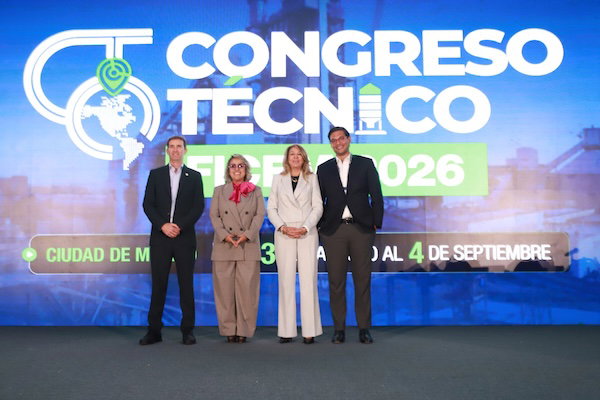
The FICEM 2026 Technical Congress opened today in Mexico City, bringing together 500 delegates and 50 exhibitors from across the Latin American cement industry.
Welcoming delegates, FICEM President José Raúl González, CEO of Cementos Progreso, announced that the federation had achieved its goal of strengthening regional representation, with FICEM now representing 100 per cent of the cement industry across Latin America. The federation comprises 77 cement companies and 14 associations, representing around 200Mt of cement across 26 countries.
Mr González, who is completing his second term as President of the FICEM Board of Directors, will step down when a new president is elected at the federation’s next Annual General Meeting.
María José García, executive director of FICEM, highlighted the federation’s ambition to position Latin America as a global leader in cement sector decarbonisation. “Leadership on decarbonisation is not exclusive to developed countries,” she said. “We are not waiting for solutions to come to us.”
She outlined FICEM’s expanding activities, including shaping regulation, facilitating access to climate finance, supporting technology development and academic research, and working with cities to transform waste into energy. She stressed that decarbonisation solutions must not only be environmentally effective but also commercially viable if they are to achieve widespread adoption.
Christian Dedeu, CEO of Holcim Mexico, reaffirmed the industry’s commitment to sustainability and highlighted co-processing as an example of how cement producers can provide tangible solutions to wider societal challenges. Mexico generates around 50Mt of waste annually, he noted, but only five per cent is currently treated, presenting a significant opportunity for increased waste recovery and co-processing by the cement sector.
Julio Cedeño, general director of CANACEM, welcomed delegates on behalf of Mexico’s cement producers, while Andrea Genoveva Solano Rendón of the Ministry of Economy described cement as a strategic industry for Mexico’s economic development. She emphasised the importance of technical standards and benchmarks in strengthening infrastructure quality and positioning Mexico’s cement sector as a reference for other industries in Latin America.
The discussions come as Mexico begins implementing its new General Circular Economy Law, which entered into force in January 2026. The legislation is expected to provide a stronger framework for waste valorisation and create further opportunities for cement producers to invest in alternative fuels and co-processing.
Cement sales in Mexico increased by two per cent in the first half of the year, despite weak construction indicators, with growth attributed to the construction of passenger railways from Mexico City to Pachuca, Querétaro, León, Guadalajara, San Luis Potosí, Saltillo, Monterrey and Nuevo Laredo, as well as self-build housing and the development of hotels, offices, industrial parks and other infrastructure projects.
The opening ceremony also included the second FICEM Health & Safety Awards, recognising initiatives by companies including Cemento Melón, Cementos Moctezuma and Cemex Mexico in areas such as road safety, working at height and safety culture.
Handpicked stories, in your inbox
Our editors pick the top news delivered to your inbox. Sign-up today!