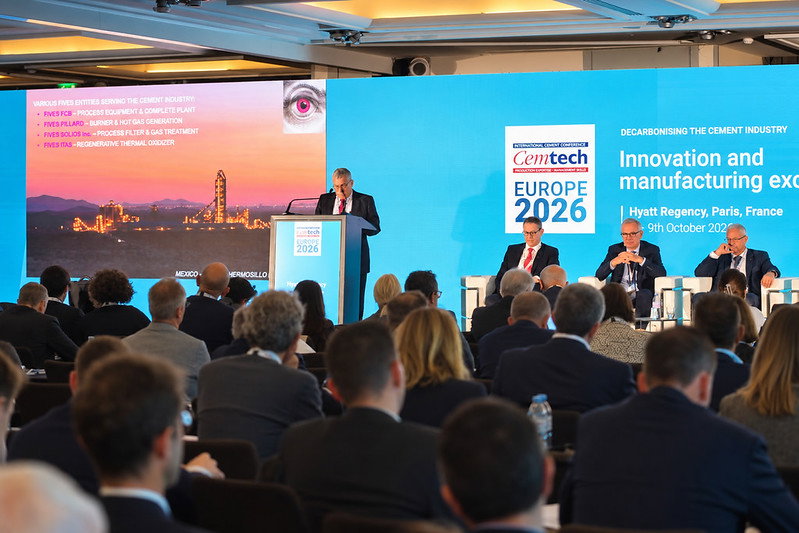
Cemtech Europe 2026, held in Paris on 8-9 October, showed how cement producers are advancing decarbonisation amid falling demand, rising carbon costs and uncertainty over CO2 infrastructure. The clearest opportunities lie in manufacturing excellence: reducing clinker content, increasing alternative-fuel use and improving plant performance through modernisation and digitalisation. Carbon capture is progressing, but its deployment depends on much more than capture technology.
1. Competitiveness takes priority over volume growth
Bruno Pillon, CEO of Heidelberg Materials France and President of the French cement association, France Ciment, described an industry pursuing substantial investment despite historically weak demand. French cement production totalled 13.4Mt in 2025.
Independent analyst Jean-Christophe Lefèvre-Moulenq warned against relying on a rapid recovery. His supplied outlook forecasts EU-15 cement consumption falling 0.8 per cent in 2026, with France down five per cent.
Lower clinker factors will also reshape production capacity. Harry Forbes, associate partner at McKinsey & Company, presented a conditional scenario in which 57 of 173 kilns close by 2035 across the western European markets modelled. Yet the cementitious value pool could expand as producers develop SCM-based products and services.
Ben Crick, senior economist at Fastmarkets, showed how the Carbon Border Adjustment Mechanism (CBAM) could alter import competitiveness. Verified emissions, sourcing and product mix will increasingly determine relative costs, creating opportunities for lower-carbon producers.
A live poll conducted by Peter Hoddinott, independent consultant and former Lafarge executive, found that a significant number of those attending expect carbon prices to reach US$150/t of CO2 within a decade.
2. Established measures are delivering results
France Ciment reported a 14 per cent reduction in the average carbon footprint of French cement between 2014 and 2025, or 20 per cent excluding methodological changes. Alternative fuels avoid more than 1.8Mt of fossil CO2 emissions annually, with an 80 per cent thermal substitution target for 2030.
Dr Mouloud Behloul, head of innovation and sustainable construction at Lafarge France, described operating calcined-clay facilities at Saint-Pierre-la-Cour and La Malle. The former uses recovered kiln heat and biomass; the latter converts an existing kiln to clay activation. Lafarge’s French calcined-clay cement offer is expected to total 1.1Mt in 2026.
Alain Cordonnier of Fives FCB highlighted industrial applications including a new, state-of-the-art 6500tpd SOCOCIM clinker line in Senegal, associated with annual CO2 savings exceeding 300,000t.
Erkam Kocakerim, global CEO of Limak, reported a 14 per cent reduction in carbon intensity since 2023 and the same cement output with 500,000t less clinker. Limak has also strengthened its 2030 emissions ambition to 409kg CO2/t of cement.
3. Clinker substitution changes the asset base
McKinsey projects western European supplementary cementitious material (SCM) demand rising from 17.2Mt in 2025 to 39.2Mt by 2035. Declining domestic fly ash and slag supplies could create a 25-30Mt supply gap, increasing the importance of alternative resources, processing capacity and logistics.
Olivier Guise, executive director of strategy, technology and business development at Ecocem Global, presented an ACT formulation containing 20 per cent clinker, 30 per cent SCM and 50 per cent limestone. He reported a 70 per cent lower CO2 footprint than the stated CEM II comparator, while stressing the importance of standards and certification for scaling deployment.
KHD highlighted mineralogical assessment and pilot testing for clay activation, Fuller Technologies examined grinding configurations for different materials, and Saint-Gobain Construction Chemicals demonstrated additives supporting low-clinker formulations.
Samir Cairae, chief technology officer of Titan group, captured the practical emphasis: “No kiln was ever decarbonised by a vision or a roadmap. Ours is being decarbonised by a pozzolan quarry, an ash pond, a control room.”
4. Carbon capture needs the whole value chain
Capture technology is advancing. At Mergelstetten, Germany, the industry-funded Catch4Climate project is demonstrating pure oxyfuel clinker production. Eike Willms, chief technology officer of thyssenkrupp Calvion, reported approximately 6,000t of clinker produced during commissioning at the 450t/day pilot. Integrated performance validation remains under way.
Holcim and Air Liquide also reported approximately 1000 hours of flue-gas operation at their Capture Lab, testing treatment systems and impurity removal.
However, the challenge is coordinating these advances with transport, storage, financing and demand. Holcim's postponed final investment decision on GO4ZERO at Obourg, Belgium, illustrated the consequences of delays in developing CO2 transport and storage.
Pillon’s ten-point agenda addressed the wider enabling conditions, including permitting, competitive electricity, carbon contracts for difference and low-carbon procurement. As he observed: “We’re building cars, we’re not building motorways.”
Eric Bourdon, deputy CEO of Vicat, outlined the proposed Rhône Decarbonation network, linking an initial 1.2Mta CO2 source at the Montalieu-Vercieu cement plant with around 300km of existing pipeline towards Fos-sur-Mer.
5. Decarbonisation success depends on manufacturing excellence and innovation
Jim O’Brien, managing director of Jim O’Brien CSR Consulting, reported average net emissions of 571kg CO2/t of cementitious product across 25 leading companies representing approximately 37 per cent of global production. Annual intensity improvement slowed to 1.5 per cent in 2025; roughly three per cent annually is needed to reach their average 2030 ambition of 484kg/t.
Plant-level examples demonstrated the available gains. Fuller Technologies reported 7.5 per cent higher mill throughput and 4.7 per cent lower specific power consumption at Chinfon Cement, Vietnam. ABB and alcemy presented AI-assisted quality control supporting lower variability, power consumption and clinker content.
Electrification is also advancing. Fives FCB reported clay-calcination trials with NOC Energy supplying 70-80 per cent of process heat electrically, with fully electric calcination trials planned for January 2027.
Investment decisions remain dependent on competitive energy supplies, alternative materials, CO2 infrastructure and demand for low-carbon cement. As Cemtech Europe demonstrated, the industry's technological options are expanding, even as its room for commercial manoeuvre narrows.
Handpicked stories, in your inbox
Our editors pick the top news delivered to your inbox. Sign-up today!