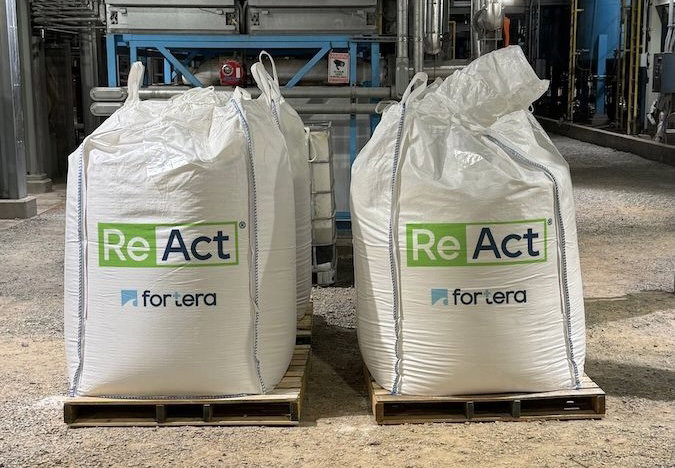
Fortera and Mississippi Lime Co’s (MLC’s) recent announcement that they have decided to locate their first commercial-scale ReAct cement plant at Ste Genevieve, Missouri, advances a project that CemNet first reported in September. While the development agreement already established the proposed capacity and technology, the latest announcement identifies where production would occur and sheds light on its intended industrial model.
The proposed facility would produce 0.3Mta of ReAct cement using CO2 emitted during MLC’s high-calcium lime production. Fortera’s ReCarb process dissolves lime before reacting it with captured CO2 to precipitate reactive calcium carbonate. The material is separated, dried and stored as a cementitious powder that can be used independently or blended with Portland cement.
Rather than constructing an entirely new mineral-processing complex, Fortera plans to add production to an established lime operation with raw materials, kilns, utilities and industrial expertise already in place. Its position on the Mississippi River also offers access to waterborne distribution across the central USA. MLC gains a potential outlet for part of its process emissions and entry into the cement market, while Fortera avoids having to establish the surrounding infrastructure independently.
The project represents a substantial scale-up from Fortera’s current 15,000tpa ReCarb plant, which is situated alongside CalPortland’s Redding cement works in California. Ste Genevieve would be 20 times larger, moving the technology from demonstration output towards a volume capable of serving a regional construction market.
Mineralising CO2 – a different model for inland plants
This model differs from conventional carbon capture and storage: mineralising CO2 into a saleable product removes the need for a pipeline, export terminal and geological storage site. Therefore, it could suit inland plants that cannot readily connect to emerging CCS networks. The quantity of cementitious material produced is nevertheless linked to market demand: permanent mineralisation only addresses emissions at scale if customers can absorb the resulting product. The partners say ReAct is intended for use across the Midwest, including by concrete producer Ozinga, although no binding off-take volume or purchasing term has been disclosed.
Fortera has issued supplier certification stating that ReAct meets all six ASTM C1157 categories, supported by independent testing by Construction Testing Services, as reported by CemNet in December 2025. The standard covers general use, early strength, sulphate resistance and heat of hydration. ASTM publishes the specification but does not itself certify the product.
Fortera says the product contains almost 50 per cent captured CO2 by weight and can reduce emissions by 70 per cent compared with ordinary Portland cement while achieving cost parity. Those remain company claims whose commercial significance must be demonstrated through sustained production and repeat purchasing.
The challenge ahead
Several material questions are still unanswered and the partners have not disclosed the investment, financing structure, construction schedule or commissioning date. The announcement also provides no plant-wide energy balance, expected capture rate or detailed allocation of the lime operation’s emissions between its existing products and the proposed cement output.
A recent independent review published by the peer-reviewed journal Energy & Fuels put processing costs for certain co-located mineralisation systems at approximately US$30-80/tCO2, excluding capture costs and product revenues. However, that range principally concerns industrial-residue feedstocks and cannot simply be applied to Fortera’s lime-based process. Furthermore, while ASTM compliance removes one technical obstacle, acceptance by concrete producers, public authorities and individual project specifications will determine the addressable market.
Therefore, the commercial test at Ste Genevieve is broader than whether Fortera can manufacture 300,000tpa. It must show that a lime producer can operate the process reliably, sell the material without a persistent green premium and substantiate its emissions performance across the complete production system. If it succeeds, existing lime works could become an additional source of cementitious capacity while mineralising some of their unavoidable process CO2 turning an isolated demonstration into a replicable industrial model.
Handpicked stories, in your inbox
Our editors pick the top news delivered to your inbox. Sign-up today!