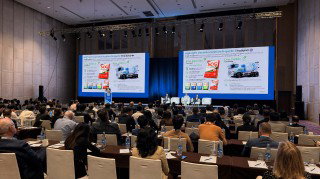
The 15th China International Cement Industry Exhibition and Conference took place over 28-30 April 2014, comprising a speaker programme and vast international exhibition tailored to promote the development of the country’s goal towards achieving efficient and environmentally-friendly cement production.
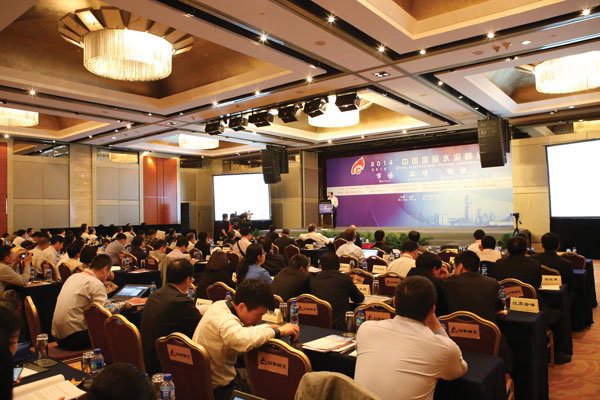
Cementtech 2014, organised by China Building Materials Federation, China Cement Association
and CCPIT Building Materials Sub Council, brings the Chinese cement market as well as
environmental and energy efficiency matters to the forefront
With reform and innovation at the core of China’s efforts to streamline its cement industry structure and improve its environmental and sustainability performance, Cementtech 2014 not only offered a progress update on the domestic sector’s latest achievements but also gave participants an arena to share in international best practices and discuss new development opportunities.
Conference proceedings, held at the Hotel Nikko New Century Beijing, were officially opened by Qiao Longde, chairman and president of the China Cement Association (CCA). During his keynote speech, he explained how the industry’s development is now centred on a two-pronged approach: R&D and innovations, and the elimination of backward capacity. Mr Longde underlined that while the country has been trying for years to lower energy consumption and significant progress has been made, there is still considerable margin for improvement. As such, a number of regulations are due to come into force over the next few years, aimed at reducing coal consumption, increasing the fuel substitution ratio and lowering clinker content in cement. Overall, he stressed the importance of gathering industry resources to research and develop the second-generation of NSP technology for future long-term development and to take full advantage of existing capacity.
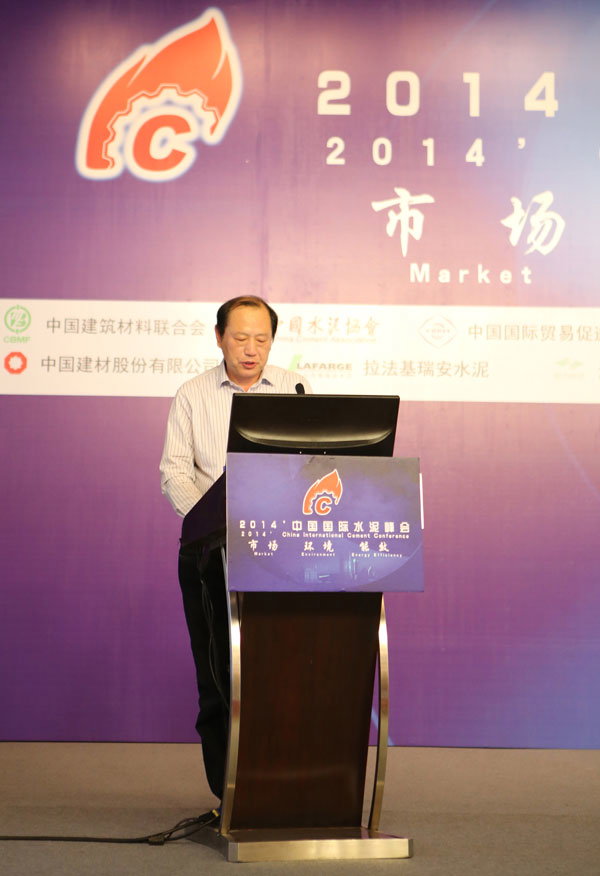
Zhang Fan, an air pollutants control technologies expert at
the Chinese Research Academy of Environmental Sciences
provides an overview of pollution studies in the
cement-producing regions of Beijing, Tianjin and Hebei
Jiang Minglin, State Council consultant, provided an update on China’s economic development, underscoring that going forward, consumption and investment will be the major drivers for promoting growth. This year the economy is expected to expand by 7.5 per cent. The government will actively push forward urbanisation efforts as well as accelerate investment and financing systems reform, promote the diversification of project funding and optimise the investment structure.
Streamlining efforts
Liu Ming, director of the National Development and Reform Commission’s Industrial Coordination Department brought delegates up to speed on the efforts China has been making to streamline its industry structure over the past year.
In October 2013, the State Council released ‘Guidelines on Tackling Severe Overcapacity Problem’ underscoring the government’s dedication to curbing the burden of overcapacity in five major industrial sectors. Mr Ming noted that the impact of these guidelines has seen more determined efforts by provincial governments and industrial associations to actively implement requirements stipulated by the report in terms of controlling increases in capacity, accelerating the elimination of backward capacity, improving quality standards and steadily working on defusing excess capacity concerns.
Cement production in China, meanwhile, reached 2.41bnt, up 9.57 per cent YoY and capacity utilisation increased by 2.1 per cent YoY to 75.8 per cent. A total of 54Mta and 63Mta of clinker and cement capacity was closed, respectively.
Fixed asset investments (FAIs) in the cement industry also slowed through 2013 by 3.7 per cent YoY to CNY132.86bn (US$21.3bn) – marking the third-consecutive year of decline. Investments in the western and central areas of China fell by 13.5 and 4.5 per cent, respectively. Meanwhile in Xinjiang, Ningxia, Shaanxi and Hubei, the reduction exceeded 30 per cent. In some provinces such as Hebei, Hunan and Guangxi, over 65 per cent of the FAI undertaken by the cement industry focussed on pollution control, energy savings, acquisitions and reorganisation.
Staying on the subject of M&A activity, Mr Ming emphasised that industry concentration further improved with large enterprises such as CNBM, Conch Cement, Sinoma, China Resources Cement, Huaxin Cement, Sunnsy Group, Tianrui Cement and Jilin Yatai remaining active on the acquisition and reorganisation front as well as further integrating previously-purchased assets, promoting competitiveness, enhancing technical management and establishing a fair and orderly market environment. In 2013, the top 10 Chinese cement enterprises accounted for 37.8 per cent of total capacity, a three per cent increase on the previous year.
China market overview
Chen Bailin, vice director of Information and Media of the CCA, provided a comprehensive overview of China’s cement market performance in 2014 where production increased “beyond expectations” thanks to a 20 per cent increase in FAIs and huge expenditure in the infrastructure and construction sectors nationwide. Cement production reached 2.42bnt and clinker output was 1.36bnt, increasing by 9.5 and 5.5 per cent, respectively. These figures also highlight the imbalance between cement and clinker production. There were 11 provinces where cement production exceeded 100Mt, with Jiangsu province leading the way by producing 180Mt.
In terms of the easing capacity additions, CCA data showed that 72 new production lines were put into operation and newly-designed clinker capacity was 94.3Mta, the lowest capacity increase since 2011.
Mr Bailin stressed that while the demand and supply relationship improved compared to 2012, overcapacity still persists. By end-2013, NSP clinker design capacity reached 1.7bnta (the actual capacity was about 1.9bnta) and total cement capacity was over 3.1bnta.
Profitability and prices climb
The industry realised profits of CNY76.6bn in 2013, a rise of about 16.4 per cent YoY, second only to the 2011 record. The rise was attributed to lower coal prices and increasing demand. However, there were regional differences with profits in the north relatively lower than in the south. Cement prices remained low over the first three quarters of the year but picked up from September onwards.
Outlook
Overall, Mr Bailin is optimistic on the outlook for the industry this year, stating: “In 2014, cement demand growth will continue and production is expected to rise by 6-7 per cent. The increasing rate of new clinker additions will slow, the elimination of backward capacity will accelerate and a better demand and supply relationship is promised.”
Mr Bailin reiterated that new urbanisation construction as well as infrastructure will be the main driving forces behind the economy and cement demand this year.
According to the China Development Bank, investments in urbanisation will reach CNY25trn over the next three years. The Central Urbanisation Work Conference held in December 2013 underscored China’s commitment to urbanisation, calling it “the road China must take in its modernisation drive.” Currently there are three mature metropolitan areas (Beijing-Tianjin-Hebei, Yangtze River Delta and Pearl River Delta) and it is expected that more metropolitan areas will form in the midwest and northeast. “The government will continue supporting development in the west this year, especially for infrastructure, transportation and water conservation projects – all of which is good news for the cement industry. It is also expected to issue revised policies on census registration, land, housing and basic public services to promote the development of small and medium cities in the middle and west regions,” Mr Bailin emphasised during his paper.
Environment and energy efficiency
With a number of new environmental regulations due to come into force over the next few years, conference presentations included papers comparing domestic and international emissions standards as well as technologies, policies and research into the reduction of pollutants and GHG emissions. Under this umbrella came a collaborative paper by members of the Chinese Research Academy who provided an insight into the action plans being undertaken in Beijing, Tianjin and Hebei where efforts are being made to reduce capacity and emissions through each region’s respective action plan. For example, the capital Beijing is enacting the 2013-17 Clean Air Action Plan with investments totalling CNY3.39bn in measures such as denitration disposal, sealing of material storage and stockpile areas, as well as plant restructuring and capacity elimination.
Under the theme of energy efficiency came presentations on international energy efficiency management measures. Lafarge’s experiences in alternative fuels were showcased by the company’s Gilles Bourrain who detailed the best examples and solutions from around the world.
Ritu Bharadwao of the Institute of Industrial Productivity (India) shared experiences of promoting AFR usage and discussed collaboration to bring about change. With China and India being the first- and second-largest cement producers in the world, respectively, Ms Bharadwao highlighted the large pool of resources that can be drawn upon with AFR and waste heat recovery “promising areas” to kick start such a cooperation.
Presentations from China National Building Materials Group Corp, Sinoma Group, the Institute of Environmental Standards (Ministry of Environmental Protection) also proved of valuable interest to industry peers.
Exhibition
The 15th China International Cement Industry Exhibition ran in parallel to the conference and was once again held at the Beijing Exhibition Center. The vast area showcased the latest technology on offer to the cement industry, featuring over 100 companies from China, USA, Europe and beyond.
The large global turnkey equipment suppliers were out in full force, including Sinoma Technology & Equipment Group (China), CNBM under its various subsidiaries, FLSmidth Beijing Ltd, KHD Humbolt Wedag (Germany) and Fives FCB (France).
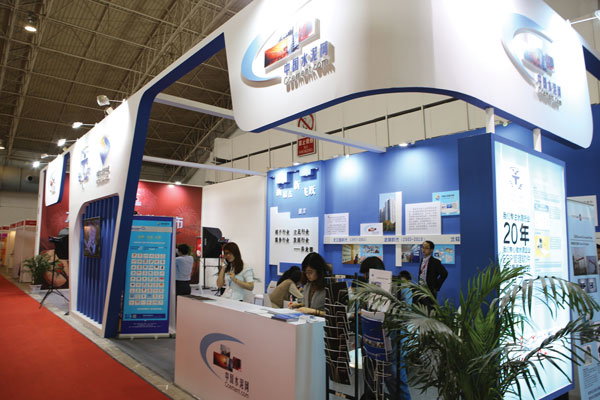
The extensive exhibition area showcases the latest technology on offer to the Chinese cement industry,
with both local and international manufacturers highlighting their products and services
The exhibition provided invaluable direct link between producers and a host of other specialist suppliers covering the complete spectrum of cement manufacturing technology: from quarry and bulk handling technologies through to grinding, pyroprocessing, storage and distribution.
With a comprehensive programme of speakers and a vast exhibition area brimming with details of the latest technological advances, the annual Cementtech event once again proved itself to be a key platform for the exchange of ideas and transfer of knowledge, helping to promote the healthy and sustainable development of the Chinese cement industry going forward.
Article first published in International Cement Review, July 2014.
Handpicked stories, in your inbox
Our editors pick the top news delivered to your inbox. Sign-up today!