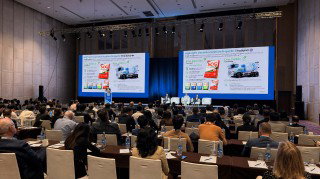
The 21st Arab International Cement Conference and Exhibition (AICCE 21) took place at the Abu Dhabi National Exhibition Centre in the United Arab Emirates (UAE) on 16-18 November 2016. This annual gathering, which incorporates the largest equipment supplier fair in the region, attracted 615 delegates from 136 companies.
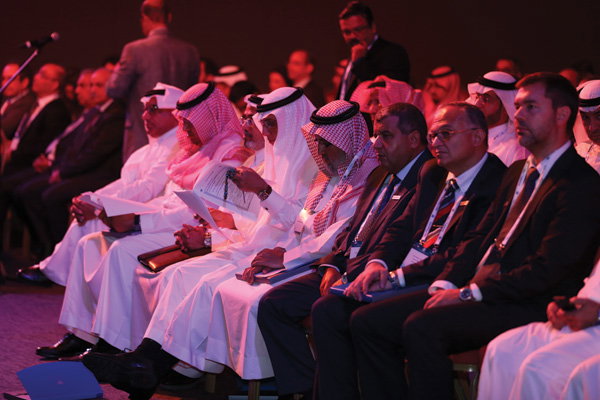
Over 600 delegates gathered at the 21st Arab International Cement Conference and Exhibition to find out more
about the latest advances in cement production technology
The Middle East and North Africa (MENA) faced a challenging year in 2016, with the Gulf region adjusting to the realities of lower oil prices, Iraq and Syria suffering from ongoing conflicts, and continued security issues suppressing economic activity in Libya and Tunisia.
Nevertheless, discussions throughout the meeting with equipment suppliers and cement producers reveal that a significant level of new investment in the region is still being generated. The range of projects in the pipeline include new plants planned for Morocco, Egypt, Saudi Arabia and Iraq.
The latent potential in the region is still immense, and given peace and security, demand for cement and related equipment would boom. In anticipation of this, all major turnkey suppliers were present at the event, including Sinoma and CNBM (China), thyssenKrupp Industrial Solutions (Germany), FLSmidth (Denmark) and Fives Group (France). But for now perhaps the most active country is Algeria, where all the main turnkey suppliers are engaged in new plant construction, primarily for state cement company Groupe Industriel des Ciments d’Algérie (GICA).
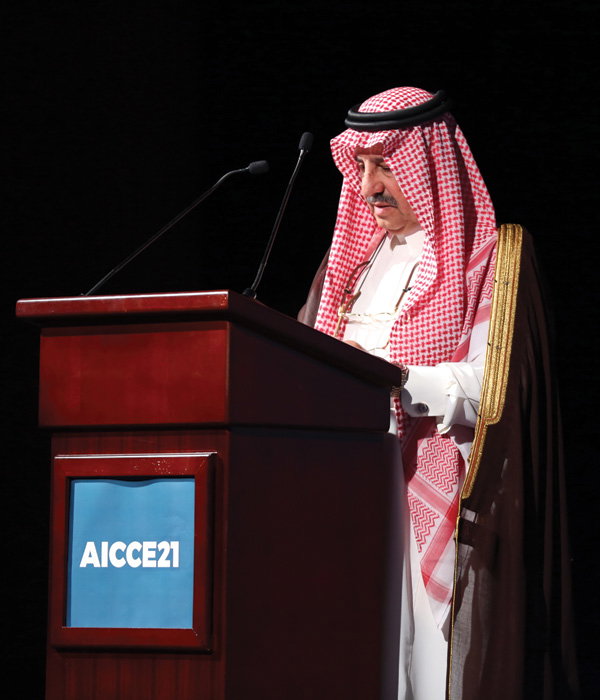
AUCBM Board Chairman Prince Sultan
Bin Mohammed Bin Saud Al Kabir,
addresses the AICCE 21 audience
The biggest project currently underway in the Middle East is the new Yamama Cement plant in Riyadh, which will consist of two 10,000tpd kiln lines supplied on an EPC basis by thyssenKrupp Industrial Solutions (for more details, see next month’s issue of ICR).
The effects of the downturn in China could also be felt at the meeting through the increased presence of equipment suppliers from Asia. This year saw companies such as China National Heavy Machinery Corporation, CITIC Heavy Industries, Jiangsu Pengfei Group and several others join the exhibition. As the domestic market in China has peaked, the demand for new equipment is in decline and many of these companies will depend on generating international sales to survive. It is clear they will introduce increased competition in the market over the coming years.
A range of other equipment suppliers are also having success in the region, with much activity focussed on Egypt, where the energy situation since 2014 has forced producers to switch from gas to solid fuels.
Christian Pfeiffer (Germany) has recently completed the construction of a coal milling system for Amreyah Cement Co (Egypt), consisting of two closed circuit ball mills equipped with DSL-K 65 separators, finish product silos, and dosing and conveying units. The system allows Amreyah Cement to switch from natural gas to imported coal and petcoke, greatly reducing costs and avoiding energy shortages.
Fives Group has installed the FCB TSV classifier at Suez Cement Co (Egypt) to help optimise the operation of the solid fuel grinding plant.
Conference papers
The conference hall at AICCE featured more than 40 presentations and engaged with a truly comprehensive range of topics, from the core process technologies to more modern advances in cement manufacturing.
Digitisation
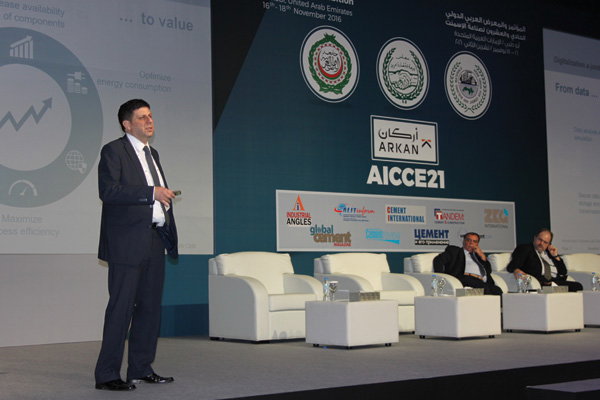
Omer Oydasik, Siemens AG (Germany), discussing
the digitalisation of them cement plant at AICCE 21
Omer Oydasik, Siemens AG, provided an exciting presentation on how the technological ability to transfer and analyse large amounts of data is improving the efficiency of many industries, offering potential for the cement sector. Of course, automation systems such as Siemens’ own CEMAT are already well established, but they are becoming increasingly powerful with the digitalisation of industry. They bring enormous benefits for asset management and predictive maintenance, which greatly reduce plant downtime.
O&M
Similarly, remote plant operation is now a reality for cement plants. According to Martin Paterson of FLSmidth, the Denmark-based company is evolving its operation and maintenance (O&M) offering to include 24/7 remote monitoring of plants and their equipment, allowing experts located in Denmark to fine tune, troubleshoot and supervise operations, raising productivity and reducing costs in the process.
Alternative fuels
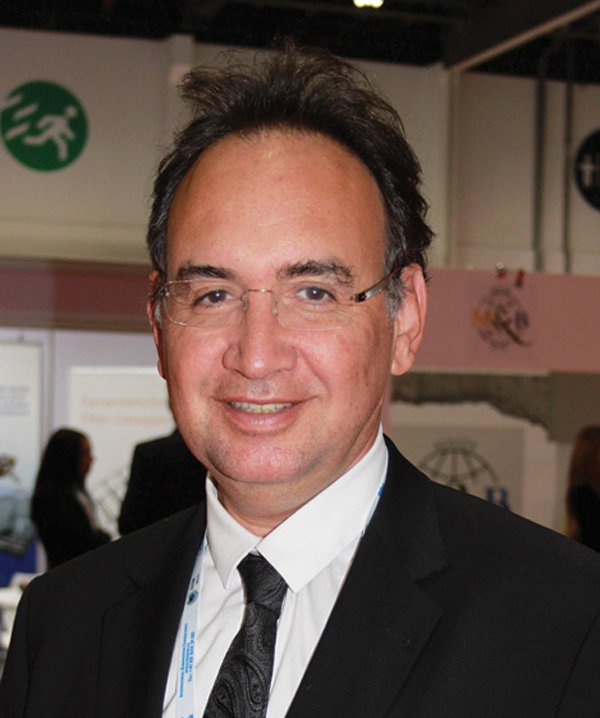
Brahim Laraqui, CEO of Asment Temara (Morocco) and
AUCBM representative of Morocco. The country is
expecting modest growth at around 2.5 per cent in 2016
and longer-term prospects are positive
Alternative fuels are only just starting to penetrate the Middle East cement sector. Dirk Lechtenberg, MVW Lechtenberg & Partner, argues that because the rate of urbanisation in MENA countries is set to rise to 70 per cent over the coming five years, it will create a significant and viable waste source for alternative fuels. The pressure on these societies to dispose safely of this increased waste means that alternative fuels will become a regular fuel, regardless of fossil fuel prices, in the years ahead.
Luigi Di Matteo, Di Matteo Group, was on hand to present what he terms the ‘seven-stage concept’ for the preparation, handling and dosing of alternative fuels to the kiln. The German-based Di Matteo Group supplies much of the equipment to this process and is particularly well known in the cement sector for its tubular weighing system – a screw conveyor and weigh scale alternative fuel feeding unit.
According to Mr Di Matteo, one key to a successful alternative fuel system is correct physical characterisation of the bulk fuel, so that each of the process steps leading to the kiln can be fully optimised, namely: reception, preparation, material storage, transport, metering, feeding to kiln and combustion.
Kiln and refractories
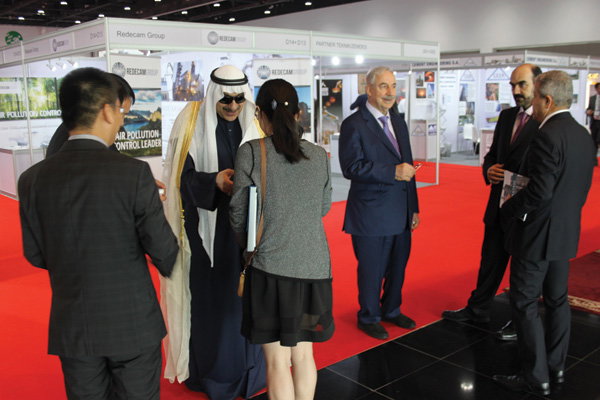
New entrants: Saudi invester Ali-Al Khawan, CEO, Riyadh
Investment Companies Group (second from left), is
seeking to establish a new 3000tpd kiln line in Iraq
Presentations on kiln technology focussed on service and maintenance issues, with thyssenKrupp Industrial Solutions, FLSmidth and Ozek Makina all offering hot kiln alignment and on site tyre and roller resurfacing services. In spite of the simple geometry of the rotary kiln, changes caused by uneven wear or incorrect repair can lead to overloading of individual components and result in serious damage and loss of production. It requires skill, specialist knowledge and experience to maintain a kiln and ensure high kiln availability.
Turning to the inside of the kiln system, Stefan Thomas, Refratechnik Cement GmbH, provided a detailed review of the causes of refractory failures in modern preheaters. These include mechanical or thermochemical factors resulting from abrasion or alkali attack, alkali reactions resulting in the mineralogical formation of feldspar and feldspathoids, and anchor corrosion. Correct selection of refractory material, depending on fuel type and kiln zone, are critical to solving these issues, explained Mr Thomas.
Grinding media
Willy Sonnet of Magotteaux unveiled the company’s brand new MGT grinding media, a mill charge with lower wear and breakage rates than conventional products. This is made possible by an innovative foundry and heat treatment techniques capable of producing very fine, hard chromium carbides, which have the added benefit of offering a lower environmental footprint. With chrome content as low as nine per cent, the MGT media is also less sensitive to ferrochromium price fluctuations, giving greater price stability for the end user.
Bulk material handling
A standout presentation from the conference technical sessions was given by Jean-Baptiste Agnes, Claudius Peters (Germany), who provided a detailed cost comparison for a coal handling system comprising Panamax vessel unloading, stockpiling, and feeding to the plant. The combined capex and opex costs for the non-automated stockyard – using wheel loaders – was three times the cost of using an integrated system with automated stockyard system and ship unloader.
Air pollution control
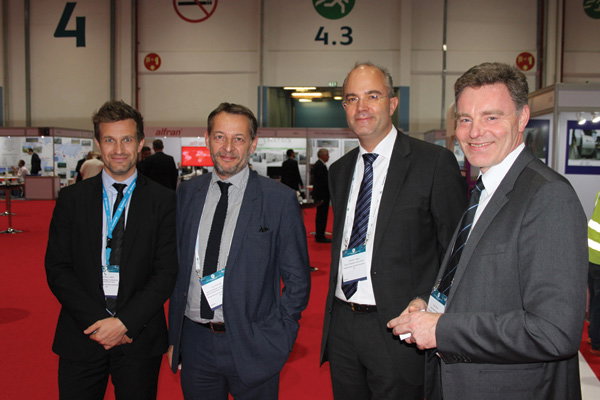
thyssenkrupp representatives, including (L to R): Francois
Lepetit, senior sales manager, Luc Rudowski, head of BD &
Sales Cement, Alexander Tigges, head of Integrated
Cement Plants, Frank Ruoss, CEO Business Unit Cement
Emissions control remains a perennial concern for cement producers given the focus on adhering to ever tighter environmental limits. Ruggero Baldi, Scheuch (Austria) showcased his company’s market leading solutions for bag filtration systems used for dedusting in the kiln/raw mill, kiln bypass, clinker cooler and cement mill. A detailed reference of Arabian Cement’s Rabigh Plant in Saudi Arabia was presented, where an emission level of < 5mg/Nm3 has been achieved following the installation of the kiln-raw mill and by-pass EMC filters.
The AICCE 21 provided delegates with a broad survey of equipment and services for the cement sector and the opportunity to meet with the widest possible range of companies under one roof. The next meeting, AICCE 22, will be held in Sharm El Sheikh, Egypt, in November 2017.
Article first published in International Cement Review, January 2017.
Handpicked stories, in your inbox
Our editors pick the top news delivered to your inbox. Sign-up today!