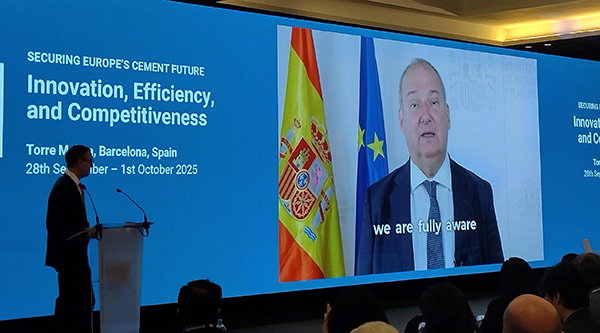
Spain’s Minister for Industry and Tourism, Jordi Hereu Boher, has called for stronger public-private collaboration to secure the future of the cement industry as it faces the twin challenges of competitiveness and decarbonisation.
In a recorded message to the Cemtech Europe conference in Barcelona, Mr Hereu Boher underlined the importance of urgent action. “The future of the sector depends on the decisions we all take today. It is fundamental to deepen public-private collaboration to reach climate neutrality and advance the decarbonisation of the industry,” he said.
He praised the sector’s role across construction, transport, energy and water management. “You are an industry that connects Spain, with plants across the country. Your contribution to industrial development is undeniable, and we want to accompany you to ensure a sustainable and competitive future,” he added, highlighting support measures such as the EUR1.3bn Industrial Decarbonisation PERTE programme and EUR600m in CO2 compensation aid this year.
Mr Hereu Boher concluded: “We need strong, competitive and sustainable cement companies. The ability to integrate the circular economy, technological innovation and energy autonomy will define the industries that lead the future – and the cement sector must be among them.”
Introducing the conference, Thomas Armstrong, managing editor of International Cement Review, set Mr Hereu Boher’s remarks within the broader European context. “Cemtech Europe is being held just three months before the EU’s Carbon Border Adjustment Mechanism comes into force in January 2026, marking the beginning of the phase-out of free carbon allowances for cement,” he said.
“Free allowances will be halved within five years and eliminated within ten, while carbon prices could reach EUR200-250/t. This makes decarbonisation not just a policy issue, but an existential matter for Europe’s producers.”
Mr Armstrong noted that the conference programme showcases multiple technological pathways. “We see progress in alternative fuels, with some plants achieving up to 95 per cent thermal substitution, and in clinker reduction, with leading producers reducing clinker factors below 60 per cent. Digitalisation is increasingly driving efficiency and quality control, while carbon capture is now advancing from concept to reality,” he explained.
He pointed to Heidelberg Materials’ Brevik plant in Norway as the first cement works to operate CCS and the company’s forthcoming Padeswood project in the UK, due online in 2029, which will capture 800,000t of CO2 annually.
In a welcome speech, Salvador Fernandes Capo, president of Ciment Catala, VP of Oficemen and Molins’ executive VP Cement and RMC for Spain and Mexico, noted that hosting the event in Barcelona was particularly fitting given this year marks Oficemen’s centenary.
He called on policy makers and administrators to implement more compensatory mechanisms, noting that more carbon capture investment was still needed as a matter of urgency if climate neutrality targets were to be achieved without damage to the domestic industry.
Handpicked stories, in your inbox
Our editors pick the top news delivered to your inbox. Sign-up today!