The European Environment Agency’s (EEA's) 2025 review, Europe’s Environment and Climate: Knowledge for Resilience, Prosperity and Sustainability, paints a sobering picture of Europe’s industrial decarbonisation. Greenhouse gas emissions from energy-intensive sectors, including cement, have fallen by little more than one per cent since 2015. The report concludes that Europe remains off track for its 2030 targets, warning that “incremental efficiency improvements will not suffice” and that deep transformation of core industries is now unavoidable.
Cement, alongside steel and chemicals, sits at the heart of that challenge. The sector accounts for roughly five per cent of the EU’s total CO2 emissions and remains heavily dependent on fossil fuels and process emissions from clinker production. The EEA is explicit: achieving climate neutrality by 2050 demands “fundamental changes in production processes, including the substitution of raw materials, electrification and carbon capture and storage.” Yet despite clear technical pathways, the report acknowledges that “deployment remains slow and geographically uneven,” a diplomatic way of describing an industry still paralysed by uncertainty and administrative delay.
Much of the problem lies not in technology, but in tempo. The EEA’s data confirm that Europe’s industrial transformation is being slowed by policy complexity, fragmented funding, and slow permitting. The Agency’s call for a “Clean Industrial Deal” reflects the recognition that the transition cannot happen at market pace alone. But even this framework, spanning multiple EU and national funds, is proving difficult to navigate. As the report concedes, “state-aid complexity continues to delay investment in clean technologies.”
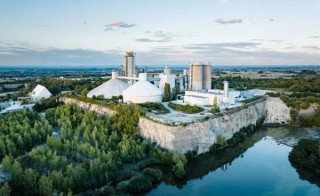
For cement producers, that friction is measurable. Several major companies are postponing capital commitments until carbon pricing and border adjustment mechanisms are fully defined. Heidelberg Materials, Europe’s largest cement producer, completed its pioneering carbon-capture project at Brevik, Norway, and has another (arguably more ambitious) project underway at Padeswood in the UK - two western European nations that are conspicuously not part of the European Union! Moreover, the company has been explicit that large-scale rollout of CCS will depend on clarity regarding carbon pricing, funding mechanisms and CO2 transport networks.
Holcim, similarly, has said it cannot commit to “multi-billion-euro capture facilities” without predictable carbon costs. Cemex, while piloting CCS at sites in Spain and Germany, warns that “long permitting timelines and fluctuating carbon allowances introduce uncertainty into investment planning.” And in its 2024 position paper, CEMBUREAU, the European cement association, confirmed that “several investment decisions have been postponed because companies cannot model future carbon costs or revenue streams with sufficient certainty.”
At the centre of that uncertainty lies the Carbon Border Adjustment Mechanism (CBAM), due to enter its definitive phase in 2026. It will gradually replace free ETS allowances by 2034, ensuring imported cement pays the same carbon price as domestic product. In theory, this levels the playing field; in practice, it introduces further risk. But key design features — including the recognition of non-EU carbon pricing, the treatment of exports, and the methodology for verifying embedded emissions — remain unresolved. Without these details, firms cannot calculate long-term liabilities or price scenarios, and so they wait.
The EEA captures this dynamic with studied restraint: “Investment uncertainty continues to delay industrial transformation despite the growing urgency of the transition.” Beneath the phrasing lies a structural truth about Europe’s governance model. Every major decarbonisation project must pass through multiple layers of approval — environmental assessments, cross-border coordination, state-aid review — each designed for accountability but collectively limiting speed. The continent’s administrative precision has become its economic drag.
The building sector, which the EEA calls Europe’s “largest single energy consumer,” tells a parallel story. It still accounts for 42 per cent of final energy use and 35 per cent of CO2 emissions, figures almost unchanged since the last five-year review. The EEA again prescribes renovation, insulation and boiler replacement as primary solutions — essentially the same toolkit as in 2020.
Donatas Karciauskas, CEO of the energy-efficiency firm Exergio, calls this “a strategy stuck in the past.” Karciauskas's AI-based energy management systems, reckoned to be capable of cutting waste by up to 30 per cent, are already in commercial use — yet digital optimisation is absent from the report. In the EEA's defence it relies heavily on data sets provided by Eurostat, national energy agencies, and research institutes; sources that inevitably favour mature technologies with quantifiable results. For as long as algorithms remain jealously-guarded mysteries, with little in the way of harmonised methodology, then how is that data supposed to be assimilated anyway?
Equally, it's hard not to grow exasperated at the slow execution and byzantine regulations that prevent plans from turning into plants. The EEA warns that “further postponement of implementation will make transitions more expensive and socially disruptive.” It is a careful phrasing for a blunt reality: the longer Europe deliberates, the harder — and costlier — the transition becomes.
For the cement industry, the implications are existential. Once CBAM and full carbon pricing are enforced, low-carbon cement from outside the EU could outcompete domestic production on both cost and verified emissions, particularly if Chinese or Gulf producers achieve scale in alternative binders. Europe’s policy frameworks, meant to protect its industrial base, may end up accelerating its disappearance.
The EEA’s 2025 report is not a critique of the sector, but it inadvertently exposes the consequences of bureaucratic delay. Europe’s climate strategy is detailed, principled and technologically sound — but administratively slow.
Handpicked stories, in your inbox
Our editors pick the top news delivered to your inbox. Sign-up today!