A recent report by Japan’s Renewable Energy Institute’s on the current state of the country’s cement sector frames decarbonisation as a sequencing challenge: prioritise actions that cut emissions per tonne now, while preparing for longer-lead options.
The report reiterates the sector’s emissions split: process CO2 from calcination dominates, with energy-related emissions (fuel and electricity) accounting for the remainder. As a result, measures that lower the clinker factor – specifically widespread adoption of supplementary cementitious materials (SCMs) – will deliver the most immediate intensity reductions.
By contrast, switching to alternative fuels, renewable energy and carbon capture are positioned as medium- to long-term levers, valuable but insufficient if pursued without accelerating clinker reduction.
Put bluntly, Japan’s current pathway is lagging significantly compared to clinker reduction in other major countries. The divergence between GCCA’s intensity-driven milestones and the Japan Cement Association’s (JCA) aggregate-emissions framing comes under criticism.
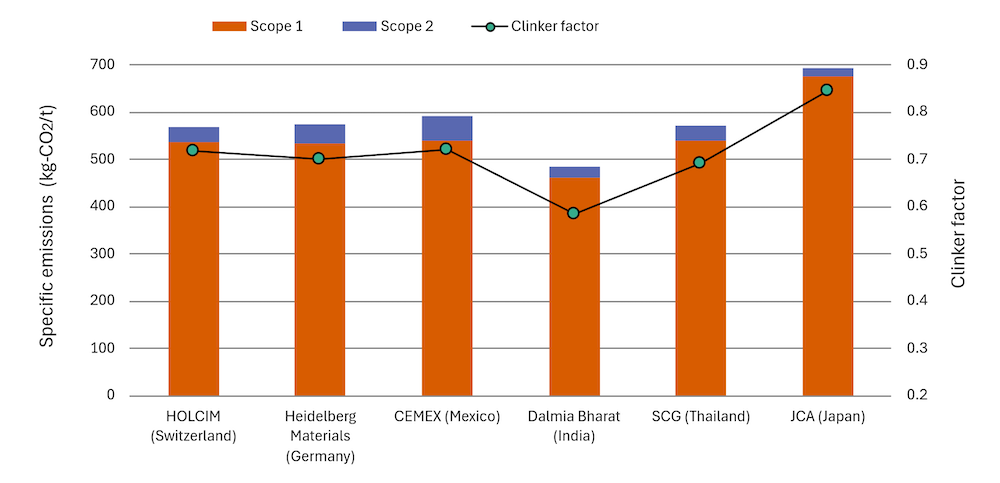
GCCA’s indicative clinker factors—0.58 by 2030 and 0.52 by 2050—contrast with the JCA's more conservative assumptions of 0.825 and 0.80, respectively, signalling a slower expansion of blended cements in Japan than in peer markets. The report argues that tightening intensity metrics and accelerating the uptake of SCMs are essential to align with a 1.5°C trajectory.
The report isolates three structural causes. First, a preference for coal keeps thermal emissions elevated and crowds out substitution with lower-carbon fuels. Second, Japan’s electricity decarbonisation in cement has been slow relative to leading multinationals that actively deploy Power Purchase Agreements (PPAs) and on-site renewables, weakening Japan’s position in LCA/EPD-based international comparisons. Third, standards and procurement practices favour ordinary Portland cement, limiting flexibility to incorporate a broader set of SCMs and to raise SCM ratios in line with EU/ASTM norms.
Across Japan’s heavy industries, similar structural barriers are impeding decarbonisation. The steel, chemicals, and non-ferrous sectors all rely on mature, capital-intensive processes built around fossil fuels, with long asset lifetimes that discourage rapid change. High-process emissions, limited renewable energy capacity, and constrained access to low-carbon feedstocks such as green hydrogen or biofuels compound the difficulty.
These challenges are reinforced by entrenched standards, procurement rules, and concerns about competitiveness that favour existing technologies. As a result, industrial transition in Japan tends to progress cautiously, with incremental efficiency gains rather than major process substitution—reflecting systemic inertia across much of the country’s heavy manufacturing base.
Revised standards
On solutions, the report proposes a clear policy-technical package. It calls for reform of industrial standards to enable wider SCM use (including limestone and calcined clays), performance-based procurement in public works to reward durability and strength outcomes rather than prescriptive recipes, and deliberate “industrial symbiosis” to channel steel-sector slag into cement at higher rates.
It also notes the need to future-proof supply by developing domestic calcined-clay options as fly ash availability declines. The emphasis is on near-term, scalable reduction of the clinker factor as the “first-order” measure, with CCUS positioned as a complementary, later-stage abatement route rather than the primary plan.
The report’s benchmarking underscores the gap. Advanced producers (Holcim, Heidelberg Materials and Cemex are among those used for comparison purposes) already operate with clinker factors ~0.6–0.7 and Scope 1+2 intensity of ~486–592 kg CO2/t, versus Japan’s reported intensity (~695 kg CO2/t) and higher clinker factor, indicating plenty of headroom for Japan to accelerate blended cement deployment. The authors also note the absence—so far—of Science Based Targets initiative-validated 1.5°C targets among Japanese producers, compared cement producers in other countries.
Although the report is light on case studies and examples, there has been some progress in Japanese cement decarbonisation, albeit a little off the pace. Examples include the joint CCUS study announced by Mitsubishi UBE Cement Corp (MUCC) and Osaka Gas encompassing capture, liquefaction, intermediate storage, shipping and utilisation/storage pathways at MUCC’s 8.347Mta Kyushu plant. In 2025, it also reported Japan’s first successful commercial-kiln natural gas demonstration at the same plant. MUCC has also been collaborating with Mitsui as part of a project to develop an integrated CCS value chain transporting CO2 from Japan as part of the Offshore Peninsular Malaysia CCS scheme.
Taiheiyo Cement has been working with Toyo Wharf & Warehouse CCS export-hub joint study, announced last year, in addition to its exploration of technology to capture CO2 from flue gas.
Meanwhile, in February 2025, Sumitomo Corp and Fortera signed an MOU to study a commercial-scale low-carbon cement project in Japan using Fortera’s CO2 mineralisation route.
However, these projects are outliers and the report’s authors caution that Japan’s near-term compliance with a 1.5°C pathway depends primarily on reforms that unlock higher SCM penetration—especially slag, limestone, and calcined-clay blends—across standards and procurement.
Without this, Japan risks slower intensity gains, continued reliance on coal in the interim, and eventual over-dependence on capital-intensive CCUS to close the gap later.
Handpicked stories, in your inbox
Our editors pick the top news delivered to your inbox. Sign-up today!