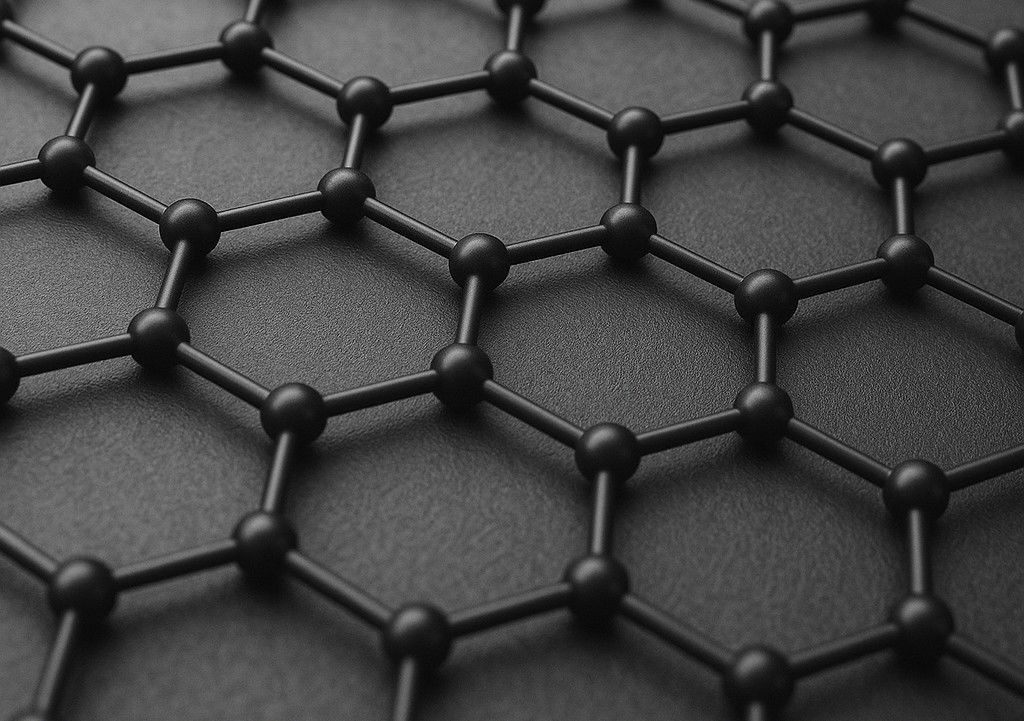
Since the discovery of the process to synthesise its production in the early years of the 21st century, graphene has been proclaimed as a miracle substance poised to revolutionise everything from biomedicine to energy storage.
The Graphene Council summarises the potential benefits for cement and concrete applications thus:
• faster cure rate
• increased load and compressive strength
• reduced water permeation
• reduced micro-cracking and fractures
• effective for use in repair compounds and mortars
• requires less cement in a concrete mix, reducing embedded CO2
• requires less concrete to achieve the same engineering performance, providing a further reduction in CO2
Being exceptionally strong as well as light, graphene’s potential as a construction material is clear, however the challenges of high production costs, quality control and toxic byproducts have slowed its progress.
But in recent years there have been encouraging signs of progress. Among those at the vanguard of graphene research is Australia-headquartered First Graphene, which earlier this week announced a partnership with Breedon that will see its graphene-enhanced additive for cement, PureGraph® CEM, added to 600t of cement to be produced at Derbyshire’s Hope Cement Works and then distributed to numerous material, construction and academic partners around the UK who are keen to explore the expected performance improvements and CO2 reduction graphene enhanced cement (GEC).
Among the recipients of the new product will be precast concrete manufacturer FP McCann, which intends to utilise 40-60t of GEC in the production of thousands of roof tiles at its Cadeby manufacturing plant, Leicestershire, for subsequent testing at its R&D facility. The cost of graphene and other raw materials for the project will be covered by a UK Government grant awarded by the Department for Energy Security and Net Zero (DESNZ) and Defra: Resource Efficient Construction Impacts. Cadeby traditionally uses large quantities of CEM I in its production, but this will be replaced with GEC, which incorporates graphene platelets to enhance waterproofing.
First Graphene and Breedon first began collaborating on GEC trials two-and-a-half years ago, as part of a consortium that also included construction group Morgan Sindall and the University of Manchester, in what was then said to be the biggest trial of its kind, with 1.2t of its PureGraph 50 product used to create around 2000t of GEC. Dispersal of graphene into the cement line was achieved using traditional grinding and dosage, with minimal changes required, and was reported to have achieved a 15 per cent reduction in CO2 emissions and a 10 per cent increase in strength. Further trials followed in late 2023 and 2024.
Elsewhere, Toronto-based Bio Graphene Solutions has been making progress with its own proprietary graphene enhanced cement which uses entirely organically-sourced materials instead of graphite. Most recently, the company’s admixture technology has been incorporated into concrete infrastructure at Toronto’s Exhibition Place, one of Canada’s largest entertainment and convention venues. Cement usage is said to be reduced by up to 25 per cent, with CO2e reductions of 275-500kg per truckload, without compromise to performance.
Back in the UK, a collaboration between the Graphene Engineering Innovation Centre (GEIC), Cemex UK, Galliford Try, Sika and Northumbrian Water saw 15m3 of graphene and micronised lime-enhanced concrete poured at a Northumbrian Water wastewater treatment facility. The lower-carbon concrete, known as CoMLaG (Combining Micronised Limestone and Graphene), was developed and trialled at the GEIC and Cemex’s National Technical Centre. The mix uses a ternary cement blend, replacing a portion of the high-carbon clinker with GGBS and micronised limestone. A graphene-based additive formulated at GEIC was introduced to enhance the strength that might otherwise be lost through clinker reduction.
A cheaper option in cementitious composites is graphene oxide. However, it is said to disperse poorly, raising problems in achieving a uniform distribution and with a tendency towards rapid aggregation. Nonetheless, companies such as the UK’s Concretene, a Manchester-based nanotechnology company, which combines graphene oxide with graphene nanoplatelets, believe it is possible to reduce cement usage by 20-30 per cent.
In Sri Lanka, where pure vein graphite is in good supply, Ceylon Graphene Technologies has established itself as a frontrunner in high-quality graphene oxide production. It claims to have the most comprehensive and advanced concrete testing data to date in the graphene-enhanced cement and concrete additive space, although hitherto there have been no reports of commercial usage.
Handpicked stories, in your inbox
Our editors pick the top news delivered to your inbox. Sign-up today!