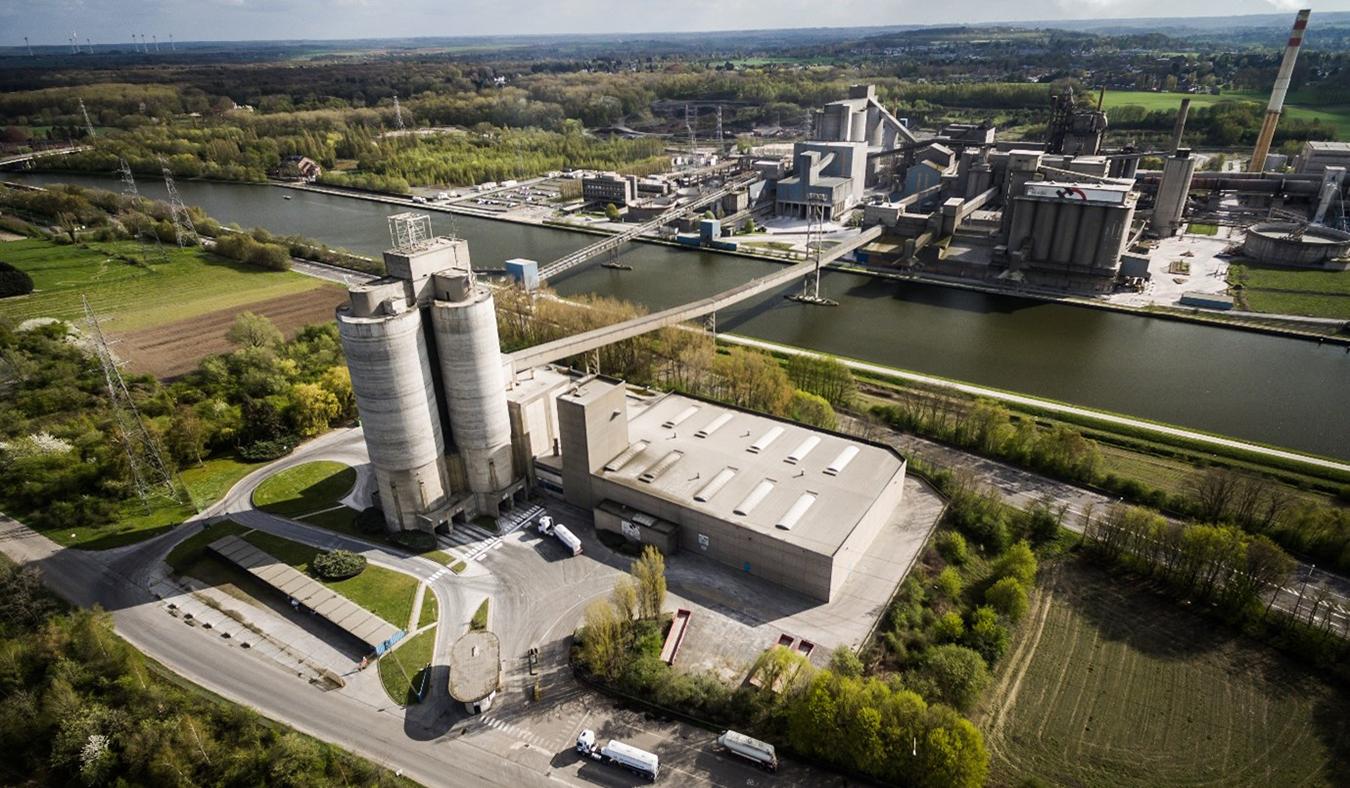
Holcim is developing the river and rail transport facilities at the Vaulx site, near Obourg, Belgium. The facilities will transport limestone extracted from Vaulx and then shipped to the company’s Obourg cement plant.
The company will use the Nimy-Blaton-Péronne canal under a concession agreement between Holcim Belgium and Port Autonome du Centro et de l’Ouest (PACO). The agreement details nearly 800m of quayside at a river terminal in Obourg. The project is expected to handle more than 600,000tpa of goods and finished products, or 2.5 times the current volume.
Meanwhile the largest raw material volumes will be transported by rail via Infrabel line 78. As part of the company’s GO4ZERO project, Holcim and CFL Cargo formalised in October 2025 a five-year partnership for the limestone transport between the quarries in the Tournai region, the loading station in Vaulx (to be built on the Vignobles site) and the Obourg station (on the future GO4ZERO clinker production site). Holcim plans to transport approximately 2Mta by 2029-30 using a fleet of around 100 rail cars with up to four daily trains with a payload capacity of 2200t.
“We were able to purchase the necessary rails from Infrabel, rails that have been used on high-speed lines but remain perfectly usable for our project with reduced-speed trains,” explained Vincent Michel, director of the GO4ZERO programme. “All the rails are already on site in Vaulx, and Infrabel has carried out an entry test on the first track laid there. The three tracks will be completed by the end of January 2026. The signalling and control cabin will then need to be installed. The railway work in Obourg will begin at the end of January on both sides of the unloading point. This will start with major civil engineering operations. We estimate that everything will be ready by the end of October 2026 for the first rotation tests between Vaulx, where the rolling stock will arrive and be stored on the tracks in July 2026, and Obourg.”
Holcim aims to build a strategic limestone stockpile of ~100,000t in Obourg to prepare for the first tests with the new kiln, which is scheduled to be commissioned at the end of the first quarter of 2027.
Handpicked stories, in your inbox
Our editors pick the top news delivered to your inbox. Sign-up today!