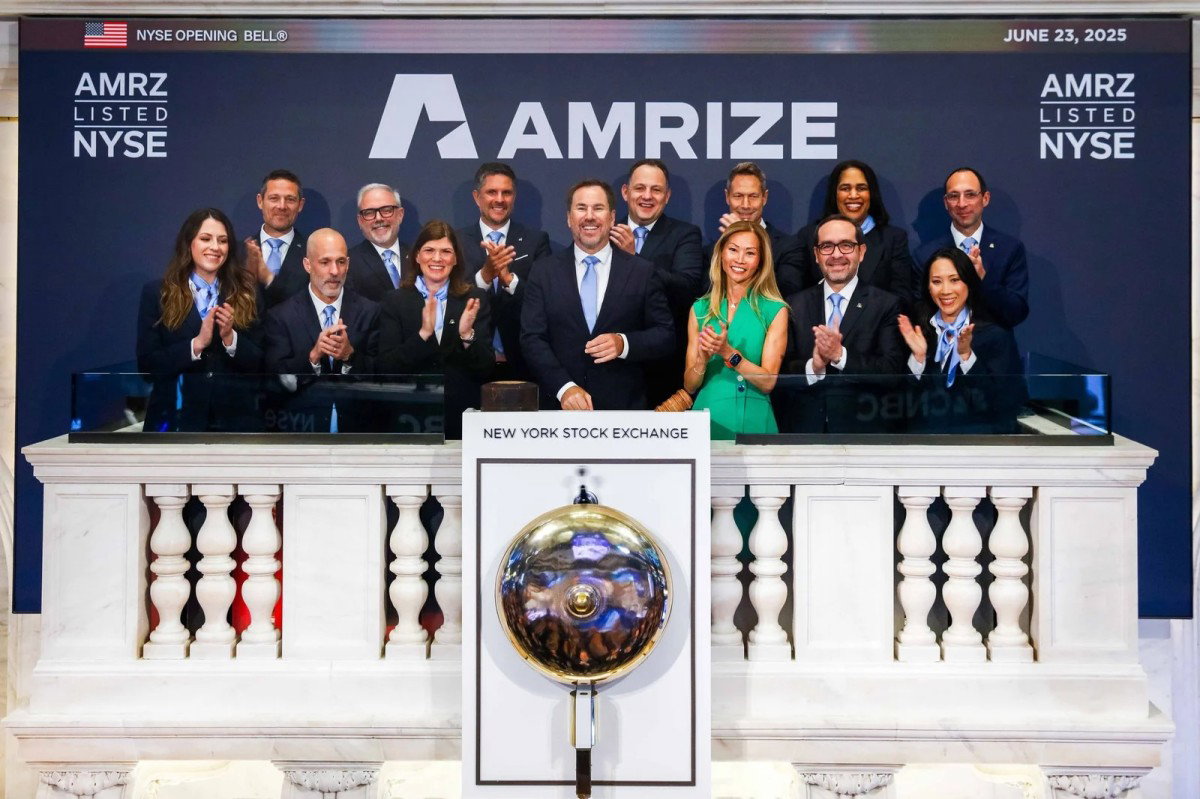
When Holcim announced the spin-off of its North American business as Amrize, the rationale was presented as strategic clarity rather than financial engineering. The argument was straightforward: the US market operates under different demand dynamics, regulatory pressures and capital expectations than Europe. A standalone North American company could pursue pricing, investment and shareholder returns without being tied to the strategic constraints of a global portfolio increasingly shaped by European carbon policy.
One year on, the 2025 results suggest that, at least in the near term, that theory is holding.
Jan Jenisch, Chairman and CEO commented: "2025 was a milestone year for Amrize as we completed our spin-off, delivered for our customers and set the foundation for our long-term, profitable growth. I thank our 19,000 empowered teammates who are serving our customers across North America as the partner of choice for their most important building projects."
Amrize reported revenue of roughly US$11.8bn, broadly stable YoY, with adjusted EBITDA of around US$3.0bn. The company highlighted that price realisation was the principal driver of earnings performance in 2025, with price increases more than offsetting softer residential volumes and cost inflation. Free cash flow reached approximately US$1.5bn, supported not only by operating profitability but also by favourable working capital movements, allowing the group to maintain low net leverage of close to 1.1x.
Cement and aggregates performance offset weakness in residential roofing, underscoring the benefit of exposure to infrastructure and commercial construction. Guidance for 2026 calls for revenue growth of 4–6 per cent and EBITDA growth of 8–11 per cent, alongside capital expenditure of around US$900m. Management has distinguished between maintenance capex and growth investments, signalling continued reinvestment in core assets while selectively expanding in stronger regional markets. The proposed US$1bn share repurchase programme and dividend payments were framed explicitly as an expression of confidence in the sustainability of long-term cash flows.
While not spectacular growth figures, they are disciplined and cash-generative — and, importantly, pricing-driven. That was central to the spin-off narrative. The US business, management argued at the time, could exercise pricing flexibility in a market supported by infrastructure spending and characterised by relatively tight regional supply structures.
The results suggest that pricing momentum remains intact. Margins have been protected not by volume expansion, but by steady price execution and cost control. Targeted portfolio moves, such as the acquisition of PB Materials in West Texas, further reinforce a strategy of regional consolidation rather than diversification for its own sake.
The more strategic question is whether this performance reflects a structural shift in transatlantic cement economics — and whether the spin-off represents more than a corporate reshuffle.
There is little doubt that operating frameworks differ. European producers face tightening emissions baselines under the EU Emissions Trading System (ETS), progressive reductions in free allocations and the ongoing implementation of CBAM. Recent political discussion around potential adjustments or delays to aspects of the ETS — including the possibility of reviewing mechanisms such as the Market Stability Reserve — has added another layer of uncertainty. Even if the direction of travel remains toward decarbonisation, the path is politically sensitive and subject to recalibration.
That policy backdrop contrasts with a US environment in which decarbonisation remains incentive-driven rather than tax-led. The difference does not automatically guarantee superior pricing in North America, but it does ensure greater transparency and more predictability. US-exposed building materials businesses continue to command stronger valuation multiples than their European counterparts.
Yet permanence should not be overstated. US cement demand is still closely linked to federal and state infrastructure programmes. A plateau in public spending later in the decade would test volume assumptions. Equally, European markets could stabilise if construction activity recovers and carbon policy clarity improves. Capacity rationalisation and CBAM enforcement may yet tighten supply conditions in parts of Europe.
So the strategic case for separation was not misplaced. Amrize has shown margin resilience, strong cash conversion and balance sheet discipline in its inaugural year as an independent entity. It has also signalled a willingness to combine reinvestment with shareholder returns — a combination that implies confidence rather than caution.
Whether this marks a lasting decoupling of US and European cement pricing remains open to debate. What is clearer is that the two markets are now operating within increasingly distinct regulatory and policy frameworks. For investors and industry participants alike, that divergence — more than any single year’s earnings — may prove the more enduring legacy of the spin-off.
Handpicked stories, in your inbox
Our editors pick the top news delivered to your inbox. Sign-up today!