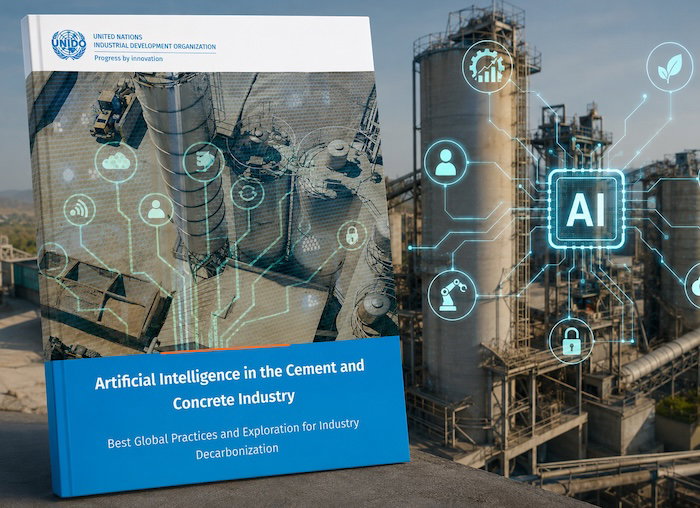
Artificial intelligence (AI) is rapidly moving from the periphery of the cement industry to the mainstream. A recent report from the United Nations Industrial Development Organisation (UNIDO) highlights how AI is no longer simply a promising technology but an increasingly important tool in the industry's drive to improve efficiency, reduce emissions and develop lower-carbon products. However, the report also identifies a series of obstacles that could limit the technology's impact if left unaddressed.
AI, it concludes, is already delivering measurable benefits in areas such as predictive maintenance, process control and energy management. The vast quantities of operational data generated by the modern cement plant are well-suited to machine learning systems capable of identifying patterns that traditional control systems might overlook. According to the report, AI-assisted optimisation has been shown to deliver 2-5 per cent improvements in energy efficiency, reduce electrical energy consumption by 3-8 per cent and cut unplanned downtime by as much as 15 per cent.
Notable are the experiences of Cementos Molins, which has used machine learning tools developed by alcemy to optimise cement formulations. The project reportedly reduced the clinker factor by 1.9 percentage points while maintaining product performance, cutting CO2 emissions by approximately 12kg/t of cement.
This may ultimately prove more significant than many of the operational gains currently attracting attention. At a time when much of the industry's decarbonisation investment is focussed on carbon capture, some of the largest long-term emissions reductions are likely to come from reducing clinker content through supplementary cementitious materials and the development of lower-carbon products. If AI can accelerate the identification and validation of new formulations, its contribution may extend far beyond plant optimisation.
Quality concerns
Yet UNIDO's report is equally clear about the challenges facing wider adoption. The most commonly cited barrier is data quality. Many cement plants continue to operate with fragmented information systems, inconsistent data collection practices and legacy equipment never intended for advanced analytics. One of the report's central conclusions is that AI systems are only as effective as the information available to them.
This raises an important question: is the industry's biggest challenge really one of data quality, or rather one of data governance? Most cement producers already collect vast quantities of information, but these datasets are often stored in different formats, managed by different departments and created for different purposes. Much of the industry's digital infrastructure has evolved to satisfy regulatory reporting requirements rather than support machine learning. Plants have become increasingly proficient at reporting data to governments and regulators but less successful at creating datasets that can be shared, compared and analysed across organisations.
UNIDO also identifies a structural shortage of personnel capable of bridging process engineering, automation and data science, alongside uneven levels of digital maturity and difficulties integrating AI into existing operational structures. These problems are particularly acute for smaller producers, which often lack the resources available to major multinational groups. The companies generating the most impressive AI case studies are typically those that have already invested heavily in digitalisation. Smaller producers, by contrast, often struggle to establish the data foundations required to deploy comparable technologies.
The report also cautions that AI is not environmentally neutral. The rapid expansion of data centres and advanced computing infrastructure is increasing demand for electricity and water, highlighting the need to consider the environmental footprint of digital technologies alongside their potential benefits.
If AI is to realise its full potential, the industry may need to focus less on algorithms and more on standardisation. Common approaches to process data, laboratory information, maintenance records and emissions reporting could dramatically reduce the barriers to adoption.
But who should lead that effort? Individual producers have little incentive to establish industry-wide standards, while technology suppliers often benefit from proprietary systems. Therefore, the most credible candidates are likely to be industry bodies such as the GCCA, VDZ and other independent organisations capable of acting in the interests of the sector as a whole rather than promoting the priorities of individual market participants.
The report's broader message is that AI is not a shortcut to decarbonisation. It will not eliminate process emissions, replace carbon capture or solve the industry's structural challenges. What it can do, is help producers navigate increasing complexity. However, realising that potential may depend less on advances in AI than on the industry's willingness to develop a common language for the data on which it depends.
Handpicked stories, in your inbox
Our editors pick the top news delivered to your inbox. Sign-up today!