Researchers from the Massachusetts Institute of Technology (MIT) and CarbonCure Technologies have identified for the first time the chemical mechanism by which injected CO2 enhances cement performance during curing.
The findings, published in the Journal of the American Ceramic Society, show that cement paste containing CO2 equivalent to one per cent of cement weight achieved a 13 per cent increase in compressive strength after 24 hours compared with conventional mixtures.
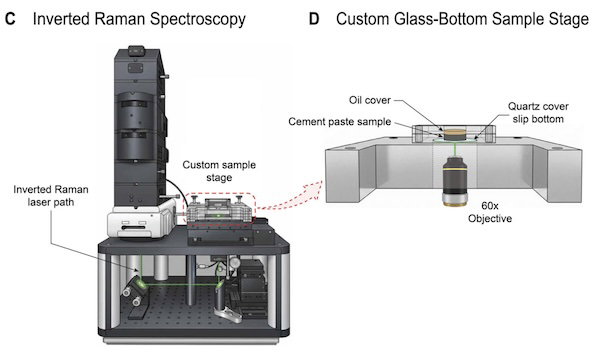
Using Raman spectroscopy, the MIT team tracked the early-stage reactions occurring in fresh cement paste following CO2 injection. The researchers found that the CO2 initially reacts with calcium released from clinker, forming calcium carbonate and temporarily altering the normal hydration process. This leads to the formation of a transient silica gel network that subsequently promotes a more uniform distribution of calcium silicate hydrate (C-S-H), the principal binding phase in cement.
According to the researchers, the improved distribution of C-S-H is responsible for the observed strength gains rather than the calcium carbonate particles themselves, as previously believed.
The study provides new insights into carbon mineralisation technologies already being deployed commercially to reduce the carbon footprint of concrete products. The authors believe a better understanding of the underlying chemistry could help optimise CO2-cured cement systems and support the development of stronger low-carbon cement and concrete products.
Handpicked stories, in your inbox
Our editors pick the top news delivered to your inbox. Sign-up today!