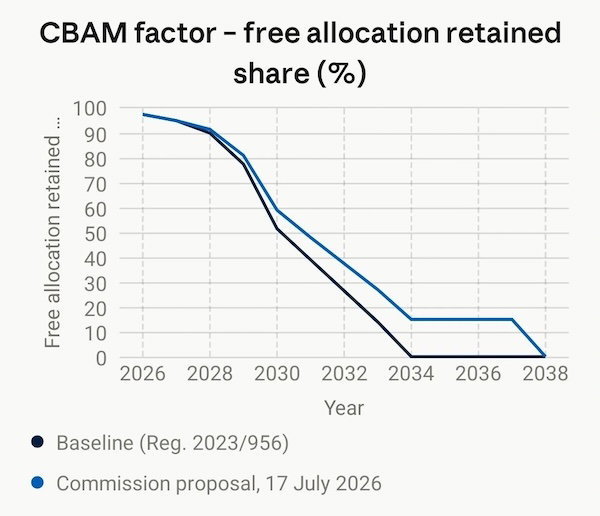
Last week, the European Commission published its long-awaited proposals for the revision of the EU Emissions Trading System (ETS). Under the plans, the withdrawal of free ETS allowances for hard-to-abate sectors covered by the Carbon Border Adjustment Mechanism (CBAM), including cement, would be delayed beyond the original end date of 2034. Instead, the proposal suggests a 15 per cent free allocation from 2034 to 2037, with full phase-out postponed until 2038.
The proposal reflects a growing emphasis on industrial competitiveness and investment certainty. Rather than signalling a retreat from the ETS or CBAM, it acknowledges that the supporting infrastructure—particularly carbon capture, transport and storage—has not developed as quickly as originally envisaged. Extending free allocation would provide additional protection while that framework catches up.
Since the introduction of the EU ETS in 2005, cement producers have been required to surrender one emissions allowance for every tonne of verified CO2 emitted. Since 2013, part of those allowances has been allocated free of charge under benchmark rules based principally on clinker production. CBAM, which was implemented from 1 January this year, is intended gradually to replace that free allocation by applying an equivalent carbon cost to imported cement.
Implications
For cement producers, the proposal means lower carbon-cost exposure than under the existing timetable and additional time to develop carbon capture projects, secure transport and storage capacity and reduce clinker-related emissions before free allocation disappears entirely.
But there are caveats. From 2031, eligibility for free allowances would become contingent on producers' participation in EU-based decarbonisation investment plans and their subsequent implementation.
The withdrawal of free allocation also slows the pace at which CBAM assumes its full protective role. The proposal therefore delays the point at which EU producers and importers are expected to face fully equivalent carbon costs. It also postpones the moment at which European producers must rely solely on their own decarbonisation investments to remain competitive.
Reaction
Among European cement producers, the initial reaction appears to be cautiously positive. Heidelberg Materials CEO Dominik von Achten welcomed the proposals as providing a reliable signal through a stable CO2 price, but argued that "it is only half the story". While producers can invest in carbon capture equipment, he argued, they cannot develop the shared CO2 transport and storage infrastructure required to make those investments commercially viable.
"We are happy to build the car and take the risk for that but we cannot build the roads on top," Mr von Achten wrote. In other words while individual producers can invest in carbon capture equipment, they cannot develop the shared CO2 transport and storage infrastructure required to make those investments operationally and commercially viable.
Mr von Achten also welcomed the proposed reinvestment of ETS revenues into industrial decarbonisation, but argued that funding must reach each industrial sector through dedicated instruments capable of supporting commercially viable deployment.
Financial analysts have also interpreted the proposals as broadly supportive for the cement sector. BNP Paribas concluded that, while the package contains both positive and negative implications for the EU carbon market, it should have little immediate impact on CO2 prices at current levels.
The bank also suggested the cement industry could be well placed to benefit from a proposed 400Mt in carbon allowances from an Investment Booster programme if companies invest in decarbonisation projects. The initiative would raise an estimated EUR30bn between 2028 and 2030 on a "first come, first served" basis, rather than competitive bidding.
Next steps
The Commission's proposals must now pass through the European Parliament and the Council, both of which may amend the timetable, conditionality and funding provisions before any revised legislation is adopted. Political agreement is expected during the first quarter of 2027.
Some will inevitably argue that the Commission has simply deferred the inevitable by extending free allocation. Yet the proposal arguably addresses a broader reality: carbon pricing alone cannot deliver industrial decarbonisation at scale if the enabling infrastructure is not in place.
Perhaps the more pertinent question, therefore, is whether the EU can align carbon costs, border protection, carbon capture infrastructure and investment support quickly enough to ensure that low-carbon cement production remains economically viable within Europe.
Handpicked stories, in your inbox
Our editors pick the top news delivered to your inbox. Sign-up today!