The GCCA’s latest progress report, launched during COP31 on 12 November, records a 25 per cent reduction in net CO2 emissions per tonne of cementitious material since 1990 among reporting companies. Progress since 2020 has been slower than required, however: emissions per tonne of cement fell 4.4 per cent by 2024, against a target of 20 per cent by 2030.
Electricity decarbonisation contributes five per cent of the roadmap’s projected savings by 2050, equivalent to 190Mt of CO2 annually. Yet CCUS accounts for 36 per cent of its reductions, with capture identified as the principal source of additional electricity demand towards 2050.
Supplying that equipment with expensive or carbon-intensive power would compromise its operating economics or emissions performance. The report assumes emissions from electricity generation used in cement and concrete production eventually fall to zero, an outcome producers cannot deliver independently.
Producers nevertheless have considerable scope to change their supplies. JSW Cement increased the combined contribution of renewables and waste heat recovery from 3.6 per cent in FY2022 to 36 per cent in the first half of FY2027. UltraTech’s Kukurdih plant has met its electricity requirements through those sources in every month since April 2026. Waste heat recovery improves efficiency but does not make the underlying kiln process carbon-free.
Nor does cleaner electricity necessarily come at a premium. Cemex’s Mexican distribution-centre solar programme is financed and operated by a developer under a 10-year power-purchase agreement. Cemex incurs no upfront capital expenditure, with tariffs guaranteed at least five per cent below the applicable utility tariff. Distribution centres have different requirements from integrated works, but the arrangement demonstrates how decarbonisation can coincide with lower costs.
UltraTech is also deploying batteries across its network, while TCC is evaluating solar and storage for electric quarry fleets. Storage can help align generation with consumption, although the report provides insufficient detail to establish how much demand these installations could cover or for how long. Monthly electricity balances offer no assurance that renewable generation continuously matches plant demand.
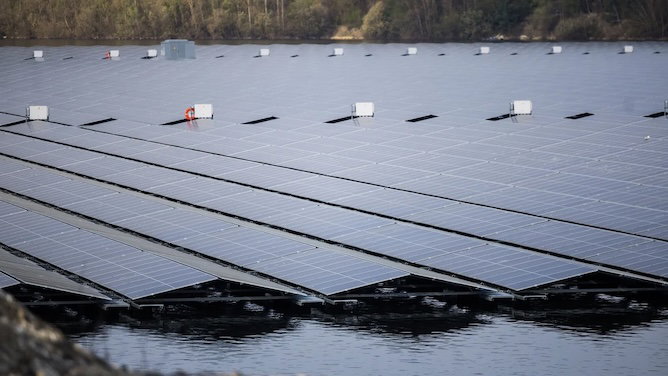
The scale of future requirements is apparent at Obourg, where Holcim’s 31MW floating solar installation produces around 30GWh annually. Despite its size, it is expected to cover only up to 15 per cent of GO4ZERO CCS project power needs by 2030.
Curiously, nuclear power receives no mention in the report, although Vicat and Lafarge France signed Nuclear Production Allocation Contracts with EDF in 2025. Federbeton has agreed to explore newcleo’s modular nuclear technology, while Cementir has invested in the developer. Nuclear procurement is therefore already part of some producers’ electricity strategies, although the modular-reactor announcements do not yet establish the cost or timetable for supplying a cement works.
Alternative production routes could also reduce the emissions requiring capture. CIMPOR’s electrically melted X-Clinker uses industrial by-products and construction waste, with a company-reported footprint of 350kg CO2e/t using renewable electricity. It remains at development stage, but illustrates how changing feedstocks can address emissions that electrifying conventional limestone-based clinker production would leave behind.
Producers contemplating electric kilns must compare delivered electricity costs, including network charges and taxes, with fuels and carbon costs, while financing conversion. Long-term contracts can improve cost visibility, but the agreed electricity price must still support the operating economics of the new process.
The report calls for affordable renewable electricity without quantifying the additional power or network investment its pathway requires. Nevertheless, momentum and investment into renewable energy projects, particularly solar, is growing while battery storage solutions are gaining credibility. For the low-CAPEX route companies will look towards power-purchase agreements.
Handpicked stories, in your inbox
Our editors pick the top news delivered to your inbox. Sign-up today!