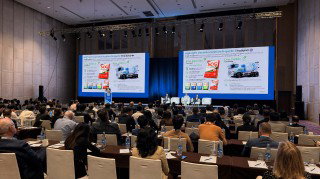
The 22nd Arab International Cement Conference and Exhibition (AICCE22) was held at the International Congress Center, Maritim Jolie Ville, in Sharm El Sheikh, Egypt, between 14-16 November 2017, attended by 450 delegates from over 30 nations. An international exhibition with 119 stands was the main focus of the event, supported by a comprehensive conference programme with 46 presentations dealing in the full range of cement manufacturing technologies.
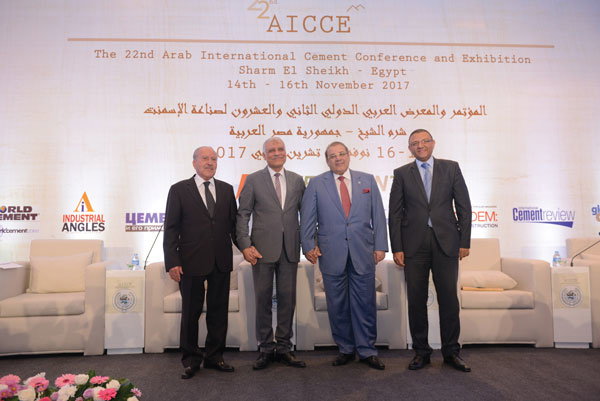
Opening session of AICCE22 in Sharm El Sheikh, Egypt: (left to right) Eng Ahmad Al-Rousan, Secretary General, Arab
Union for Cement and Building Materials (AUCBM); General Mahmoud Mostafa Eissa, General Secretary for South Sinai
Governorate; Dr Hassan Rateb, Vice President of AUCBM and representative of Egypt in the Board of Directors and
Chairman of Sinai Cement Company, and Mr Waleed El Arabi, Housing and Urban Development Executive,
League of Arab States ENVSUSDEV Department
The Arab cement sector in the Middle East and north Africa has faced continuing challenges in 2017, with areas of instability and economic weakness placing pressure on cement demand. Saudi Arabian demand fell 16.5 per cent in the first nine months of 2017 as the country grappled with economic reforms, while Syria and Yemen have seen the industry decimated through war. Egypt has also experienced negative growth in 2017, with demand off by seven per cent in the first half of the year.
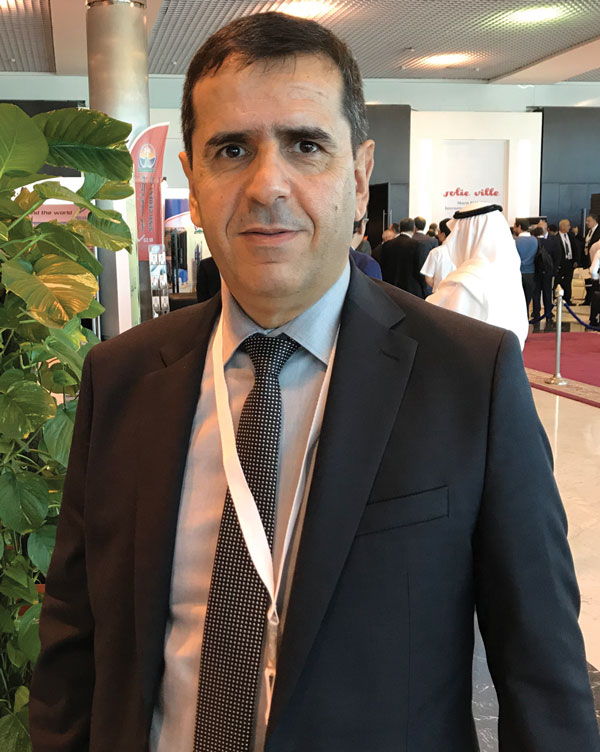
Rabah Guessoum, president director general,
Groupe Industriel des Ciments d’Algérie and
AUCBM Board member, representative of Algeria:
“Algeria is now well positioned to export to Europe and beyond”
In terms of project development and new plant construction, the pace has inevitably slowed. Algeria, which has been busy installing new capacity, is now reaching self-sufficiency and is poised to enter the international markets as an exporter. Speaking on the sidelines of the conference to ICR, Rabah Guessoum, president director general of the state-owned Groupe Industriel des Ciments d’Algérie (GICA), said that Algeria will have a production capacity of 30Mta by 2020 and that the country already has an exportable surplus.
In spite of the slowdown in new plant construction, there are still some important projects underway in the region, including the construction of the new 12.5Mta mega plant at Beni Suef, Egypt, a state-owned enterprise funded by Egypt’s Ministry of Defence. Sinoma CDI (China) is delivering the plant on an EPC basis and will commission the facility, which includes six 6000tpd clinker lines, by the start of 2018. The project is also a major success story for European equipment supply, as it includes 18 Loesche vertical roller mills for raw material, clinker and coal grinding. The impact of this facility, and others that are now under construction, will have consequences and are likely to push Egypt into a period of significant oversupply and intensify competition.
All-in-all, the regional markets are seen to be reaching the bottom of the cycle, and there is hope that renewed economic momentum in the Gulf and north Africa, combined with the prospect of stability and post-war reconstruction of Syria, may see the region’s industry turn around over the course of the next 18 months.
Underlying drivers for regional cement consumption remain positive in the medium and long term. In his address to delegates in the opening session of the meeting, Waleed El Arabi, housing and urban development executive, League of Arab States, argued that housing construction and urban development were strategic priorities for all Arab countries and such trends would positively support the cement industry for years to come.
Providing delegates with an historical perspective of the Egyptian cement sector, Esam Zahran, Sinai Cement Company (Egypt), traced the country’s rapid expansion in cement consumption over the last decade, which saw the market double between 2006 and 2016 to its current level of 56.5Mt. Currently growth is under pressure, with demand weakening in 2017, but the country is expected to re-enter a growth phase from 2019. Domestic supply has expanded at a corresponding rate with domestic capacity expected to reach 83.7Mta by 2018.
Talking technology
Among the 46 topics discussed in the conference programme, vertical roller mill (VRM) grinding technologies received a high level of attention. A series of presentations highlighted the increasing trend towards larger VRMs made possible by a general acceptance of the economic benefits of larger single-mill installations. Carsten Schoessow, FLSmidth (Denmark), quantified the benefits, which he said amount to a 30 per cent lower capex as well as reduced operation costs due to higher energy efficiency. FLSmidth has added the OK mill for raw grinding to its portfolio, which is an evolution from the OK cement mill and will benefit from the new Max maagTM Drive with no maximum power limit.
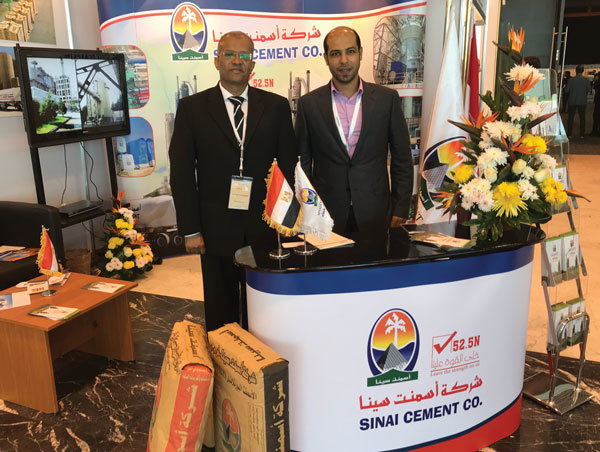
AICCE22 also hosted a 119-stand exhibition where a wide range
of equipment suppliers and producers showcased their products
Roland Martini, Gebr Pfeiffer (Germany), presented experiences of clinker grinding with the company’s largest mill, the MVR 6700 C-6, operating in northern Africa and Brazil, which is equipped with six drives and frequency converters that allow the table speed to be adjusted to suit different finish product requirements.
Dr Mathis Reichert, Loesche (Germany), spoke about the trend to larger VRMs, which offer economies of scale, a smaller physical footprint and active redundancy. In the Loesche 4+4 mill, for example, two rollers can be taken out of operation for maintenance, while the mill can continue operating at 60 per cent capacity.
Several papers were given on the subject of pyroprocessing, with contributions including PM Technologies presenting low-capex solutions for precalciner and cyclone optimisation to improve plant efficiency, while FONS Technology presented the Delta Cooler, which is setting new standards for high-efficiency clinker cooling.
Alternative fuels in focus
In 2016 the government of Egypt approved a plan to encourage increasing the waste used as energy in cement plants to 15 per cent of the fuel mix by 2030. A range of suppliers offered technologies for alternative fuel (AF) utilisation, with KHD Humboldt Wedag presenting key references from its portfolio, including Cemex’s Broceni plant in Latvia, where the preheater is equipped with a Pyroclon combustion chamber enabling the plant to reach high substitution rates of 68 per cent. In addition, KHD has new patented AF technologies which are under installation in Europe, including the Pyrorotor (rotation reactor).
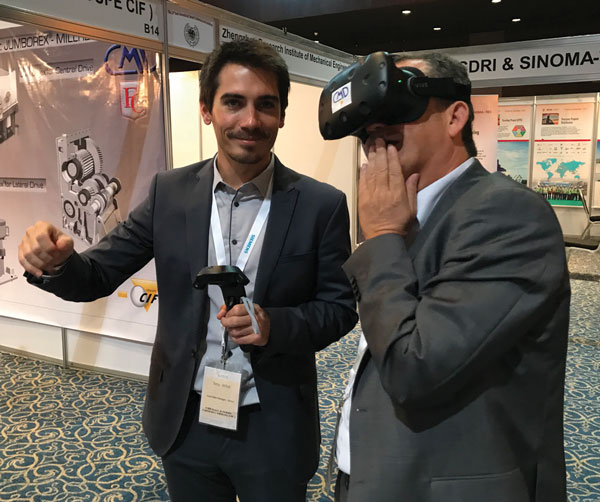
Terry Boudan, CMD Gears (France), using virtual reality
to walk a delegate through its latest product range
Dr Dominik Aufderheide, Di Matteo (Germany), described how a successful solid AF supply chain depends on fully understanding the characteristics of the waste sources so that appropriate waste preparation and dosing equipment can be selected and installed.
Jaleel Mohamed, Mapei (Italy), discussed the impact of burning AF on clinker quality. AF use can increase clinker hardness due to the more compact and coarse silicate structure, thereby increasing grinding time. Grinding aids can be used to increase grindability, or to enhance the strength levels while grinding at a lower fineness.
Bulk technologies
Dr A Haack of thyssenkrupp Industrial Solutions (Germany) unveiled the first ever fully-automated bulk storage system for limestone, gypsum, clay and iron ore. An intelligent radar sensor technology and stockpile management software enable precise, automated stacking and reclaiming as well as highly-accurate inventory control.
Eric Hartman of Haver & Boeker (Germany) outlined the latest developments in packing technology for reducing dust during the packing process, and a new Rotolock design which lowers dust emissions, while a new intelligent aeration system automatically adjusts the level of compressed air, removing the need for manual adjustment by the operator.
Next event
The 23rd Arab International Cement Conference and Exhibition (AICCE23) will be held in Amman, Jordan, in November 2018.
This article was first published in International Cement Review in January 2018.
Handpicked stories, in your inbox
Our editors pick the top news delivered to your inbox. Sign-up today!