Holcim’s decision to acquire a majority stake in Cementos Pacasmayo for US$550m has emerged as one of the most notable cement transactions of the year, surprising some observers given the group’s recent divestments in the sector. However, the move underscores Holcim’s willingness to invest selectively in cement markets where strong fundamentals and strategic alignment support long-term value creation.
Holcim claims the acquisition is consistent with its ‘strategy NextGen growth 2030’, which prioritises profitable expansion in attractive markets while leveraging sustainability leadership. Latin America is a central pillar of this plan, supported by industrialisation trends, population growth, and large-scale infrastructure projects. Holcim is targeting average annual net sales growth of 3–5 per cent.
“The synergetic acquisition of Cementos Pacasmayo is fully in line with our NetGen Growth 2030 strategy to accelerate growth in the attractive Latin American region. This is an opportunity to continue Cementos Pacasmayo’s exceptional legacy, built on its strong performance culture, its deep commitment to its people and its well-regarded brand in Peru,” said Miljan Gutovic, Holcim CEO.
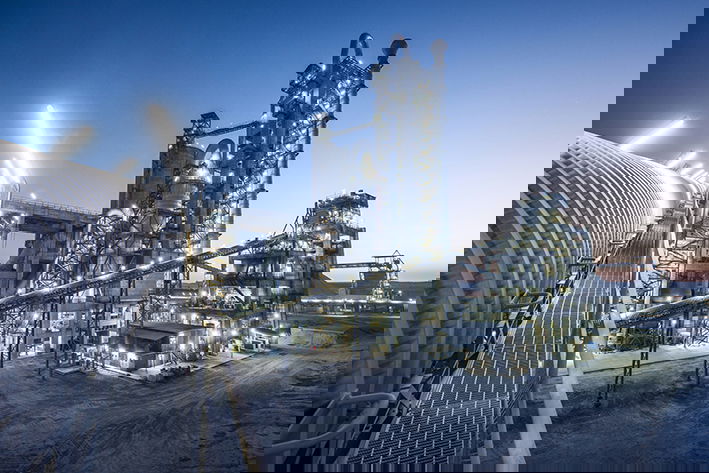
The Pacasmayo acquisition offers Holcim an immediate ~26 per cent market share in Peru’s grey cement market with a strong presence in the north of the country. The Pacasmayo group generates around US$630m of sales with an EBITDA of 28 per cent. It owns three cement plants with 5Mta cement capacity and 28 ready-mix and precast concrete facilities. The 2.9Mta Trujillo cement plant is also being expanded by 0.66Mta of clinker production. The Pacasmayo acquisition comes with an established retail store network called DINO and digital capabilities.
A sensible deal
Analysts broadly welcome the deal. BNP Paribas claims the deal is ‘sensible’ and the terms ‘look sound financially’. The analyst company suggests, “Although US$1.5bn is an apparent lofty premium to Pacasmayo’s market cap (cUS$0.7bn on Bloomberg), the stock is liquid and the 8.8x EV/EBITDA deal multiple is attractive for building materials businesses in this highly profitable region.
Peru is forecast to see a GDP of 2.9 per cent in 2025, according to the IMF. BBVA similarly expect the GDP to expand by 2.7 per cent in 2026. Peru has managed a stable economy despite having had six new presidents since 2025.
Domestic cement production showed a 5.7 per cent YoY rise in October 2025, while cement exports fell by seven per cent over the same period. Cement imports have risen to 157,233t in October 2025, up from 32,000 in October 2024.
The country's attractiveness is also seen in its construction projects. For example, the Majes Siguas II Special Project in southern Peru is still awaiting completion to enhance the agricultural and energy development though a hydroelectric and irrigation project. It awaits a completion date with US$650m having been invested in the phase II project since 2017.
Meanwhile, the Line 2 and 4 Metro de Lima y Callao expansion projects were 72 per cent completed by August 2025 with more than 4200 cement segments to reinforce the drilled underground tunnels.
Growth in Latin America
The Latin American region is clearly a target market where Holcim believes it can increase its portfolio footprint. Net sales in the region for the multinational in the 3Q25 totalled CHF769m (US$966m), behind the CHF914m achieved in Asia, Middle East and Africa and the CHF2231 accumulated in Europe. Other recent building material company acquisitions for Holcim in this region include: Compañia Minera Luren SA (building systems and mortars) in Peru, and Horcrisa (ready-mix) in Argentina. In Peru, Holcim previously acquired Comacsa (white cement and industrial minerals) and Mixercon (cement and ready-mix).
The Peru acquisition appears inconsistent with the company's exit from Brazil. Holcim divested its cement assets in September 2021 to Companhia Siderurgica Nacional (CSN). Presumably the Brazilian market was not deemed sufficiently attractive to Holcim, as it was not the market leader. Votorantim and InterCement had larger market shares, and CSN subsequently elevated itself into the top three cement producers following the Holcim Brasil acquisition. In Peru, Holcim now fits closely behind Unión Andina de Cementos SAA (Unacem), as one of two leading cement producers.
Holcim’s platform strategy
Holcim has been building a platform strategy across the building materials sector globally which has seen divestments mainly in cement and reinvestment in roofing, aggregates, insulation, ready-mix, walling and flooring. The Pacasmayo acquisition tips the trend a little, in being a cement acquisition, but it fits with the group’s strategy of being an attractive market, sustainability in driving profitable growth, expanding its high-value building solutions and in having a decentralised and lean business model for value creation.
Handpicked stories, in your inbox
Our editors pick the top news delivered to your inbox. Sign-up today!