Last week’s launch of Breedon Group’s “Back British Cement” campaign is the latest indication of the growing structural pressure facing the UK cement sector. Breedon’s 2025 results show a broadly resilient performance, but the underlying picture remains challenging: subdued domestic demand, rising import penetration and continued uncertainty over the UK’s Carbon Border Adjustment Mechanism (CBAM).
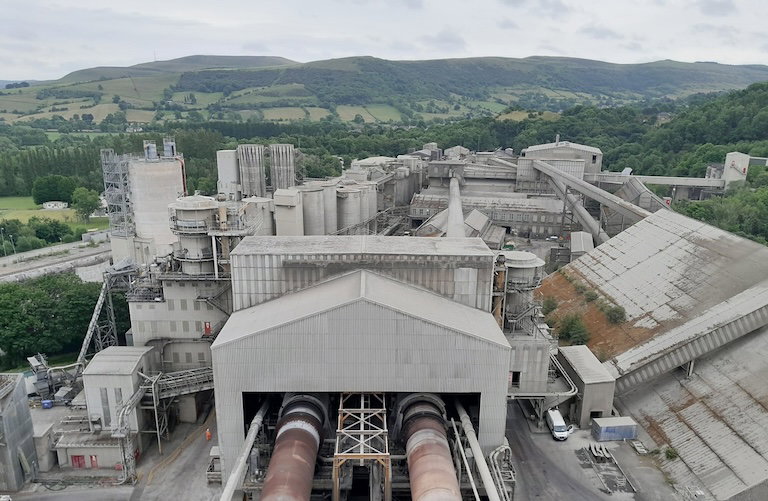
Breedon has already begun to position itself for that transition. At its Hope cement works in Derbyshire, the company is progressing its Alternative Raw Materials (ARM) project, increasing the use of recycled and alternative raw materials in clinker production to reduce process emissions. The scheme also incorporates rail-based logistics, cutting transport emissions, with each train replacing dozens of road deliveries.
According to the Mineral Products Association (MPA), UK cement production fell to 7.3Mt in 2024, the lowest level since 1950, while imports increased from 12 per cent of consumption in 2008 to around 32 per cent in 2024. This reflects a sustained shift in market structure rather than a purely cyclical downturn.
At the same time, the physical configuration of the market is evolving. Recently, ICR visited Holcim UK’s Tilbury Cement Works, due to come online later in 2026. Designed as an import and grinding hub supplying both CEM I and blended cements, the plant reflects a broader trend toward port-based grinding, blending and SCM handling. A full report will follow in a forthcoming edition of ICR. Similar developments elsewhere in the UK reinforce the same shift toward greater import flexibility.
A market tilting toward imports
Although Breedon’s campaign announcement is light on specific targets, the company is participating in the UK government’s CBAM consultation. The mechanism is due to take effect from 1 January 2027, one year after the EU’s full implementation in 2026, creating a potential window for trade diversion.
Current proposals indicate that importers should provide verified emissions data “where possible”, but may otherwise rely on default emissions values. Industry stakeholders have warned that unless these defaults are sufficiently robust, the system risks uneven application and could allow higher-carbon imports to retain a cost advantage.
Breedon has argued that public procurement should support domestically produced cement, particularly for major infrastructure and housing projects. The MPA has also highlighted structurally higher UK industrial electricity costs as a persistent competitive disadvantage.
Decarbonisation limits: SCMs and CCUS
The long-term viability of UK cement production ultimately depends on how far emissions can be reduced. The MPA’s UK Concrete and Cement Industry Roadmap to Beyond Net Zero identifies clinker reduction and supplementary cementitious materials (SCMs) as important levers, but with clear limits. SCM substitution can reduce clinker demand, but supply constraints and performance requirements restrict the extent of substitution across the market.
The roadmap concludes that carbon capture, utilisation and storage (CCUS) will be required to deliver around 60 per cent of total emissions reductions. The UK’s most advanced project is Heidelberg Materials’ planned installation at Padeswood, targeting capture of approximately 800,000t/yr of CO2, alongside the proposed Peak Cluster, which aims to capture around 3Mt/yr.
Even assuming successful deployment of both CCUS and increased SCM use, a material share of UK cement production may remain outside a clearly defined decarbonisation pathway. This challenge is not evenly distributed: while major clusters cover key production hubs, plants located outside emerging CO2 transport networks—particularly in parts of the East Midlands, Yorkshire & Humber, South Wales and Scotland—may face greater uncertainty.
This suggests that a significant minority of UK cement production—potentially on the order of 20–30 per cent—could face structural challenges in decarbonising, reflecting both geographic constraints and limits on SCM availability. If carbon pricing renders clinker production at these sites uneconomic, the resulting shortfall is unlikely to be fully offset by existing or planned CCUS-enabled facilities.
Further consolidation?
In that scenario, further consolidation of UK clinker production appears likely, alongside continued growth in import dependence. Domestic production would persist, but increasingly concentrated around strategically important plants with access to carbon capture infrastructure, while ports expand their role in grinding, blending and handling imported clinker and SCMs.
Calibrating the UK CBAM is therefore a delicate balancing act. Too lenient, it risks accelerating the erosion of domestic production; too aggressive, and it risks increasing construction costs and constraining delivery. Breedon’s campaign ultimately brings the issue back to first principles: if the UK intends to maintain a domestic cement industry, policy must reflect the realities of a hard-to-abate sector.
Without that alignment, “Back British Cement” risks becoming less a rallying cry and more a marker of managed decline.
Handpicked stories, in your inbox
Our editors pick the top news delivered to your inbox. Sign-up today!