This week the European cement association, Cement Europe, released its annual report for 2025. Of immediate concern is the nearly 500 per cent increase in imports from neighbouring countries in the EU since 2016. The report blames this increase on the absence of a level playing field for domestic producers who face rising costs of production, making them less competitive, as well as issues around the implementation of CBAM.
The EU has already stressed, through its Clean Industry Deal, that European industries, especially energy-intensive sectors, face significant challenges due to high energy prices, slow economic growth and fierce international competition. The immediate future for cement in Europe will be determined by the CBAM, the key policy instrument with the ability to ensure a level playing field for EU businesses and the Industrial Accelerator Act, which is designed to boost demand for low-carbon and “Made in Europe” products.
The Cement Action Plan
These challenges have encouraged Cement Europe to develop its Cement Action Plan, which will serve “as the central milestone guiding the association’s outreach in 2026" and "will require a strong mobilisation across associations and companies.”
The plan sets out a concrete pathway to deliver industrial decarbonisation while preserving Europe’s competitiveness. It makes five demands on the EU Commission, which are required if the industry is to continue to succeed, namely: a predictable EU ETS, a watertight CBAM, including an export solution, access to CO2 infrastructure for carbon capture, competitive energy and the creation of demand for low-carbon cements through a lead market.
Furthermore, Europe Cement’s Working Group argues that the planned revision of the EU ETS for the post-2030 period (Phase V) represents a key opportunity. “Maintaining the ETS framework must go hand in hand with ensuring the availability of allowances beyond 2039,” says the group.
Industry data
Across Cement Europe members, cement consumption declined from 167.5Mt in 2023 to 165.1Mt in 2024, and cement consumption in the EU27 in 2024 fell by 1.3Mt to 148.1Mt, with significant differences across national markets. Whereas the combined regional decline in cement consumption reached around eight per cent between 2023 and 2024, the contraction moderates to approximately one per cent between 2024 and 2025, indicating early signs of stabilisation.
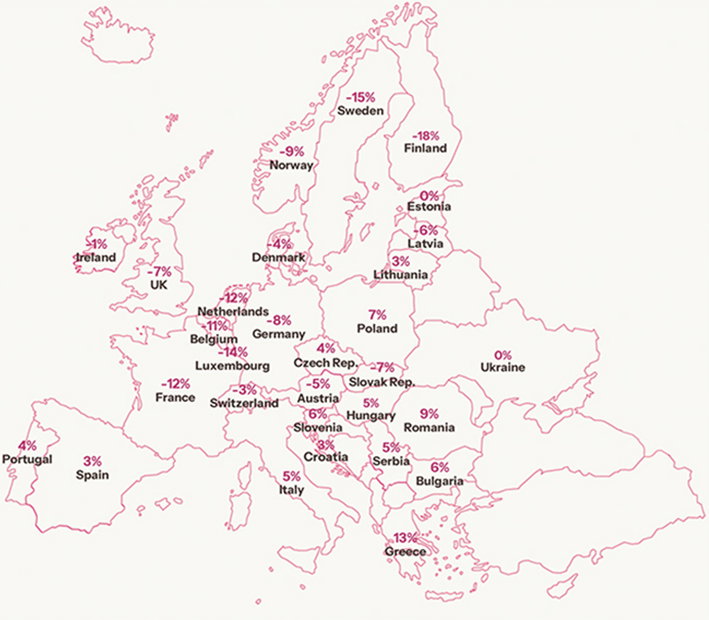
The biggest cement consumption declines between 2023 and 2024 were in Finland (-18 per cent), Sweden (-15 per cent) Luxembourg (-14 per cent), Greece (-13 per cent), and France (-12 per cent). The largest growth areas for cement consumption included Romania (nine per cent), Poland (seven per cent), Bulgaria (six per cent) and Slovenia (six per cent).
In 2024 cement production in the Cement Europe area reached 174.5Mt, down 0.5 per cent or 924,000t YoY, while EU27 production stood at 160.8Mt (-0.2 per cent YoY), reflecting a slowdown in the pace of contraction.
The number of employees in Europe’s cement sector in 2024 totalled 40,603 (Cement Europe members) and 36,530 in the EU27.
The areas where the European cement sector can monitor its performance are across the level of imports, thermal energy and alternative fuel use and CO2 emissions. In 2025 the countries receiving the highest rise in imports since 2016 were: Spain (2822 per cent), Italy (1747 per cent) and Greece (1535 per cent).
Thermal energy from alternative fuels in the EU’s cement sector rose from 30 per cent in 2010 to 58 per cent in 2022 but fell to 56 per cent in 2023. In addition to the 44 per cent share of conventional fuels, non-recyclable waste accounted for 34 per cent while bio-waste accounted for 22 per cent.
Between 1990 and 2023, gross CO2 emissions of grey clinker in the EU27 were reduced by 13 per cent, while net emissions decreased by approximately 24 per cent. For cementitious products, gross emissions per tonne fell by almost 19 per cent, and net emissions by nearly 29 per cent.
Low-carbon cements
The Working Group’s central focus in 2025 was how to turn low-carbon cement from a technical possibility into a market reality. Advocacy towards policymakers, particularly in the context to the Industrial Accelerator Act (IAA), announced under the Clean Industrial Deal, is seen as essential to stimulate demand for low-carbon products. A further enabler is standardisation. This will be revised through the Construction Products Regulation, which is scheduled to be published by the end of 2027. An EU-wide labelling scheme for low-carbon cement is also being proposed by Cement Europe.
Outlook
Cement Europe’s 2025 Statistics report confirms that the region’s cement sector is stabilising after a period of decline, with early signs of recovery across construction markets. Forecasts from Euroconstruct for the EU16 countries indicate cement consumption growth of two per cent in 2025, followed by 3.6 per cent in 2026, 2.7 per cent in 2027 and 1.7 per cent in 2028 across key European markets. But the recovery remains fragile. In addition to the current challenges, decarbonisation projects are expected to scale up in the next few years, which will add further pressure on electricity demand.
Handpicked stories, in your inbox
Our editors pick the top news delivered to your inbox. Sign-up today!