UltraTech Cement’s 1QFY27 results, published recently, underline the growing scale of India’s largest cement producer. Domestic sales volumes increased 13.1 per cent YoY to 39.2Mt, while net sales and profit after tax rose 16 and 17 per cent, respectively. Despite higher fuel costs, operating EBITDA reached INR1214/t (US$12.72)
Performance at its principal challenger was less impressive. Ambuja Cements, the centre of Adani Group’s increasingly integrated cement business, saw profit after tax fall 37 per cent YoY to INR5.04bn, as volumes declined from 18.4Mt to 17.1Mt and EBITDA fell from INR1069/t to INR931/t. Attempts to raise prices in April were partly reversed amid intensified competition.
Results among the second-tier producers have also been mixed. Nuvoco Vistas delivered a strong first quarter, while Dalmia Bharat and JK Cement experienced greater pressure on profitability. The significance of these results extends beyond a single quarter as India enters an unusually aggressive phase of capacity expansion.
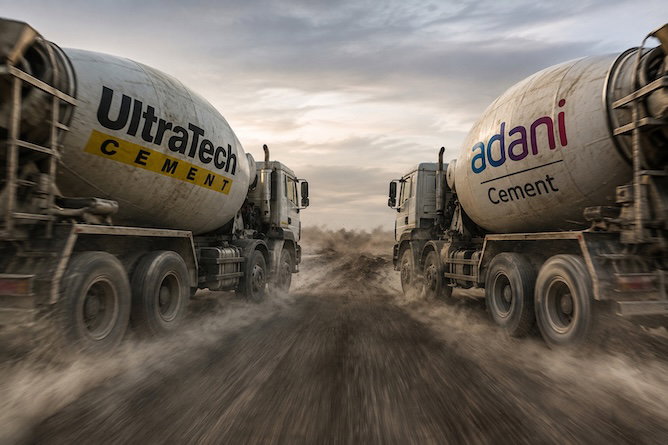
UltraTech has now passed 200Mta of domestic capacity and continues to expand both organically and through acquisition. Adani, meanwhile, has transformed the former Ambuja-ACC business since acquiring it in 2022, adding Sanghi Industries, Penna Cement and Orient Cement. The acquisitions form part of an increasingly intense contest for market share between the two groups.
A decade of consolidation
The transformation is striking when viewed over a decade. In 2016 UltraTech had around 66Mta of capacity, while Ambuja and ACC together operated around 60Mta. By 2021 UltraTech had expanded to around 115Mta, compared with approximately 66Mta for Ambuja and ACC. Today UltraTech and the Adani cement platform control around 200Mta and 109Mta, respectively. Together, the two groups now account for around 309Mta of Indian cement capacity, compared with around 126Mta a decade ago. UltraTech alone has more than tripled its domestic capacity over the period.
Much of the recent consolidation has involved capacity previously controlled by independent or smaller producers. India Cements and Kesoram’s cement operations have been absorbed by UltraTech, while Ambuja has acquired Sanghi, Penna and Orient. Stronger second-tier players, including Shree Cement, Dalmia Bharat and JK Cement, are pursuing expansion programmes of their own, creating the possibility of a self-perpetuating capacity race as companies seek to protect their market positions.
Overcapacity or market-share battle?
India certainly has the demand to justify considerable investment. Cement production reached 480.57Mt in 2025, up 9.8 per cent, according to The Global Cement Report, 16th Edition. The report estimates that growth will moderate to 5-6 per cent in 2026, supported by continued demand from housing and infrastructure.
Yet capacity is expanding sufficiently rapidly to prevent this demand growth from significantly tightening utilisation. In its March sector outlook, ratings agency ICRA estimated that 47-49Mta of capacity would be added in FY26 and another 35-37Mta in FY27. Industry utilisation was forecast to remain around 70-72 per cent.
This does not yet constitute an overcapacity crisis. Continued growth in Indian cement consumption provides considerable scope for new production. Nevertheless, maintaining utilisation at little more than 70 per cent despite strong demand growth suggests that capacity is being added for more than simply satisfying immediate consumption. ICRA itself has identified strengthening market share as one motivation behind the organic and acquisition-led expansion of the major producers.
The danger is particularly apparent for smaller regional producers who don't benefit from the same economies of scale. UltraTech and Adani possess the balance sheets, distribution networks to compete aggressively for volume while continuing to invest. Those advantages become more important when prices are difficult to raise and utilisation remains subdued.
India’s capacity race is steadily intensifying as it reshapes the corporate landscape. In the short term, competition between UltraTech, Adani and an expanding second tier should restrain cement prices. But sustained pressure on utilisation and margins could make smaller independent producers increasingly vulnerable to acquisition.
Handpicked stories, in your inbox
Our editors pick the top news delivered to your inbox. Sign-up today!