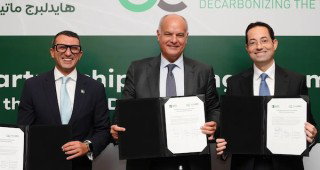
Holcim’s Eco2fly carbon capture project at its Villaluenga de la Sagra cement plant in Toledo, Spain, has taken a further step forward with a new agreement supporting the production of synthetic sustainable aviation fuel (e-SAF).
Developed by Holcim, Eco2fly Power and Exolum, the project is expected to capture around 700,000tpa of CO2 from the cement plant. Approximately half of the captured CO2 will be combined with renewable hydrogen to produce around 100,000tpa of e-SAF, while the remainder will be permanently stored in geological formations.
The project is designed to address process emissions inherent in cement production while establishing a value chain for the utilisation of captured CO2. New facilities will be constructed alongside the Villaluenga de la Sagra plant, with start-up scheduled for 2032.
Eco2fly has now signed a memorandum of understanding with European airline Volotea for the potential supply of e-SAF over a 10-year period from the start of commercial production. Supply is expected to begin at 6.5Ml in 2032, rising to 12-19Ml in 2033-34 and 32Ml annually from 2035.
Eco2fly Project Director, Javier Esteban, said the agreement validates the project’s e-SAF production model and provides further impetus for scaling synthetic fuel production in Spain and Europe.
By combining carbon capture, utilisation and permanent storage, Eco2fly aims to provide a route for reducing emissions from cement manufacture while supplying captured CO2 as a feedstock for the decarbonisation of aviation.
Handpicked stories, in your inbox
Our editors pick the top news delivered to your inbox. Sign-up today!