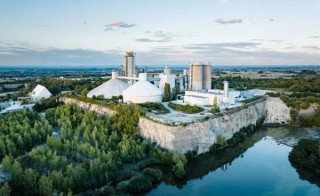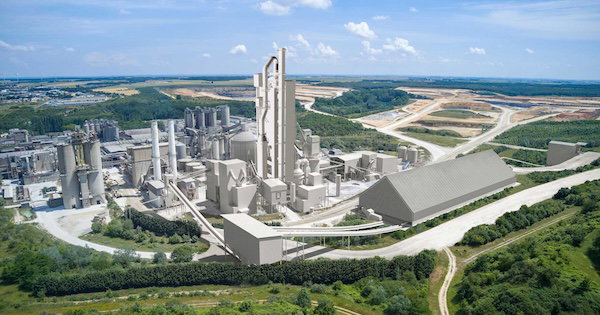
The commissioning of Heidelberg Materials’ new kiln line at its Airvault cement plant in western France marks the completion of one of the largest recent cement modernisation projects in Europe. Located in Nouvelle-Aquitaine, the Airvault plant has historically been one of Heidelberg Materials’ principal French clinker production sites.
Prior to the current project, the plant operated two semi-dry clinker lines dating from the post-war expansion era of the European cement industry. Semi-dry systems, widely installed in Europe between the 1960s and 1980s, consume more thermal energy than modern dry-process precalciner kilns, offer lower alternative fuel flexibility and are increasingly exposed to rising EU ETS carbon costs.
A new state-of the-art line
The Airvault modernisation programme replaces these older lines with a new 1.25Mta dry-process clinker line incorporating a five-stage preheater and precalciner system. Heidelberg expects the project to reduce electricity consumption per tonne of cement by approximately 10 per cent while allowing almost 90 per cent of the plant’s thermal energy demand to be met through alternative fuels.
Combined with lower clinker factors and future calcined clay integration, Heidelberg estimates the modernised plant will reduce the carbon footprint of cement produced at Airvault by almost 30 per cent compared to the previous configuration. The project involved investment of more than EUR350m, rising to over EUR400m when associated decarbonisation works are included.
Heidelberg has confirmed that the programme received support from the French government. The German multinational recently disclosed that the project required approximately 18,000t of steel and 38,000m3 of concrete, with first clinker produced after 1289 days of construction and commissioning activity. The project also reflects wider changes underway within European cement economics, where carbon intensity itself is increasingly becoming a direct cost factor under the EU Emissions Trading System.
AirvaultGOCO2 carbon capture investment
The very chemistry of cement production means that emissions cannot be eliminated through alternative fuels or renewable electricity alone. This explains Heidelberg Materials’ parallel development of AirvaultGOCO2, which is intended to capture approximately 1Mta of CO2 from the plant using large-scale CCUS technology.
Air Liquide will play a central role in this phase of the project. The French industrial gases group is partnering Heidelberg Materials on the design of the carbon capture system and oxygen supply infrastructure required for oxy-combustion technology.
Under oxyfuel combustion, fuel is burned in a high-oxygen environment rather than ordinary air, producing a more concentrated CO2 stream and simplifying downstream capture processes. However, the technology also significantly increases electricity demand because of the energy intensity of oxygen production.
The Air Liquide partnership reflects the extent to which cement decarbonisation projects are increasingly dependent upon wider industrial infrastructure, including gas suppliers, pipeline operators, shipping terminals and storage providers. AirvaultGOCO2 forms part of the wider GOCO2 initiative launched in 2023 to decarbonise western France.
Under the proposed scheme, captured CO2 from Airvault and other industrial sites would be transported via pipeline to Saint-Nazaire on the Atlantic coast. From there, the CO2 would be liquefied and transported by ship to permanent geological storage sites beneath the North Sea.
The Saint-Nazaire infrastructure is emerging as one of France’s principal proposed carbon export hubs. The GOCO2 network is expected to serve multiple industrial emitters, including Heidelberg Materials, Holcim and Lhoist, with transport infrastructure being developed by NaTran, formerly GRTgaz. The wider system remains heavily dependent upon future infrastructure deployment and continued public support.
AirvaultGOCO2 has already secured backing from the EU Innovation Fund, while associated transport infrastructure has also received support through the Connecting Europe Facility programme.
In many respects, Airvault symbolises both the technical progress and the economic complexity now shaping European cement decarbonisation. While the new kiln line materially improves efficiency and reduces emissions, the project’s long-term decarbonisation strategy still depends upon the successful deployment of large-scale CO2 transport and storage infrastructure extending well beyond the cement plant itself.
Handpicked stories, in your inbox
Our editors pick the top news delivered to your inbox. Sign-up today!