China’s cement producers are being squeezed by falling domestic prices. Anhui Conch Cement’s 1H26 cement and clinker sales fell four per cent to 121Mt, but associated revenue declined 16.5 per cent. Attributable profit dropped 41.9 per cent to CNY2.72bn (US$381m).
CNBM reported an even sharper divergence. Cement and clinker volumes remained broadly unchanged at 97.8Mt, but their average selling price fell 16.7 per cent. The group recorded a CNY829m loss, against a CNY1.36bn profit in the 1H25. China Resources Building Materials also swung from a CNY307m profit to a CNY441m loss as revenue declined 15.4 per cent.
Official price data confirm the pressure. Bulk PO42.5 cement averaged CNY249.10/t in mid-August, approximately nine per cent below its early-March level. Meanwhile, as CemNet reported on 20 August, national cement output fell 8.6 per cent to 859.87Mt in January-July, including an 11.6 per cent YoY decline in July.
Diverging strategies
Producers are combining cost reductions and production restraint with two outward-looking strategies.
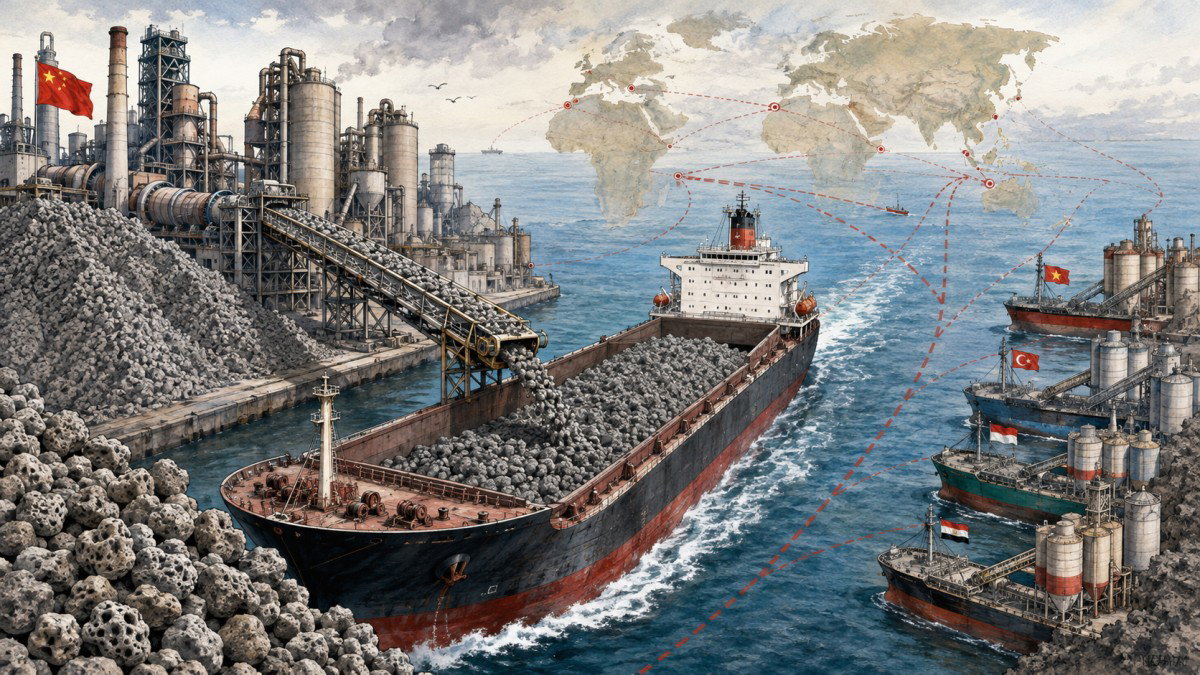
Chinese customs data show that cement and clinker exports reached 15.52Mt in January-July, up 200.5 per cent YoY and already exceeding the 11.71Mt exported during the whole of 2025. More than 70 per cent of the latest shipments comprised clinker.
The second is overseas production. Huaxin Building Materials offers the clearest evidence that this can offset China’s domestic weakness. Its overseas cement and clinker sales increased 57 per cent to 13.18Mt in 1H26, while overseas revenue more than doubled to CNY8.54bn. Overseas capacity has reached 36.15Mta, with the proposed acquisition of Holcim Philippines extending this strategy.
Conch is also increasing exports and overseas investment, while CNBM subsidiary Tianshan Cement reported 57 per cent growth in overseas cement and clinker volumes. The contrast is increasingly between producers exposed to Chinese prices and those able to earn through international assets.
Established suppliers face a new competitor
China remains a relatively small exporter when its enormous production base is considered, but the volumes are already internationally significant. Its seven-month shipments exceed the recent annual clinker exports of established suppliers including Türkiye, Egypt and Algeria.
Chinese clinker is entering Africa, southeast Asia and central Asia—the same markets served by Vietnam, Indonesia, Japan, Türkiye and Middle East exporters. Therefore, excess Chinese capacity could depress FOB prices, displace established suppliers and weaken utilisation at export-oriented plants. Grinding operations are particularly vulnerable because clinker can be redirected between markets more easily than bagged cement.
Facing this new competitor has led to cement producers taking action to protect their domestic production in the face of increasing Chinese imports. Anti-dumping duties require evidence that imports are sold below normal value and injure domestic producers; safeguards can address a damaging import surge without proving dumping. The Philippines’ three-year cement safeguard introduced in 2026 provides a recent model, while its existing anti-dumping measures against Vietnamese cement demonstrate how individual exporters can be targeted.
The EU’s CBAM could provide a different barrier to Chinese exporters: emissions-intensive Chinese clinker will incur a carbon cost unless exporters supply verified plant data and evidence of a carbon price paid at origin. Other markets may instead tighten product standards, increase general tariffs or introduce domestic-content requirements.
Although not yet large enough to reshape global trade, the rapid growth in Chinese exports mean that the country’s cement contraction may become more than merely a domestic problem.
Handpicked stories, in your inbox
Our editors pick the top news delivered to your inbox. Sign-up today!