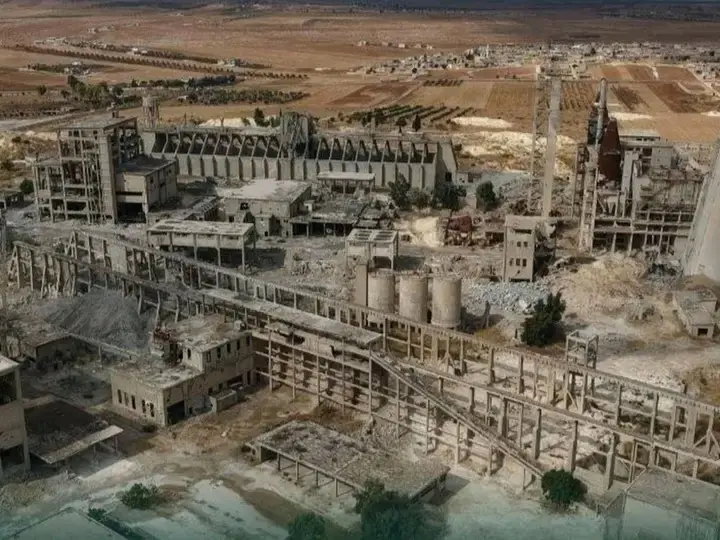
Çimko’s agreement to rebuild the Al-Muslimiyah works near Aleppo, Syria, brings an experienced Turkish producer into a substantial industrial project. However, the test is whether investment commitments can deliver dependable, competitively priced production in a country where restoring equipment is only part of the challenge.
When CemNet examined Saudi investors’ growing involvement in August 2025, the emphasis was on reconstruction demand and the companies positioning themselves to supply it. In May 2026 we highlighted a widening investment pipeline, including Chinese participation. But how much of that pipeline shows signs of translating into productive capacity?
The Aleppo agreement, signed on 1 October, envisages approximately US$200m of investment under a 30-year build-operate-transfer arrangement between Çimko, part of Turkey’s SANKO Holding, and state-owned OMRAN. A new 5000tpd clinker line is targeted for operation within 12 months of site hand-over. According to Syria’s state-owned Syrian Arab News Agency (SANA), rehabilitation of the existing works will begin subsequently, connecting them to the new line, although it is unclear how much surviving equipment remains usable. Çimko identifies eventual capacity of 1.5Mta of clinker and 2Mta of cement, with approximately 200 jobs. OMRAN says the partnership includes training Syrian technical personnel, with domestic supply taking priority over potential exports.
However, the project is not Syria’s largest announced cement investment. As CemNet reported in October 2025, Iraq’s Vertex proposed approximately US$300m for Hama. Its programme would increase the third line’s clinker capacity from 3300tpd to 5000tpd, and then add a new 6000tpd line within five years. OMRAN reported rehabilitation work progressing in March, although the publicly available updates reviewed do not establish its current state of progress.
There is evidence of progress elsewhere in the country. Tartous entered trial production in April following an agreement with the UAE-based QZ Group to rehabilitate and operate its cement mills. At that stage, one mill was running, while engineering studies covered further mill and kiln modernisation. Officials targeted more than 1Mta of cement after the preparatory phase.
Tartous’s 15-year grinding agreement explicitly relies on imported clinker while preserving public ownership of the facility, illustrating the economics shaping recovery. At Adra, grinding of Saudi clinker began in March. Such arrangements can restore cement availability, employment and use of existing assets before domestic kilns are ready, albeit with continued dependence on external clinker suppliers.
Figures presented at a Damascus cement industry press conference in September, under the auspices of the Ministry of Economy, Foreign Trade and Industry, put Syria’s cement consumption in 2025 at approximately 8Mt, against domestic production of 3Mt. Therefore, imports supplied around 5Mt, or 62.5 per cent of demand. At full utilisation, Çimko’s proposed 2Mta cement capacity would equal 40 per cent of that reported import volume.
This illustrates its potential significance, although demand growth, delivered costs and regional distribution will determine how much imported material it actually displaces. Meanwhile, rehabilitated grinding plants offer regional suppliers a continuing clinker market, even if their share of finished-cement deliveries declines.
The SANA's October review recalled OMRAN’s assessment earlier this year that expensive fuel oil made imported clinker cheaper than local production. Reported ex-works cement prices had fallen to US$100-120/t, compared with US$165-170/t previously. Therefore, rehabilitating a kiln will not automatically make its output competitive if fuel, electricity and transport costs remain prohibitive.
The proposed Raqqa plant involving Al-Hassan Holding and Jiangsu Pengfei, announced in April, offers another potential source of modern integrated capacity. However, no subsequent construction milestone has been publicised at this time.
For Aleppo, the immediate questions are practical. What equipment and infrastructure can be reused? How will the new line secure fuel and electricity? What financing, procurement and site-clearance arrangements underpin the ambitious timetable? A modern kiln could improve efficiency substantially, but whether it can be economically feasible will depend on sustained utilisation and affordable inputs.
Handpicked stories, in your inbox
Our editors pick the top news delivered to your inbox. Sign-up today!