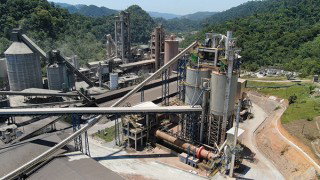
Cimpor raised its first half turnover by 8.3% to EUR1,011.6m, with almost half of the increase, or EUR36.1m, coming from the initial consolidation of the operations in China and India. The EBITDA was negatively affected by higher kiln fuel and electricity costs and lower volumes in Spain and Portugal and declined by 6.0% to EUR279.1m. An 11.0% increase in depreciation and provisions charges led to a 12.2% reduction in the trading profit (EBIT) to EUR190.8m. A jump in the interest charge from EUR35.9m to EUR92.4m produced a 45.9% drop in the pre-tax profit to EUR98.4m. The impact at the net attributable profit level was less severe thanks to a tax credit that limited the reduction in the net attributable profit to 18.6% to EUR107.1m. The net debt at the end of June was 21.8% higher at EUR1.724.3m and the gearing level rose from 76.3% to 100.1%.
Group cement deliveries were boosted by acquisitions and rose by 16.9% to 13.18Mt, in spite of markedly lower volumes on the Iberian peninsula. The turnover from international trading and shipping expanded by 54.2% to EUR21.1m, but the profit contribution from this activity declined by 16.8% to EUR3.1m at the EBITDA level. Shipments of aggregates increased by 2.6%, while ready-mixed concrete deliveries rose by 4.7% and sales of mortar by 7.9%.
The decline in the Portuguese market continued during the first half, but the sentiment in the market appears to have turned and there are expectations of improving volumes for the remainder of the year, after an 8.0% reduction in first half cement sales to 2.88Mt The Portuguese turnover declined by 3.0% to EUR229.1m and the EBITDA by 8.2% to EUR81.7m. In Spain, the reduction was considerably more marked after a prolonged period of strong growth, and the turnover fell by 22.1% to EUR187.1m and the EBITDA dropped by 38.2% to EUR46.4m. Spanish cement volumes were off by 20.9% to 1.63Mt, but in spite of the much weaker construction market, some downstream acquisitions were carried out in Spain.
In Egypt, the completion of the modernisation programme and strong demand led to a 21.2% increase in cement sales to 1.63Mt. The turnover jumped by 41.7% to EUR74.5m and the EBITDA rose by 29.7% to EUR33.2m. Margins were slightly lower at 44.6% and in the period the highest margins in the group were obtained in Morocco at 48.0%. The Moroccan turnover improved by 12.7% to EUR45m while the EBITDA rose by 24.5% to EUR21.6m on cement deliveries that were 4.4% higher at 0.6Mt.
While Brazilian cement deliveries improved by 5.4% to 2.25Mt, prices recovered strongly and turnover in what became Cimpor’s second most important market, as Spain fell from first to third in terms of sales, improved by 26.3% to EUR187.9m. As a result, the EBITDA jumped by 41.4% to EUR45.4m and prices have improved further since June.
In South Africa, cement deliveries rose by 21.6% to 0.79Mt, but the group had to rely to an increasing degree on imported clinker until the commissioning of the new kiln at Simuma, which took place in July. The group also suffered from the near 20% devaluation of the rand, but still managed to produce a 13.0% increase in turnover to EUR64.5m, but the EBITDA declined by 16.5% to EUR16.1m.
Both China and India made their initial first half contributions, with India only included from March. China contributed cement deliveries of 1.43Mt, good for a turnover of EUR25.3m and an EBITDA of EUR3.1m, while India added just 0.22Mt of cement, a turnover of EUR10.8m and an EBITDA of EUR1.0m.