German industrial AI specialist alcemy has launched a new first-of-its-kind AI transformation programme for cement producers, alcemy Foundation Partnership, while unveiling a long-term roadmap towards autonomous cement milling and concrete recipe control, reflecting what it sees as the next stage in the industry's adoption of artificial intelligence.
The Berlin-based company has spent the past eight years developing AI systems that predict cement and concrete quality in real time. By combining laboratory results with production and process data, its software forecasts quality parameters before conventional test results become available, enabling producers to adjust mill settings, clinker substitution rates and concrete recipes continuously rather than relying on periodic laboratory feedback.
The company says its technology is now deployed at 45 cement plants and more than 160 concrete plants in 18 countries, serving producers including Amrize, Buzzi Unicem, Cimpor, CRH, Molins, Titan and Votorantim.
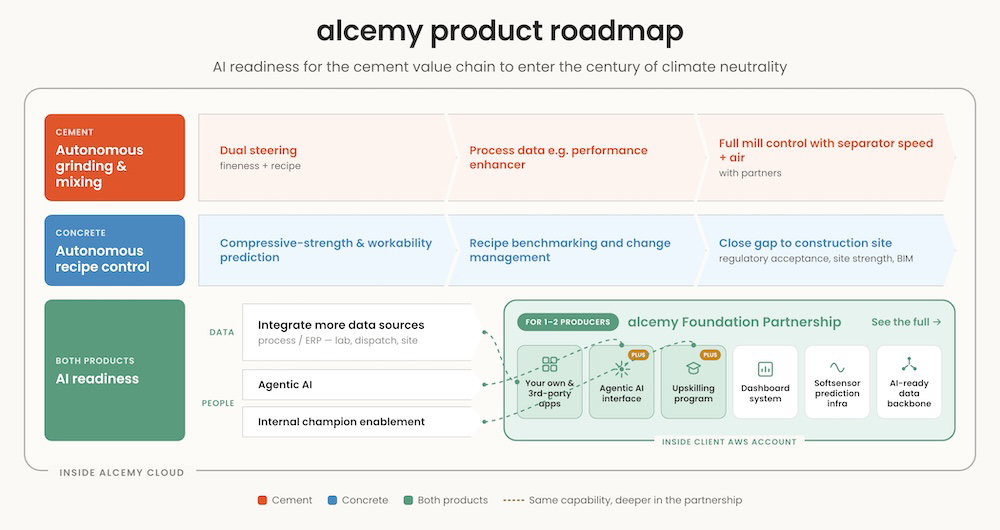
alcemy Product Roadmap (© alcemy)
However, according to CEO Leopold Spenner, recent advances in generative AI have fundamentally altered where the industry's biggest challenges now lie.
"Claude Opus and Anthropic's large language models are incredibly powerful at writing software code," he told International Cement Review. "The question is how can we make this accessible to producers?"
Harmonising plant data for AI
Rather than competing with foundation AI models, alcemy now intends to help producers build the data infrastructure, organisational capability and in-house expertise needed to deploy AI across entire businesses. Mr Spenner said the company had increasingly been approached by customers seeking support not simply for individual AI applications but for harmonising fragmented plant data so that AI systems could be deployed consistently across multiple sites.
The resulting alcemy Foundation Partnership aims to create AI-ready data architectures by integrating information from Programmable Logic Controllers (PLCs), Supervisory Control and Data Acquisition (SCADA) systems, laboratory information management systems (LIMS), SAP, manufacturing execution systems (MES) and plant sensors into producers' own cloud environments.
At the same time, alcemy intends to train internal teams to develop dashboards, manage third-party AI systems and create their own AI applications, reducing long-term dependence on external software providers. Initially, the programme will be offered to only one or two strategic partners from autumn 2026.
"The core tasks of the producer to gain a competitive advantage — harmonising the data and upskilling the people — are not so much addressed with the traditional software-as-a-service model," Mr Spenner said.
Autonomous grinding
Alongside the enterprise offering, alcemy outlined its vision for fully autonomous cement grinding. Building on its existing closed-loop (i.e. completely autonomous) optimisation platform, the company plans to incorporate additional process data, online analysers, strength enhancers and simultaneous optimisation of both fineness and cement recipes, with AI progressively taking responsibility for mill control.
"People become responsible for cleansing the data and making sure the boundaries are set correctly. They supervise the machine-learning system rather than taking active set-point decisions," explained Mr Spenner.
More than one-third of alcemy's cement customers already operate its optimisation software in closed-loop mode, according to the company. Earlier this year, alcemy announced a strategic partnership with ABB to integrate its AI quality prediction technology with ABB's advanced process control and plant information management systems as part of the move towards autonomous mill operation.
The company also announced further development of its concrete platform, which uses continuous monitoring of water additions, consistency and material variability to optimise concrete recipes in real time. alcemy says this could enable reductions in cement content of between 5kg/m3 and 30kg/m3, depending on raw materials, performance requirements and producers' willingness to operate closer to specification limits. Spenner noted that the achievable reductions depend not only on aggregate quality but also on individual producers' tolerance for operational risk.
Looking further ahead, Spenner believes AI will become an increasingly important enabler of cement decarbonisation, both by supporting lower clinker factors and by improving the operational stability required for carbon capture systems.
Handpicked stories, in your inbox
Our editors pick the top news delivered to your inbox. Sign-up today!