Future historians may look back upon 2025 as the year when a new industry paradigm finally emerged, as the EU Emissions Trading System (EU ETS) – launched in 2005 – prepared to move into its definitive stage, while industrial-scale carbon capture was commissioned for the first time.
From 1 January 2026, EU cement industry free carbon allocations will be reduced as the Carbon Border Adjustment Mechanism (CBAM) commences with full financial obligations for importers. This means that cement entering the EU will – at least in theory – be subject to a carbon border tax comparable with the EU’s Emissions Trading System (EU ETS).
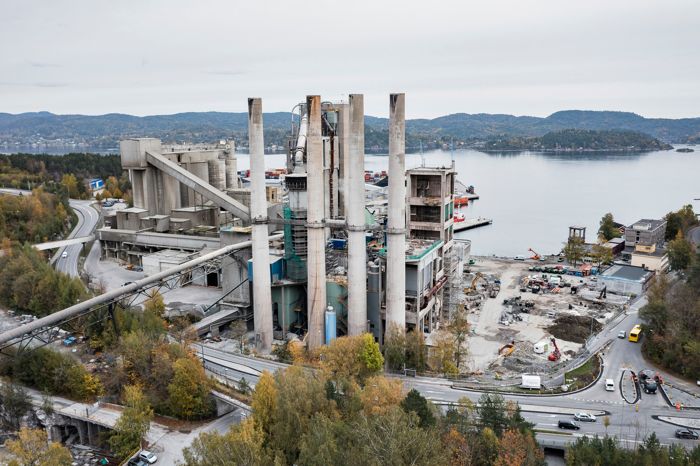
2025 also saw the commissioning of Heidelberg Materials’ landmark carbon capture facility at Brevik, illustrating that long-standing rhetoric is now being backed up by meaningful action, albeit at a very high cost.
Meanwhile, outside of Europe’s regulation-driven market, the United States continued to place greater emphasis on financial incentives to drive carbon reduction.
Elsewhere in emerging markets, where the focus remains firmly on the supply side, India’s rampant capacity expansion continued at pace. Ironically, with the adoption of modern preheaters, high thermal efficiency and integrated waste heat recovery, these new plants are often better positioned to achieve greater efficiencies than the costly retrofitting of legacy infrastructure.
Overall, global demand remained flat, as growth in emerging markets was offset by significant declines in North Asia, and particularly in China, where production fell by 15.8 per cent in the first 10 months of 2025.
January-April
In January 2025, CemNet.com reported that Saudi cement companies received written notifications from Saudi Arabian Oil Co (Aramco) that fuel prices used in cement production were being increased as of 1 January 2025. This affected major producers including Al Jouf Cement, Arabian Cement Co, City Cement Co, Najran Cement Co, Riyadh Cement Co, Southern Province Cement and Umm Al-Qura Cement. Some companies, such as Arabian Cement Co and Najran Cement Co, quantified the impact as roughly a 10 per cent increase in production costs.
February saw growing concern around the newly inaugurated President Trump’s tariff plans, with American Cement Association (ACA) president and CEO, Mike Ireland, warning that the 25 per cent taxing of cement imports from Mexico and Canada could adversely affect energy and national security. The two countries were the primary targets among countries sending cement to the USA, although in the event neither has hitherto been penalised to the scale that was threatened. Other significant cement exporters to the USA, including Greece and Türkiye, also cut deals to secure smaller penalties.
There were developments on the M&A front in March when Italy’s Buzzi SpA acquired a 38 per cent stake in the Dubai-based Gulf Cement Co. The full takeover would finally be completed in October in what CEO Pietro Buzzi described as a strategic alignment built on shared values and innovation.
CBI Ghana commissioned the “world’s largest” limestone calcined clay plant in April, a US$100m facility in the city of Tema. The new facility uses locally sourced raw materials to substitute imported clinker, improving the economics of cement production for a country that lacks limestone and domestic clinker.
Meanwhile, April also saw the Global Cement and Concrete Association India (GCCA India) and The Energy and Resources Institute (TERI) launched a Decarbonisation Roadmap for the Indian Cement Industry aimed at guiding the world’s second-largest cement producer to achieve net-zero CO2 emissions by 2070, complementing the government’s decarbonisation commitments.
May-August
In May, the Portland Cement Association (PCA) announced that it would rebrand as the American Cement Association (ACA), reflecting how US producers have diversified beyond traditional Portland cement into lower-emission products. Speaking at the IEEE-IAS/PCA Cement Conference, president and CEO Mike Ireland said the change recognises the rapid growth of low-carbon cements, which now account for more than 60 per cent of US cement consumption. The move was later echoed in Europe in October, where Cembureau rebranded as Cement Europe.
June saw the official inauguration of the carbon capture facility at Heidelberg Materials’ Brevik plant in southern Norway attended by HRH Crown Prince Haakon of Norway. The facility will capture 0.4Mta of CO2 from Brevik’s cement production process using amine-based carbon capture technology and transport the liquified CO2 via special-purpose ships to Øygarden for injection and permanent storage 2600m under the seabed.
Later in the year, Heidelberg Materials and the British government confirmed a final investment decision to build the world’s first full-scale carbon capture facility for cement production at the company’s Padeswood works in north Wales.
In July, the UK’s Mineral Products Association (MPA) issued a salutary press release after the publication of the British government’s 10-year infrastructure strategy, which promised reforms to procurement aimed at supporting domestic industry. MPA noted that cement imports have more than tripled in the last 20 years due to high industrial energy costs and the UK cement industry was at risk of disappearing.
One of the year’s most notable acquisitions took place in August, when CRH advanced its decarbonisation strategy with the acquisition of Eco Materials Technologies in a US$2.1bn deal. It consolidated the Irish-based firm’s increasingly American profile, securing its long-term access to cementitious materials, notably fly ash, endorsed by projections that the SCM market in the USA will more than double by 2050.
September-December
The year proved to be a busy one for the Nigerian cement industry, with Dangote further expanding its reach, BUA reporting record results and Huaxin Cement completing its acquisition of Lafarge Africa from Holcim. In September, a potential new player emerged when MSM Group announced plans to construct a 12Mta cement plant in Kebbi state at a cost of NGN900bn (US$600m).
In October 2025, International Cement Review reported that Indonesia was poised to become the world’s largest exporter of clinker in 2025, overtaking traditional suppliers as its overseas shipments accelerated strongly year-on-year. According to the Indonesian Cement Association's data, export volumes were being driven by robust demand from key markets.
Meanwhile, Vietnam’s National Cement Association (VNCA) published figures in November indicating that it would shortly overtake the USA as the world’s third-largest cement producer globally. Both countries are major suppliers to the Philippines, where in October the Tariff Commission mandated import duties to help protect the domestic industry.
In November, it was announced that multiple European cement projects secured EU Innovation Fund backing, including large-scale CCUS and low-clinker initiatives led by Heidelberg Materials, among others. The funding decisions reinforced Europe’s strategy of underwriting first-of-a-kind industrial decarbonisation ahead of CBAM’s 2026 implementation.
In December, the most notable development was arguably Holcim’s US$550m investment to acquire a 50.01 per cent holding in Peru’s Cementos Pacasmayo, with the company valued at US$1.5bn overall, including debt. It's an intriguing development, providing Holcim with a foothold in a potentially lucrative market as it continues its expansion in Latin America, in the same year that it divested itself of some of its Nigerian holdings and spun off its North American division as Amrize.
- 2025
- EU Emissions Trading System (EU ETS)
- Carbon Border Adjustment Mechanism
- CBAM
- Saudi Arabia
- Tarrifs
- calcined clay
- Ghana
- CBI Ghana
- India
- American Cement Association
- ACA
- Cement Europe
- Brevik
- Carbon capture
- Heidelberg Materials
- CRH
- Eco Material Technologies
- Nigeria
- BUA Cement
- Huaxin Cement Co
- Trade
- Indonesia
- Vietnam
- Volumes
- Philippines
- Holcim
- Amrize
- Pacasmayo
Handpicked stories, in your inbox
Our editors pick the top news delivered to your inbox. Sign-up today!