
2 September 2026
This transcript was generated automatically and may contain errors.
Hi tos. so good afternoon everyone. this is going to be sort of a analysis. and why, why do we need to transform? the context is already set over the last two days. the lc three technology was born out of a decade and more research between academia Tara and the institute that I belong to develop and alternatives got the job of getting the technology from the lab to the industry which was the hard part of it all because a technology which is in the lab you know has to be scaled out of the lab. And that process and that process took some time. So, just to give you a context that the cement and concrete industry has been changing.
I mean we begin with the pantheon where the first Roman concrete has been seen more than 2000 years. Then we had the age of Portland cement. And the use of fly ash in cement was first reported in 1937, which is about a hundred years back. And then came the age of blended cements. And now we have modern day concrete with a demand of 14 billion cubic meters of concrete which are being produced every you know, every day. And so the demand is quite evident. And the, the, the demand is making the cement production go up to 4.1 billion tons.
the share of the population that is estimated that would live you know, at the, at the time of 2050, is about 68% of all world population will be in the urban areas. And, and therefore, the growth, the cement production growth worldwide would be about 12 to 23% with the establishment of new cement plants. But with the growth and the demand, there would be increasing in emissions. 8% is what is estimated that cement and concrete contribute to the global co2 you know the estimates. And right now, the clinker to cement ratio is about 0.72.
we need to reduce it with every year at least for 1% till the age of till the year of 2030 in order to establish any kind of net zero scenario that the countries are aiming for, that the that the, that the world councils are, are aiming for. So it seems to be the obvious path. And conventionally when we are looking at the resources that we have been talking about within this cement industry, we have been well versed with clinker. We've been well versed with the coal, but the problems with the resources are that with coal future is uncertain because most of the countries in Asia and Africa have actually promised NDC targets which means the nation is going to move towards renewable energy.
Whereas, you know where more and more resources you know, are going to be changing. And that also makes the availability of fly ash very variable. And and if, I mean, you're from the industry, you know very well that the quality and the cost varies quite a lot for fly ash. and of course, the resource like slag is essentially very localized, and it cannot be transported over and beyond where iron and steel industry and cement industry can coexist together. So therefore shortage of conventional resources and this, and hence, you know, coming from development alternatives, we were looking at alternative technologies.
And thanks to this project of lc three, we started looking at alternative technologies. So if you look at if you, if you look at the technologies that are there at the bottom from this McKinsey report this is what the innovation landscape looks like. and if you are actually calculating that, what, what percentage of CO2 emissions in the concrete production process that you can actually address, then 90% is in the production of clinker, 5% for cement, and then maybe an added 5% to produce concrete. So therefore, clinker replacements made from widely available materials will become imminent, isn't it?
And, and, and if you look at classic supplementary cement issues, materials then fly as, and slag are only 15% of the current cement production, and this will drop to less than 10%. What are, what are we really left with? the only material really potential available in viable quantities is calcine clay and multiple reports I'll be showing for the same. So, what is lc three? Just for the ones who are who not aware it's called limestone calcine clay cement. Essentially, you're replacing 45% of the basic clinker ratio. and you're placing it with 30% calcine, clay, and limestone. Two is to one, this ratio can change depending on where you are and what kind of materials you're dealing with.
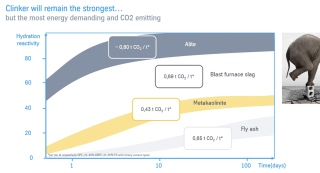
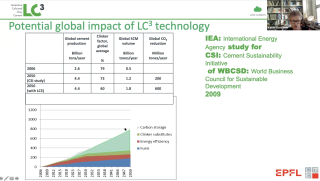
And essentially, why L lc three, it is carbon friendly. It is cost saving. It is also giving us better properties in theory than Portland cement. And so, moving on if you imagine the bag of lc three versus the bag of O O P C or S one we basically have this replacement, which contributes to the, to the, to the saving of co2, because you're not only burning you're, you're not only burning less clinker, but you're burning the calcine clay at a lower temperature of 800 degrees Celsius. So vis Avis a 795 CO2 equivalent in O P C, you get only a 5 65 equivalent in calcine clay cement.
So so at least roughly 40% of CO2 savings, sorry 30 40% of CO2 savings, which can easily, if 8% is the total carbon contribution of the cement world. And then 40% is about 2% of all global emissions can be addressed if, if of course, implemented worldwide. And so, the big question because I am a geologist, I'm a misfit in this world of engineers and cement professionals but I come from the background of clays. And where are the clays? Well, multiple sources, literature, and your geological friends will tell you that pretty much wherever you have the hot and humid climate, which is the temperate and the tropics, and we can also come down to Southeast Asia we see that there is kee present.
This is the mineral that essentially gives the reactivity properties of calcine clay. And when we are looking even further to a recent paper by 2019, we are looking at kee percentage within the particular areas. And this is what our research at Tara has brought out, that the entire Southeast Asia is quite rich with it. And hence we developed a special purpose vehicle within the organization, and we call it the Tara Applied Research Center. Our responsibility is not to provide cal signers or bucket elevators in this case, we are basically deploying lc three to the industry by carrying out some basic feasibility service.
we check it in, in, in phases, and we help you adapt this technology you know, step by step. So we begin with a GIS map where using satellite imagery, we can easily find out which areas are, are clay intensive. and of course since logistics has a huge role to play, not only in cost as well as in carbon, we need to find the clays, which are very close to your units, to your manufacturing plants, because then it'll make business sense. Once we've narrowed down we, we have a team of geologists who go on the ground and search for this raw material. See we don't really would like to advise or suggest the cement industry on limestone. So we stay away from that.
And this is the resource we are looking at. And to find the right one is quite a task. But and that's how we go about it. And to, to whoever who, to, whoever, you know, we have been meeting and, and people ask that you know, is clear available, is it nearby a cement plant? So here is an image in India. I cannot disclose the location, but you see in the background, there is a cement plant, and this is the clay mine. And for this cement plant, s e three becomes a very big, very, very profitable business scenario, because it is just at the backyard of the plant. And I can show you plenty of more mines that at least in India that we have found out. And of course, in countries all over.
And you could use the best part is you could use red clays, yellow clays, white clays and a and a wide variety of clays, which means that they're quite available. Now, why are we looking at picks here? by the way most of the high carbonite clay is not used you know is not used here in cement industry. Traditionally, they have been used by the ceramic industry. They have been used by the tiles industry and the paint industry. So essentially, you also have a circular economic model here where you can use the waste clay or the low grade clay, or the non-commercial gr grade clay that the mines have left behind, and essentially getting it inside the supply chain and into the cementitious world.
So, for example, we did a reserve of estimate. the numbers can change, but for like a place near or rajistan, we easily have about a 1000 million tons or even a 10,000 million tons clearly deposits which of course they're not individual mines. They're wide areas, but you could divide them and start looking at clays. So this is what we do at Thra. we are specialist in this tic Clay. As you can see. we we basically characterize these clays, and we bring them to to a point where the cement world understands it, knows how to use it, knows in what temperature it has to be calcine. And hence, we also lead on to go and help them into pilot scale trials within their own plant.
And we also have a, a pilot scale rotary cals signer, where we can do like small scale trials on lc three. So Tara has been doing this for like about a seven or eight years now. and the first lc three house was built in the world, was built within the Tara campus. And this house we, we keep checking it every year because the technology is new. So we keep taking course of the, of the building to see how is it performing with this you know, normal cement. we also have a picture here from the Southern India. These are one ton, 1.5 tons. tetrapods they have been made by L L N t a concrete manufacturer in India. And and our partners, IT address has basically formulated the design.
These are the breakwater structures of a nuclear power plant, which is located at the coast. And essentially, because lc three is made out of fine materials, it becomes you know resistant and more you know, like more resistant to the waves with the wave action. And in the, and hence very important for the coastal structures. We have the Swiss Embassy in New Delhi built with lc three because the Swiss had supported and funded the initial project. And we have multiple demonstration structures now up in India where one can see how, how the cement is performing. So, of course, this is the big news. this is the month where where Indian standards of L CT has finally been published.
They have got code in its all because the Ian standards came in, the ASTM standards had come in, but India doesn't follow really any of those standards. They have the standards of their own with a lot of push from the government, from the policy, from the civil society, as well as the cement manufacturers at the helm. you know it is good news for India and Indian cement manufacturers that now they can sell the lc three that they have been testing so far. Whatever lc three they were producing in the pilot, they were, they were basically using it to make their own guardhouse and their boundary walls, because you cannot put it into a bag and sell it. while the performance they were quite happy.
And now we are in 19 countries with individual seven companies helping them take on the lc. Three. Just give you a context on Nepal. you know, I think, I don't think we have been speaking about Nepal quite a lot in this conference. But just to note that the price of cement is quite high in Nepal, probably the highest, about one 20 and one 30 dollars per million per per metric ton of O P C, which means that for lc three this becomes a very important thing because it has to import most of its PO and materials from India. Also, the mountainous region has a lot of logistics cost, and and hence speaking from the Indian perspective, I think lc three makes great business sense.
So we did quite a, a lot of cost, cost comparison. If you, if you take all the resources and you and you basically put them into the, you know, very basic kind of a calculation of the O P C, PPC and the lc three, you easily get a reduction in CO2 of around 35.29%, and a reduction of dollars of up, of, up to $40 per ton which is also profitable and good enough probably for the industry to take take on. And the Asian context in Bangladesh is also pretty pretty amazing for something like lc three, because Bangladesh doesn't have any clinker or units. It imports its linker from everywhere and fly ash from India, and therefore it could do well within the country to find out more about lc three.
Even the Middle East is now not, not because they don't have limestone, they have plenty of it, but the carbon pressure the carbon targets that they have all taken it has also come quite strongly in the, in the culture. So that's just summarizing that. L C three is low carbon. so it saves about 40% of CO2 compared to your traditional SEM one or O P C. It's can help and fa therefore being a great lever of, of reducing one to 2% of CO2 emission. And then of course, it's resource savings. So it fits into your circular economy where it is using the limestone low grade limestone it's using the low grade clay that has been left over by the other industry.
performance is more or less, and, and even better in some cases than O P C, it can definitely serve global demand that is rising, and it is still scalable. and it can be applied like can be applied from at least to the global south. L C three can be used just as o pc. So there's no special training on the ground that, that the market would be demanding of it. and hence I think it is a ready to be implemented effort. So it's a feasible solution for both climate protection and development efforts and therefore and imminent and imminent transition. And, and, and why there is no alternative to a material like cement. And therefore we have to continue to produce cement, I think.
And, and, and therefore, we have to find out ways and means to do that. policy makers are now helping us to change the framework, like the policy of the standards coming out in India was, is, is a big I think a milestone. And like we discussed for Vietnam and other countries, as long as incentives and carbon tax and all, all these carbon mechanisms come into place, I think it will, it will create a lot of market for this new technology. That's all from my side. we'll be happy to answer any question or any kind of feedback that you would like to share. Feel free to mail us. Yeah, thank You. Thank you very much.
Video library
Browse 410 conference presentations, webinars, interviews and technical films from the modern CemNet video archive.
410 videos
2 September 2026

1 July 2026

1 July 2026

30 June 2026

30 June 2026

30 June 2026

30 June 2026

30 June 2026

30 June 2026

30 June 2026

30 June 2026

3 June 2026

13 May 2026
9 April 2026

1 April 2026

4 March 2026

27 February 2026

27 February 2026

27 February 2026

27 February 2026

27 February 2026

27 February 2026

17 February 2026

11 February 2026

7 January 2026

3 December 2025

5 November 2025

16 October 2025

8 October 2025

3 September 2025

2 July 2025

4 June 2025

7 May 2025

2 April 2025

18 March 2025

18 March 2025

5 March 2025
3 March 2025

5 February 2025

8 January 2025

4 December 2024

13 November 2024

6 November 2024

9 October 2024

4 September 2024

3 July 2024
10 June 2024

5 June 2024

8 May 2024

23 April 2024

23 April 2024

23 April 2024

23 April 2024

23 April 2024

22 April 2024

22 April 2024

16 April 2024

16 April 2024
11 April 2024

3 April 2024

11 March 2024

6 March 2024

7 February 2024

10 January 2024

10 January 2024
10 January 2024

6 December 2023

1 November 2023

4 October 2023
15 July 2023

15 July 2023

15 July 2023

15 July 2023

13 July 2023

24 March 2023
14 July 2022

13 July 2022
12 July 2022
12 July 2022
12 July 2022
12 July 2022
12 July 2022
12 July 2022
12 July 2022
12 July 2022
12 July 2022
12 July 2022
12 July 2022
12 July 2022
12 July 2022
12 July 2022
12 July 2022
11 July 2022
11 July 2022
11 July 2022
11 July 2022
11 July 2022
11 July 2022
11 July 2022
11 July 2022
11 July 2022
11 July 2022
11 July 2022
11 July 2022
11 July 2022
11 July 2022
11 July 2022
11 July 2022
11 July 2022
11 July 2022
11 July 2022
11 July 2022
11 July 2022
11 July 2022
11 July 2022
11 July 2022

6 July 2022
1 July 2022
1 July 2022

8 June 2022

12 February 2021
12 February 2021
12 February 2021
12 February 2021
12 February 2021

12 February 2021
12 February 2021
12 February 2021
25 September 2020
25 September 2020
25 September 2020
25 September 2020
23 September 2020
22 September 2020
22 September 2020
21 September 2020
20 February 2020
10 February 2020
10 February 2020
10 February 2020
7 February 2020
27 January 2020
23 January 2020
23 January 2020
23 January 2020
23 January 2020
2 May 2019
30 April 2019
18 April 2019
18 April 2019
18 April 2019
12 April 2019
12 April 2019
11 April 2019
10 April 2019
10 April 2019
10 April 2019
9 April 2019
9 April 2019
4 February 2019
17 January 2019
31 July 2018
31 July 2018
31 July 2018
27 July 2018
27 July 2018
27 July 2018
27 July 2018
27 July 2018
27 July 2018
27 July 2018
27 July 2018
27 July 2018
27 July 2018
25 July 2018
25 July 2018
25 July 2018
24 July 2018
24 July 2018
24 July 2018
23 July 2018
23 July 2018
23 July 2018
20 July 2018
20 July 2018
20 July 2018
20 July 2018
20 July 2018
20 July 2018
20 July 2018
20 July 2018
20 July 2018
20 July 2018
20 July 2018
20 July 2018
20 July 2018
20 July 2018
20 July 2018
20 July 2018
20 July 2018
20 July 2018
20 July 2018
19 July 2018
19 July 2018
19 July 2018
19 July 2018
19 July 2018
23 March 2018
23 March 2018
23 March 2018
23 March 2018
23 March 2018
23 March 2018
23 March 2018
23 March 2018
23 March 2018
23 March 2018
23 March 2018
23 March 2018
23 March 2018
23 March 2018
23 March 2018
22 March 2018
26 October 2017
26 October 2017
26 October 2017
26 October 2017
14 August 2017
14 August 2017
14 August 2017
14 August 2017
14 August 2017
14 August 2017
14 August 2017
14 August 2017
14 August 2017
14 August 2017
14 August 2017
14 August 2017
14 August 2017
14 August 2017
18 July 2017
18 July 2017
18 July 2017
16 June 2017
16 June 2017
16 June 2017
16 June 2017
16 June 2017
14 February 2017
14 February 2017
14 February 2017
14 February 2017
14 February 2017
14 February 2017
14 February 2017
14 February 2017
14 February 2017
14 February 2017
13 February 2017
13 February 2017
13 February 2017
19 January 2017
19 January 2017
17 January 2017
17 January 2017
17 January 2017
6 January 2017
18 August 2016
18 August 2016
18 August 2016
18 August 2016
17 August 2016
17 August 2016
17 August 2016
16 August 2016
16 August 2016
16 August 2016
12 August 2016
12 August 2016
12 August 2016
11 August 2016
11 August 2016
11 August 2016
10 August 2016
10 August 2016
10 August 2016
8 August 2016
8 August 2016
8 August 2016
6 May 2016
6 May 2016
6 May 2016
6 May 2016
6 May 2016
6 May 2016
6 May 2016
6 May 2016
6 May 2016
6 May 2016
6 May 2016
6 May 2016
6 May 2016
6 May 2016
6 May 2016
6 May 2016
6 May 2016
6 May 2016
6 May 2016
6 May 2016
6 May 2016
25 April 2016
25 April 2016
11 March 2016
11 March 2016
11 March 2016
11 March 2016
11 March 2016
11 March 2016
11 March 2016
11 March 2016
11 March 2016
11 March 2016
11 March 2016
11 March 2016
11 March 2016
11 March 2016
11 March 2016
11 March 2016
11 March 2016
11 March 2016
11 March 2016
11 March 2016
21 December 2015
15 December 2015
15 December 2015
15 December 2015
15 December 2015
15 December 2015
15 December 2015
15 December 2015
15 December 2015
15 December 2015
15 December 2015
15 December 2015
15 December 2015
2 December 2015
2 December 2015
2 December 2015
2 December 2015
2 December 2015
2 December 2015
2 December 2015
2 December 2015
2 December 2015
2 December 2015
2 December 2015
2 December 2015
21 August 2015
21 August 2015
21 August 2015
21 August 2015
21 August 2015
21 August 2015
21 August 2015
21 August 2015
21 August 2015
21 August 2015
21 August 2015
21 August 2015
21 August 2015
21 August 2015
21 August 2015
21 August 2015
21 August 2015
21 August 2015
21 August 2015
21 August 2015
20 August 2015
20 August 2015
18 August 2015
18 August 2015
18 August 2015
18 August 2015

30 June 2015
29 June 2015
29 June 2015
29 June 2015
29 June 2015
29 June 2015
29 June 2015
29 June 2015
29 June 2015
29 June 2015
29 June 2015
4 June 2015
4 June 2015
2 June 2015
2 June 2015
2 June 2015
2 June 2015
29 May 2015
29 May 2015
28 May 2015
28 May 2015
28 May 2015
18 February 2015
17 February 2015
13 February 2015
13 February 2015
Try searching for another title.