
2 September 2026
This transcript was generated automatically and may contain errors.
Okay. Good morning ladies and gentlemen. It's a great pleasure for me to be part of this important conference with so many delegates on this very specific subject. We're talking about this wave of change that we all feel coming to us. and I'd like now to connect to many of those subjects and topics, which we've listened to in the previous speeches. giving my contribution from the point of view of a technology and equipment suppliers. We've been hearing that about the complexity of this transformation, about the connections to social systems, political systems, the ecosystems, business models, all that is very complex.
but coming back to air comms one of air comms statements about the limiting factors and the barriers one of that was technology. In my point of view, this is not a barrier. technology may not be ready for solving every challenge and every objective, but there is more technological solution available today for getting started in our way into this transformation process. We will have to develop new technologies along the way, but there's enough tech technological solution available already today to get going. So my subject today is technologies and solutions for the transformation of the cement industry. And I hope I am able to use this remote control correctly.
So, starting off not to scare everybody, but to, you know, give the environment and the picture the background against which we are discussing all this. What you see here is the results of the most recent models that have been set up and used for simulating what's happening to the change of the average temperature average global temperature in certain scenarios. And you see, these are new type of scenarios that have been developed for the second assessment report of the IPCC. these models now include also the social response of the societies in all those different scenarios.
And cutting a long story short, you can see that there is only two scenarios, the yellow one and the green one that are able to develop the temperature increase into a plateau, so to stop the ever increasing temperature increase. And those are the two scenarios targeting at the 1.5 or two degrees target of the Paris Agreement. And if we don't get it right, and if we don't do what is necessary in order to limit the temperature growth to 1.5 or two degrees, we will end up with scenarios of three degrees, four degrees, five degrees, seven degrees. And if you read the IPCC report, you will see the consequences.
And everybody knows about the, the, the terrible draws and floods and extreme weather events. and still we feel some hesitation to get going because maybe we think, well, okay, I'm not directly inflicted by this flooding. I'm not inflicted by the drought. maybe you'll get lucky you maybe this drought and this flooding doesn't hit you. But what will hit you, what will hit all of us, is the economical effect of it. Because the cost of living in a three degrees plus heated up world is many, many, many magnitudes more expensive than spending any euro we can spend today and trying to get the 1.5 degrees covered. So that is something that is urgently necessary.
And that has been stated many times by many organizations. The International Energy Agency has issued a report recently that it is still possible to solve that, but we need to get going. Alright? So it is urgently needed and everybody has to contribute. Now, I don't want to scare you with this statement. Let me, let me tell you that the situation is challenging but is not hopeless. And it isn't necessarily bad because if you look at this diagram, it shows the embodied energy and the embodied carbon dioxide for building materials. And what you see is that concrete and cement are the building materials with the lowest embodied energy and the lowest embodied carbon.
So the product we are producing in this industry is eco-friendly. It's actually the most eco-friendly material building material we can think of. Many people are discussing to substitute concrete with wood. That may be possible to very small certain degree, but it doesn't help because the embedded embodied carbon is much higher than in concrete. The problem in the cement and concrete industry is arising only because we are producing such a magnitude, such a mass of product. That's why we are responsible for 8%. The product itself is eco-friendly. So what it, what does it tell us?
It tells us that there will be no future without cement, but we have to get on the way of lowering our CO2 footprint and to decarbonize our industry. You know, all this, this is the GCCA roadmap covering the complete value stream from cement to concrete and building materials. And this has been published about one and a half years ago or two years ago. And it shows the several areas of action we have to look at. this is one of many roadmaps available. We've seen a specific roadmap, for example, from Lemac. Every big cement producer has his roadmap. Every cement association has its roadmap. The international energy agency has its roadmap.
They, they are differing a little bit in some details, but on, on the, on the big scale, they're all providing the same message. And the message here is that we have savings in clinker production. We have savings in cement and binders, and we have savings in carbon capture, utilization and storage. This is the upper band of this block diagram, and that is dealing with what we are dealing with in the cement industry. The lower part of that deals with concrete building, building projects and efficiency in design and construction. So what we are interested in is the upper scale, which is dealing with cement. And that's what I'd like to focus on.
Alright, so I'll try to give you an overview on the technologies which are available today already to get going on lowering your carbon footprint. And you'll see the, those three areas of the GCC roadmap again here in this table. And additionally we've put up a column for emissions, and then you'll see the technologies. I'd like to give you some information about today. I am sure I will not be able to answer all of your questions but I'll give you an overview and maybe we come to a question and answer session. I can give you more detailed information. So let's get started with the roller press. the roller press is good for saving energy and CO2 emissions in communion.
You see a picture of the roller press in a, in a typical roller press, grinding plant set up. this is unlike the vertical roller mill, not within one housing. It is consisting of several technological units, which is the roller press by itself. And then we have separators and recirculation pneumatic transport. and finally, product collecting cyclones. this is a proven technology. I'm sure you know it. The roller press. we have sold over 320 pieces so far. we have different grinding surfaces and we have surface life solutions for a lifetime up to $40,000. And KHD is at least has been a clear market leader in HPGS or roller press supplies.
This picture you see here show displaced data from 2020. I'm sure that meanwhile, Chinese suppliers have supplied more roller presses than can KHD has still we have introduced this technology back in 1985. So we've collected a vast amount of experience and know-how to design this machine, which is the most efficient grinding machine. As such, the process of grinding is most effective in this, in embed particle combination technology. Now, I don't need to tell you that there is always ongoing discussion about whether HPGR or vertical roller mills are the most efficient grinding machines and the best grinding machines. And there are arguments pro and con of course.
let me give you some, some results of an investigation that was done by a client of us. And he was grinding slag in one plant with roller press and with vertical roller mill. And what you see in this diagram is what we call the specific grinding work that is necessary at the mill motor and the fineness of the product. And you see that the slack cement ground with the vertical roller mill needed higher power draw at the motor than the slack cement ground with the with the roller press and also the fineness was higher. Why is that? That is because in a vertical roller mill, there is, there is no forcing through the gap.
You know, you, you need to bring the particles between the grinding tools in a roller press. That's a defined process, and the applied pressure is very high. So in this case, at least the grinding in a vertical roller mill was not as effective as in a, in a roller press. I'm not saying this is the case in every case but in, in many cases, that is, and it depends on the individual case, whether the roller press is the better solution than the vertical roller mill. The next argument that is always coming up is what about the product quality? and that relates to the particle size distribution and the roundness of the material produced.
the VDZ has conducted studies on the roundness of the particles produced. and the result you can see here they have compared cement ground in dica roller mills roller press and ball mill over the particle size. and you see the roundness as a factor between zero and one. One means it's a perfect sphere, and zero means it's a flat body. But what you can see is that in all three grinding machines, the roundness of the particle is not far distant. It's not very much different. So these are some arguments that you should keep in mind when talking about grinding processes. The next thing I'd like to give you information on is the py rotor.
The py rotor is a technology that actually KHD has developed already 20 years ago, 20 years ago. Nobody was really interested, But it changes, it changes dramatically. Why that, because you see that at the example of this VDZ roadmap, the German Association of Semi Producers, they have developed two scenarios. One, what they called ambitious reference scenario, which is the least ambitious scenario of the two. And the one is the climate neutrality scenario. This is what is needed to achieve the 1.5. well, the decarbonization of the cement industry. And in both scenarios, you see that we should be looking at a substitution rate of 85% or 95% alternative fuels. And we are far away from that.
In Turkey, we've, we've heard the numbers, it's about eight or 10%. In Europe, we talk about 60%, 65%, and we need to come to 85%. Now, that shouldn't scare us because it's just the other way around. It shows how easy the potential is to be reached. You know, there's a huge region to cover it. It shows that this is the way to go. We have low hanging fruits, but we need to get there. And most of that should be biogenic. So Cage D'S offering for that is the PY rotor. You see it in green here. It's a rotating drum connected to the cin. It is easily retrofittable into each and every plant. We always find a way to to place it. as I said, it was a development 20 years ago.
Nobody wanted to have it because nobody was looking seriously into substitution. But this has changed. Meanwhile, we have sold, I think, 11 pieces of that technology and 10 of that only in the last two and a half years. So we, we see that the markets are looking into this, and they are seeing the advantages of it. And the specific advantage of the pyro rotor is that it is a very robust reactor. why do we still use rotary kilns for clin ization? Because we have partially sticky material. It has been tested many times to produce clinker into, in, in circulating fluid as bad and different type of reactors.
It did never work because you have this centering, you have this partially liquid surface potentially clogging materials. It's the same when you burn alternative fuels. So that's why we get went with this rotary kiln design. and it, you, you can fill all high mass flows of very cause material into this rotor. It has a high retention time there. It does not build coatings, but it decouples the complicated combustion of secondary fuels from the clinker production process. It keeps the difficult combustion of alternative fuels away from the rotary kiln. The materials don't drop into the inlet chamber before they've burnt out because they have a long retention time.
And the feeding fluctuations, which is sometimes really hard technologically to master if you have, you know, bulky materials, s lumpy materials exact dosing, constant dosing is not so easy. If you have direct feet into the Cal Sinai, every fluctuation of the dosing device gets into your carcin. If you have too much, it drops down. If you have too little, your temperature goes down. So that is really a headache with this one, because of its big holdup is not a problem. You, you can use very, very robust and even cheap dosing technologies because the big holdup of the py rotter equalizes that all.
Also, it's good for NOx reduction because what we do, we take tertiary air, feed it through the pyro Roger, and we can also branch off another portion of the tertiary air to feed it into the zaina downstream. So that means we are creating here subec geometric conversion. We are creating here CO2 and carbohydrates to effectively reduce the kiln built NOx. And then finally, we put the final oxidization downstream. So the PY rotor is good for huge mass flow of alternative fuels core size. you don't need much pre-processing. That's especially interesting for countries like Turkey where we learned that the infrastructure of generating RDF is not established yet.
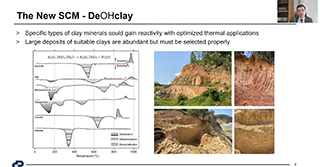
You can feed lump size material into the PY rotor. Interesting, right. The next technology I'd like to talk about, clay, we've heard that also today very important in terms of saving in cement and binders. SCM why is that? These are data from Ms. Kavin, Kavin Rener the inventor and main developer master head of lc three. And I think Hamm also pointed out in his presentation, when we look at the CO2 emissions from regular cement or regular clinker cement with in comparison to clay, we see that clay has four times less CO2 emissions than clinker. And doesn't that go along with a reduction of quality? No, it doesn't. It doesn't.
Here you see the comparison of Portland cement strength development and lc three 50, which means an lc three cement with 50% clinker and catine clay and limestone. And you see that the strength developments are almost comparable. You know, every region has its own norms and standards and, and Calcine, clay and lc three needs to pass all through these quality norms. But this is a huge lever for decarbonization. But you need calcine clay for it. So keine clay can be produced in rotary kilns and in flash ke sinus we offer actually both.
but for new built plants, we favor the flash cal sign because of what, because the flash cal sign allows you to better control retention time and temperature exposure. Because if you overdo retention time or temperature exposure then you turn to maite, Maite doesn't have that hydraulic strength compared to what you want to have. So the, the process we have set up consists of units which KHD has been introducing into the market decades ago, cyclones, flash tubes mixing chambers. So there's nothing new with it. Absolutely nothing new with it. only the way we utilize them. We recirculate gas in order to have, you know, oxygen control, color control all these kind of things that's new.
Other than that, this is all existing technology. We are also integrating alternative fuel reactors into it, which is not always easy, especially it depends on how you treat the gas afterwards. because if you put alternative fuels and you have no subsequent, you know, appropriate gas handling, then all the emissions will be directly at the stack. So we can integrate that into existing kiln lines, for example, and utilize the Preeta as and, and the existing gas cleaning equipment or we can find other ways to decouple the alternative fuel combustion from the calcination process. So that is very individual.
If you are interested in getting more information and maybe talk about certain specific projects, please come to our booth and, and contact us. we'll have a solution for you. Why is that so important? That is so important because clay, as you see here, is besides limestone, the only material reserve that is abundantly available worldwide. So clay is a real substitute to limestone which is different for industrial byproducts like slags or, or ashes or something like that. Especially when we decarbonize the power production. There will be not so many slacks and ashes available in the future, but clay is available and you see the map of the appropriate clay deposits in the world.
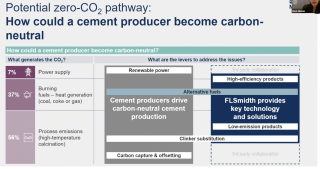
You can see it's, it's available almost everywhere. So calcine clay SCM reducing clink effect in cement is the second important lever for everybody to get working on. besides alternative fuel usage. Alright, the next technology, oxy fuel plant. We've, we've heard that before. There's a huge cost step when we come from reducing our CO2 footprint by reducing the clinker factor and cement and using more alternative fuels. Now the next step is total decarbonization. That's a huge cost step, and that's, that's not necessary in the beginning, but it will have to be necessary down the way. Why that? Again, this is an excerpt from the VDZ roadmap, and it clearly shows we can do a lot of things.
We can do a lot of things to reduce our footprint, but in the end, from 2030 onwards, we have to decarbonize, we have to capture the remaining carbon dioxide emissions from Archons. Full stop is not possible without, how can we do that? We can, of course, install amine scrubbing facilities behind regular cement counts. The only disadvantages, those facilities, they need heat almost as much as you need for the production of clinker. around 2,500 kilojoules per kilogram captured. CO2 is the heat demand for a amine scrubbing plant. So that almost doubles your heat input. That increases your carbon emissions, and then you'll have to capture that carbon additionally.
Again the investment for that is also ranging at around maybe 150 to 200 million with gas cleaning compression and whatever you need, this will be a bridge technology only the next step forward must be to concentrate CO2. So that is easier to capture concentration of CO2. Today we have one technology that is fu oxy fuel means you are recirculating your kiln of gas and put only that amount of oxygen into it, which you need for combustion. In the end, you will achieve recirculating load of gas with say maybe 85% CO2, which you can drag out and capture easy with less capital and opex cost than compared to a regular cement plant off gas with maybe 25% CO2 on something like that.
So what do we need for that? You see the traditional kiln plant here, and then you see a big recirculating loop. we need some gas cleaning, we need some other stuff, desulfurization some other gas cleaning stuff. but then we can take out the highly concentrated CO2 much more easy. What we believe at KHD is, you know, probably that there are proposals around to run an oxy fuel kiln without recirculation. We don't believe that's good, honestly speaking because it's still a cement plant. I mean, you'll have to open and poke and you have to clean and then happens this, and then happens that. So you need to be flexible. You need to be able to run this in pure air mode regular.
And then you switch over into oxy fuel mode by recirculating evermore gas. The second thing we find to be very important is this is retrofittable reputable. We don't believe that you have to necessarily build new cement plants in order to run fure. That would be just another 150 million investment necessarily. We don't believe that. We believe that you can convert your cement plant into an oxy fuel plant. You'll have to retrofit certain ceiling technologies, burner technologies, of course, oxygen source. You'll have to install the recirculation duct and the gas cleaning. Yes, it's still an investment, but it is less investment than building a complete new plant. It's available today.
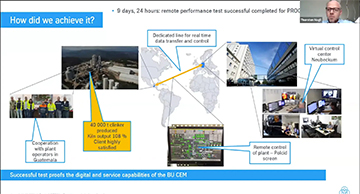
We're having projects and we're quoting and we are very I'm sure that there will be oxy fuel plants within the next two years. None of that is running today. Not a single fu plant is running today. Next thing I'd like to talk about real time optimizers. We've been talking about digital transformation and the necessity and the importance of digitization as an enabler. And we also believe that that's why we have created a product called KHD promax, which stands for productivity maximization. May be easy to, to remember.
this is a general approach, a general idea to create a digital twin of your plant to transfer the data that are either taken from the real plant or partnered up with data from digital twins from artificial intelligence. Put that all together in some digital sphere. And then you can take this digital sphere and do lots of things with it. for example first of all, all those assets, all those machines, all those plants, whatever level you look at, can be connected. You have an assets management, asset management asset monitoring tool for it. You can do your own internal benchmarking and all this kind of stuff.
But really interesting is what we can do in terms of maintenance and production optimization. We can run online real time optimizers for it driven by artificial intelligence plus process and machine knowledge that is very important. We our optimizer does not work on artificial intelligence only. as far as we know, all those project have failed because these, these systems start drifting away after a certain time. You, so you need to implement also process and machine knowledge into it. Our system has two artificial neural networks. One is always ruling, the other one is being reteach, then they are compared.
And the better one is then taking the place of the other one while the, the next one is being reteach again and then quality compared. And all that is hedged around in a sphere of process knowledge and machine knowledge. So our, our system doesn't drift. that is the real time optimizer for current plants and grinding plants. But you can do so many things more about spare time, spare parts logistics lifetime prediction, all these kind of things. So you transfer your real plant into a digital sphere, and then you have access to all the data, including predictions and optimizations. So that is the concept of the promax.
It is also equipped with you know, maintenance tutorials in, in virtual reality or augmented reality. You can get your plant on your mobile phone and walk around at the beach in Haiti and see whether or not the hydraulic pump on your clinker cooler is working or not. So digitization comes with a lot of, you know, possibilities. And I think we have to use them all. The last thing I'd like to mention here, plant modernization. Why do I say that explicitly? I say that explicitly because the cement industry is going to have to invest such a high amount of money that we cannot afford to always build a new thing on it.
We firmly believe that we need to modernize the existing plant population in most of the cases. Maybe sometimes we have to build new plants, yes, but also depends on the region. But lots of these things we believe we can do in, in form of retrofitting and modernization. And we put a focus on that. Summing up Thomas. we have developed our vision for the transformation of the cement industry. And our vision is cement beyond carbon. What does it mean? Cement beyond carbon? Carbon is ruling everything today in our world. and obviously we have to transform our industry into a carbon free era. Latest from 2050 onwards. But we're talking about the 20 years journey, 25 years journey.
Our vision is to help our customers to walk this transformation into a post carbon era. And we've been listening to a very interesting presentation this morning about the future business models. I'm sure we're gonna see a lot of that coming, and I'm sure we have to close the carbon loop. The chemical industry needs to de fossilize. They are not allowed anymore to take carbon from fossil fuels from 2050 onwards. We have too much excess carbon. We have to connect it. We are gonna see a lot of changes coming up and it needs a tight partnership among all stakeholders. And we consider ourselves to be the technological stakeholder in this game.
we want to supply the solutions for you that enable you to walk this walk into the transformation. That's why we have initiated our initiative, initiative cement beyond Carbon because there is no future without cement. Remember the, the, the, the pictures and, and the, the information you got. There is no future without cement. Don't let yourself be fooled by somebody telling you something else. It's, it's impossible. No future without cement, but also know cement without decarbonization. So we have to get going. The cement industry will transform into a future without cement.
Even, even if we're hesitant at these days because we don't have the clear picture and we don't think we have all the information we need in order to make decisions. We are gonna have to, we are going to have to, and we can get going even in small steps today. And KHD will provide those solutions for successful transformation with less fuel and electricity consumption and higher use of alternative fuels and alternative raw materials. And in the end, we'll have to capture and use what is left over as CO2 emissions questions left unanswered. I guess. Yes, I don't know whether we have time now. If not, probably not. We can always meet at our booth. Thank you very much for your attention.
Thank you.
Video library
Browse 410 conference presentations, webinars, interviews and technical films from the modern CemNet video archive.
410 videos
2 September 2026

1 July 2026

1 July 2026

30 June 2026

30 June 2026

30 June 2026

30 June 2026

30 June 2026

30 June 2026

30 June 2026

30 June 2026

3 June 2026

13 May 2026
9 April 2026

1 April 2026

4 March 2026

27 February 2026

27 February 2026

27 February 2026

27 February 2026

27 February 2026

27 February 2026

17 February 2026

11 February 2026

7 January 2026

3 December 2025

5 November 2025

16 October 2025

8 October 2025

3 September 2025

2 July 2025

4 June 2025

7 May 2025

2 April 2025

18 March 2025

18 March 2025

5 March 2025
3 March 2025

5 February 2025

8 January 2025

4 December 2024

13 November 2024

6 November 2024

9 October 2024

4 September 2024

3 July 2024
10 June 2024

5 June 2024

8 May 2024

23 April 2024

23 April 2024

23 April 2024

23 April 2024

23 April 2024

22 April 2024

22 April 2024

16 April 2024

16 April 2024
11 April 2024

3 April 2024

11 March 2024

6 March 2024

7 February 2024

10 January 2024

10 January 2024
10 January 2024

6 December 2023

1 November 2023

4 October 2023
15 July 2023

15 July 2023

15 July 2023

15 July 2023

13 July 2023

24 March 2023
14 July 2022
13 July 2022
12 July 2022
12 July 2022
12 July 2022
12 July 2022
12 July 2022
12 July 2022
12 July 2022
12 July 2022
12 July 2022
12 July 2022
12 July 2022
12 July 2022
12 July 2022
12 July 2022
12 July 2022
11 July 2022
11 July 2022
11 July 2022
11 July 2022
11 July 2022
11 July 2022
11 July 2022
11 July 2022
11 July 2022
11 July 2022
11 July 2022
11 July 2022
11 July 2022
11 July 2022
11 July 2022
11 July 2022
11 July 2022
11 July 2022
11 July 2022
11 July 2022
11 July 2022
11 July 2022
11 July 2022
11 July 2022

6 July 2022
1 July 2022
1 July 2022

8 June 2022
12 February 2021
12 February 2021
12 February 2021
12 February 2021
12 February 2021
12 February 2021
12 February 2021
12 February 2021
25 September 2020
25 September 2020
25 September 2020
25 September 2020
23 September 2020
22 September 2020
22 September 2020
21 September 2020
20 February 2020
10 February 2020
10 February 2020
10 February 2020
7 February 2020
27 January 2020
23 January 2020
23 January 2020
23 January 2020
23 January 2020
2 May 2019
30 April 2019
18 April 2019
18 April 2019
18 April 2019
12 April 2019
12 April 2019
11 April 2019
10 April 2019
10 April 2019
10 April 2019
9 April 2019
9 April 2019
4 February 2019
17 January 2019
31 July 2018
31 July 2018
31 July 2018
27 July 2018
27 July 2018
27 July 2018
27 July 2018
27 July 2018
27 July 2018
27 July 2018
27 July 2018
27 July 2018
27 July 2018
25 July 2018
25 July 2018
25 July 2018
24 July 2018
24 July 2018
24 July 2018
23 July 2018
23 July 2018
23 July 2018
20 July 2018
20 July 2018
20 July 2018
20 July 2018
20 July 2018
20 July 2018
20 July 2018
20 July 2018
20 July 2018
20 July 2018
20 July 2018
20 July 2018
20 July 2018
20 July 2018
20 July 2018
20 July 2018
20 July 2018
20 July 2018
20 July 2018
19 July 2018
19 July 2018
19 July 2018
19 July 2018
19 July 2018
23 March 2018
23 March 2018
23 March 2018
23 March 2018
23 March 2018
23 March 2018
23 March 2018
23 March 2018
23 March 2018
23 March 2018
23 March 2018
23 March 2018
23 March 2018
23 March 2018
23 March 2018
22 March 2018
26 October 2017
26 October 2017
26 October 2017
26 October 2017
14 August 2017
14 August 2017
14 August 2017
14 August 2017
14 August 2017
14 August 2017
14 August 2017
14 August 2017
14 August 2017
14 August 2017
14 August 2017
14 August 2017
14 August 2017
14 August 2017
18 July 2017
18 July 2017
18 July 2017
16 June 2017
16 June 2017
16 June 2017
16 June 2017
16 June 2017
14 February 2017
14 February 2017
14 February 2017
14 February 2017
14 February 2017
14 February 2017
14 February 2017
14 February 2017
14 February 2017
14 February 2017
13 February 2017
13 February 2017
13 February 2017
19 January 2017
19 January 2017
17 January 2017
17 January 2017
17 January 2017
6 January 2017
18 August 2016
18 August 2016
18 August 2016
18 August 2016
17 August 2016
17 August 2016
17 August 2016
16 August 2016
16 August 2016
16 August 2016
12 August 2016
12 August 2016
12 August 2016
11 August 2016
11 August 2016
11 August 2016
10 August 2016
10 August 2016
10 August 2016
8 August 2016
8 August 2016
8 August 2016
6 May 2016
6 May 2016
6 May 2016
6 May 2016
6 May 2016
6 May 2016
6 May 2016
6 May 2016
6 May 2016
6 May 2016
6 May 2016
6 May 2016
6 May 2016
6 May 2016
6 May 2016
6 May 2016
6 May 2016
6 May 2016
6 May 2016
6 May 2016
6 May 2016
25 April 2016
25 April 2016
11 March 2016
11 March 2016
11 March 2016
11 March 2016
11 March 2016
11 March 2016
11 March 2016
11 March 2016
11 March 2016
11 March 2016
11 March 2016
11 March 2016
11 March 2016
11 March 2016
11 March 2016
11 March 2016
11 March 2016
11 March 2016
11 March 2016
11 March 2016
21 December 2015
15 December 2015
15 December 2015
15 December 2015
15 December 2015
15 December 2015
15 December 2015
15 December 2015
15 December 2015
15 December 2015
15 December 2015
15 December 2015
15 December 2015
2 December 2015
2 December 2015
2 December 2015
2 December 2015
2 December 2015
2 December 2015
2 December 2015
2 December 2015
2 December 2015
2 December 2015
2 December 2015
2 December 2015
21 August 2015
21 August 2015
21 August 2015
21 August 2015
21 August 2015
21 August 2015
21 August 2015
21 August 2015
21 August 2015
21 August 2015
21 August 2015
21 August 2015
21 August 2015
21 August 2015
21 August 2015
21 August 2015
21 August 2015
21 August 2015
21 August 2015
21 August 2015
20 August 2015
20 August 2015
18 August 2015
18 August 2015
18 August 2015
18 August 2015

30 June 2015
29 June 2015
29 June 2015
29 June 2015
29 June 2015
29 June 2015
29 June 2015
29 June 2015
29 June 2015
29 June 2015
29 June 2015
4 June 2015
4 June 2015
2 June 2015
2 June 2015
2 June 2015
2 June 2015
29 May 2015
29 May 2015
28 May 2015
28 May 2015
28 May 2015
18 February 2015
17 February 2015
13 February 2015
13 February 2015
Try searching for another title.