
2 September 2026
This transcript was generated automatically and may contain errors.
Please. Thank you very much, Thomas. And yes, I'm very proud because AI is in everybody's mouth these days. And to show here an experience of more than 25 years using these technologies I would like to show you in my presentation and I give this presentation also this title Process Knowledge that creates instruments for AI Control.
If you understand process knowledge is a human gift and engineer's knowledge must be considered also in the today's control concepts working only with mathematical statistical models, process models makes from our experience, and this is also quite long, 55 years, 25 years, no sense the knowledge of the single operator of the single process experts in the plant of the specific mill and kiln must be considered. And we do that. However, control systems are depending on the information they get. So instrumentation plays a major role. We as kema process control, we become famous by developing the electronic ears smart fill for our high level control systems. For mills, that was the first step.
900 of these ball of ball mills are equipped with this electronic ears worldwide. And I would like to show you that huge companies like Holim, Heidelberg, cement and others knock on the door of Keah to ask the research and development company to develop new sensors. And this is my introduction today with our sensors and with our automated control of milks and kilns. Ladies and gentlemen, carbon footprint. We have saved 5.6 million tons since 1996 to 2022, and you can imagine we are very proud about that. Each day, 730 tons of CO2 are just saved by optimized automated control of milks and kilns.
Our products to do that are high sophisticated cooling of your kiln shell, not with air, which is high power consuming, but with a water mist, a product which is called K cooler. And I have given plenty of presentations that during conferences in the world, the smart full electronic ear for ball mills, as I told you will be part at the end of the presentation. Guest temp is one product which is relative new. This product was developed on demand of wholesome in HOL Bank, Switzerland. They asked us to find an alternative for thermocouples and for P two tube and delta P measurements because these measurement principles are too slowly and too sensitive and inaccurate for the cement control.
So finally, of course there's the software Smart Control. We have smart control for the mills and smart control for the kilns with Mill Master and Kiln Master. I would like to announce today already to everybody that these old names, which we have founded together with HOL Sim, we were technology partner of HOL Sim. When we designed the software, these names will be changed. To make clear, there is a complete different product which we as Kema sell today to the mill master and kil master from. So look into the news within the next couple of days there is some name exchange coming, however, ai, artificial intelligence as I introduced already, we have a couple of technologies behind ai.
There's model predictive control, there's non-linear model, predictive control and physi logics. And I thank also Thomas again Armstrong. He has said in the introduction, 2001, I founded the company Power Tech Intelligent Technologies, ladies and gentlemen. In 2002, we controlled the first kiln with non-linear model, predictive control in power tech intelligent technologies. So a huge knowledge using these technologies are behind us. And today I'm very proud to speak about the latest, the kiln master which is the future of of kiln operation for autonomous control.
And here I want to first in the first moment make a big, big difference between that what is happening today general, what is state of the art and that what we do in future, you see that energy flows from clinker cooler to kiln and from kiln to preheated tower are operated in separate control loops. So we speak about three control loops. The problem is if you control single loops, they can start skating. There will be a shift in active and you will see that if you go to your plant today, tomorrow and look into your operate operation, you will always see this skatings, this movements up and down. This is not quality. This so-called coefficients of violence is too high.
This is why we work in a new concept with a entire control loop for all three modules in one controller. And this is only possible when you have, think about the title of my presentation, adequate instrumentation. And this instrumentation means we measure today continuous the gas flow and the temperature punctual wise with a precision of plus minus 1%. Yes, gas flow plus minus 1%. I come to this a little bit later now. When you measure so precisely the gas flows and the process, you can see immediately when there is for instance a change in the heat value of your fuels. If you start with alternative fuels, you need an information. Where is the change in the heating?
Where's the change in the energy input? And which effect does this have into the entire process to avoid the skating effects? Now here we can see now we have the pre heter, we have the kiln and we have the cooler. So all these three modules are in one big controller. And now we measure the gases, we measure tertiary air, we measure secondary air, we measure the down comer, which is here, the exhaust gas. And we measure also the cooler exit. Now you can imagine that this is a very precise analyzation now of nth LP flow, energy flow. This is new and this is with this precision of this sensor. This instruments giving you opportunities to increase productions of kilns between five and 10%.
With this reduction of coefficients of variants and this precise out control, now we see if the kiln gets less fuel and energy from the main burner or from the pre heater burner. Now to measure this, and this is again the content today we designed gas temp and gas temp flow, an acoustic measurement which is measuring gas flows and temperature in very high dust contending gases. And also with changing dust content and with high temperatures up to 1,500 degrees. I would like to confront you with this measurement principle a little bit.
Look, thermocouples are from the speed very, very slowly because the housing itself of this sensor must be heated up first until the measurement itself can give out a change to the control system. Delay time, we come to that later. The other thing is it's not a non-contact system, it's a contact system. So if you put such, let me call it finger, inside this combustion room, you will have an effect of the infrared radiation. And this infrared radiation from clinker and from flame does not allow you anymore to measure the pure guest temperature.
An acoustic measurement principle is complete different and the guest flow measurement also short explained, if you work with pit tubes, they are very sensitive. You see that by the way, these are these nozzles which you see on an aircraft on the cockpit outside there is measured and also on the on the wings there are always these pit tubes to measure the pressure. if you, if you use that, it's very sensitive in view of dust and maintenance. Of course, similar if you use delta P, if you use a delta P, you know exactly that you have to change from one diameter to another diameter and to another diameter. Again, this means you slow down your gas flows.
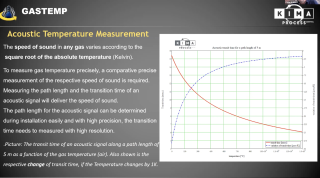
No need with the acoustic measurement principle, which works as follows, we are working with, so-called horns and transmitters. So we sent an acoustic sound produced by a compressed air flush similar to a air cannon, air shock cannon, similar. And we sent this sound through the entire duct. So a cross section, full cross section. We have here a microphone and we have here a microphone. And the time this sound needs is a hundred percent related to the temperature we see here. The first signal, remember here that is the first microphone and the second microphone on the opposite side of the duct. And this delta T which we measure, we measure time, not temperature.
This time we can now translate into temperature In electronic measurement, nothing can be more precise measured than time. And this is the big advantage. If one of the sensor falls out, you can change it, but the distance remains. So the system should be not calibrated anymore. The system is parameterized at the beginning and then running forever. Very nice technology and this technology has a big advantage. The speed, let us speak about the speed of this measurement. You see here a cal signer exit, Steiner exit is of course necessary to measure the temperature so that you are having a good out burn.
The today's control is happening with these thermocouples and you see already the offset of the thermocouple is more than 100 degrees. Infrared radiation, infrared radiation from the flame. Now the acoustic pyrometer sees this increasing of start of increase of a temperature. 50 seconds earlier, 50 seconds is hell of time in combustion you will agree. But more interesting is today you control on this thermocouples and when the thermocouples show there is a peak, the acoustic pyrometer says this is already history. Interesting for process optimization. Also the secondary air temperature, the heat recuperation from the clinker cooler into the kiln. Here you are using also usually thermocouples.
And these thermocouples which are installed usually here on the kiln hood have an big influence from the main burners flame and from the running clinker. So when we measure a cross section over the kiln hood, now we are independent from this heat radiation. So again, this offset shows us that the thermocouple is complete on the wrong way and we are so fast that we even see when the shock blowers on the static grid of your clinker cooler are avoiding the snowman. We see that the temperature has drops. Nothing to compensate, nothing to control. Just to show you how fast this temperature measurement is. The principle of the flow measurement is very similar.
We use the same sensor but not one and two microphones. We have a third microphone. And this microphone then is used to measure the time between a distance, a defined distance, and you as technicians, you know, defined distance with variation, time, speed, seconds per meter, seconds per centimeter. And this is what we do. We measure the time and we can give you the exact guess flow. Again, we measure time, not guess flow, not pressure or something like that. Contactless, this makes it possible to measure for is for instance to measure the down come air volume with a precision of plus minus 1%. The success of this measurement is phenomenal.
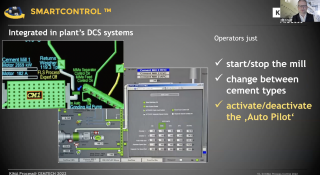
We have installations in the meantime in Tran team in Heidelberg, cement, in Halim, in Zi nearly everywhere and I hope we come soon. Also here in this region, you see here the fast measurement, a 72 hour plot of the temperature and of the nominalized flow in the down comer and here also in the tertiary. I jump a little bit forward to show you what chemo because the time runs so that we can see also what such software and instrumentation can reach. In YTL Malaysia content plant, the mill master with electronic ear smart fill has reached on the cement mill number five and six with full auto autonomous operation. That means the operator steps back like in a Tesla car, go from here to there.
Ah, Tesla is a bad copy autonomous operation, let me say. So we drive the mill or the kiln autonomous so the operator can do everything else in this moment, five 6% production increase. And I would like to show you how this production increase is settled. You see that here very rudimentary. The kill the, the mill feed was adjusted by manual operation without mill master and the mill master now is automatically adjusting the feed however it is necessary autonomous, fast, quick, reducing the coefficient of variants, improving the product quality.
And if you're interested in that specific, I would like to show that later on, maybe on my booth, which I have in front of the presentation hall here certified this re reference results also in ra cement of the meth group in India. We have reached on cement mill number five number one phenomenal 12% production increase. Ladies and gentlemen, 12% production increase means a return of invest of this system of one and a half months software cement. My friends there said Dirk, this is a cash machine. We want to equip more of our cement mills because in a short time we are able to produce the same amount of cement instead of eight hours in six hours. Good example, I think.
So here also nice to see without mill master, the more or less digital adjustment by manual or by PID controller or depending on the as everybody drives usually bucket elevator current. And here the mill master using the smart field signals and smart fill is the electronic ear on bone mills equipped on 900 mills globally. huge success. In the meantime the company mago to is using the system in the minerals industry and relabel it as mega sense powered by kea. the advantage of this system is here again in the slides, easy to see. The manual operation does not work. If you stop with your activity as operator and the operators have to do something else, then only to look at the fill levels.
Fill level one, fill level two are this green and blue line. Now you see that the mill becomes empty. Do you believe that the same quality of cement is produced here and here? No. So this is why we are using consequent the smart fill signals to adjust the fresh feed and the separator speed for a full autonomous milk control. And that was it already today. I hope I can see you and talk with you later on, on my booth. Just outside booth number five. Thank you very much for your.
Video library
Browse 410 conference presentations, webinars, interviews and technical films from the modern CemNet video archive.
410 videos
2 September 2026

1 July 2026

1 July 2026

30 June 2026

30 June 2026

30 June 2026

30 June 2026

30 June 2026

30 June 2026

30 June 2026

30 June 2026

3 June 2026

13 May 2026
9 April 2026

1 April 2026

4 March 2026

27 February 2026

27 February 2026

27 February 2026

27 February 2026

27 February 2026

27 February 2026

17 February 2026

11 February 2026

7 January 2026

3 December 2025

5 November 2025

16 October 2025

8 October 2025

3 September 2025

2 July 2025

4 June 2025

7 May 2025

2 April 2025

18 March 2025

18 March 2025

5 March 2025
3 March 2025

5 February 2025

8 January 2025

4 December 2024

13 November 2024

6 November 2024

9 October 2024

4 September 2024

3 July 2024
10 June 2024

5 June 2024

8 May 2024

23 April 2024

23 April 2024

23 April 2024

23 April 2024

23 April 2024

22 April 2024

22 April 2024

16 April 2024

16 April 2024
11 April 2024

3 April 2024

11 March 2024

6 March 2024

7 February 2024

10 January 2024

10 January 2024
10 January 2024

6 December 2023

1 November 2023

4 October 2023
15 July 2023

15 July 2023

15 July 2023

15 July 2023

13 July 2023

24 March 2023
14 July 2022
13 July 2022
12 July 2022
12 July 2022
12 July 2022
12 July 2022
12 July 2022

12 July 2022
12 July 2022
12 July 2022
12 July 2022
12 July 2022
12 July 2022
12 July 2022
12 July 2022
12 July 2022
12 July 2022
11 July 2022
11 July 2022
11 July 2022
11 July 2022

11 July 2022

11 July 2022
11 July 2022
11 July 2022
11 July 2022
11 July 2022
11 July 2022
11 July 2022
11 July 2022
11 July 2022
11 July 2022
11 July 2022
11 July 2022
11 July 2022
11 July 2022
11 July 2022
11 July 2022
11 July 2022
11 July 2022
11 July 2022

6 July 2022
1 July 2022
1 July 2022

8 June 2022
12 February 2021
12 February 2021
12 February 2021
12 February 2021
12 February 2021
12 February 2021
12 February 2021
12 February 2021
25 September 2020
25 September 2020

25 September 2020

25 September 2020

23 September 2020

22 September 2020

22 September 2020
21 September 2020
20 February 2020
10 February 2020
10 February 2020
10 February 2020
7 February 2020
27 January 2020
23 January 2020
23 January 2020
23 January 2020
23 January 2020
2 May 2019
30 April 2019
18 April 2019
18 April 2019
18 April 2019
12 April 2019
12 April 2019
11 April 2019
10 April 2019
10 April 2019
10 April 2019
9 April 2019
9 April 2019
4 February 2019
17 January 2019
31 July 2018
31 July 2018
31 July 2018
27 July 2018
27 July 2018
27 July 2018
27 July 2018
27 July 2018
27 July 2018
27 July 2018
27 July 2018
27 July 2018
27 July 2018
25 July 2018
25 July 2018
25 July 2018
24 July 2018
24 July 2018
24 July 2018
23 July 2018
23 July 2018
23 July 2018
20 July 2018
20 July 2018
20 July 2018
20 July 2018
20 July 2018
20 July 2018
20 July 2018
20 July 2018
20 July 2018
20 July 2018
20 July 2018
20 July 2018
20 July 2018
20 July 2018
20 July 2018
20 July 2018
20 July 2018
20 July 2018
20 July 2018
19 July 2018
19 July 2018

19 July 2018
19 July 2018
19 July 2018
23 March 2018
23 March 2018
23 March 2018
23 March 2018
23 March 2018
23 March 2018
23 March 2018
23 March 2018
23 March 2018
23 March 2018
23 March 2018
23 March 2018
23 March 2018
23 March 2018
23 March 2018
22 March 2018
26 October 2017
26 October 2017
26 October 2017
26 October 2017
14 August 2017
14 August 2017
14 August 2017
14 August 2017
14 August 2017
14 August 2017
14 August 2017
14 August 2017
14 August 2017
14 August 2017
14 August 2017
14 August 2017
14 August 2017
14 August 2017
18 July 2017
18 July 2017
18 July 2017
16 June 2017
16 June 2017
16 June 2017
16 June 2017
16 June 2017
14 February 2017
14 February 2017
14 February 2017
14 February 2017
14 February 2017
14 February 2017
14 February 2017
14 February 2017
14 February 2017
14 February 2017
13 February 2017
13 February 2017
13 February 2017
19 January 2017
19 January 2017
17 January 2017
17 January 2017
17 January 2017
6 January 2017
18 August 2016
18 August 2016
18 August 2016
18 August 2016
17 August 2016
17 August 2016
17 August 2016
16 August 2016
16 August 2016
16 August 2016
12 August 2016
12 August 2016
12 August 2016

11 August 2016
11 August 2016
11 August 2016
10 August 2016
10 August 2016
10 August 2016
8 August 2016
8 August 2016
8 August 2016
6 May 2016
6 May 2016
6 May 2016
6 May 2016
6 May 2016
6 May 2016
6 May 2016
6 May 2016
6 May 2016
6 May 2016
6 May 2016
6 May 2016
6 May 2016
6 May 2016
6 May 2016
6 May 2016
6 May 2016
6 May 2016
6 May 2016
6 May 2016
6 May 2016
25 April 2016
25 April 2016
11 March 2016
11 March 2016
11 March 2016
11 March 2016

11 March 2016
11 March 2016
11 March 2016
11 March 2016
11 March 2016
11 March 2016
11 March 2016
11 March 2016
11 March 2016
11 March 2016
11 March 2016
11 March 2016
11 March 2016
11 March 2016
11 March 2016
11 March 2016
21 December 2015
15 December 2015
15 December 2015
15 December 2015
15 December 2015
15 December 2015

15 December 2015
15 December 2015
15 December 2015
15 December 2015
15 December 2015
15 December 2015
15 December 2015
2 December 2015
2 December 2015
2 December 2015
2 December 2015
2 December 2015
2 December 2015
2 December 2015
2 December 2015
2 December 2015
2 December 2015
2 December 2015
2 December 2015
21 August 2015
21 August 2015
21 August 2015
21 August 2015
21 August 2015
21 August 2015
21 August 2015
21 August 2015
21 August 2015
21 August 2015
21 August 2015
21 August 2015
21 August 2015
21 August 2015
21 August 2015
21 August 2015
21 August 2015
21 August 2015
21 August 2015
21 August 2015
20 August 2015
20 August 2015
18 August 2015
18 August 2015
18 August 2015
18 August 2015

30 June 2015
29 June 2015
29 June 2015
29 June 2015
29 June 2015
29 June 2015
29 June 2015
29 June 2015
29 June 2015
29 June 2015
29 June 2015
4 June 2015
4 June 2015
2 June 2015
2 June 2015
2 June 2015
2 June 2015

29 May 2015
29 May 2015
28 May 2015
28 May 2015
28 May 2015
18 February 2015
17 February 2015
13 February 2015
13 February 2015
Try searching for another title.