
2 September 2026
This transcript was generated automatically and may contain errors.
Which is Alexandra Les from Seeker Services. He's gonna talk to us about the activation of SEM blends to reduce the clinker factor. Alexandra began his career with a, with a German company, which specialized in tunnel boring machines over 13 years as a project engineer and project manager, he was involved in the design, fabrication, transport, commissioning operation, and later refurbishment of different machines for tunnel projects around the world, working in Germany, Ireland, Spain, and Australia. In 2015, he joined Seeker Services as a corporate product engineer responsible for the developments, global support and marketing of various seeker technologies.
Over the last three and a half years, he's also become responsible for corporate support related to cement additives. so someone with a lot of experience and an interesting perspective from the, from the tunneling days. But today we're gonna be talking about reducing clinker factora. Welcome, Alexandra. Okay. it's okay. Can you hear me? First of all, thank you very much to the organization team. it's a wonderful event also to my local colleagues who are always supporting us. The corporate team does not work with our local team. And last but not least, to the customers who allows us to sell the products in the different plants.
As mentioned before, we will talk during the next 10 to 15 minutes about CCCA solutions that you can apply to enable, let's say, more addition of SCM in the concrete, in the cement production and trying to reduce the ER factor. First of all, this is a, a picture of our headquarters in Switzerland, in Zurich, where we are located. The presentation has been prepared. We are always a team of people. It's not only one person. So myself and Emmanuel, Gallucci Manuel is responsible from the chemical point of view and head of cement tissues materials in the Zika group worldwide. I am Alejandro EZ, corporate product engineer, also based in Zurich. And our task is to support the different countries.
When there is a specific requirement or expectation from a local country, we try to to bind the different experience around the world and bring it to the specific customer or, or client. What we will do, we will talk a little bit about Zika, of course, we will talk about the challenges and trends. I think it's a little bit of confirmation about what we have been doing the last yesterday and today production of CO2. Then we will have some exciting examples without mentioning names of cement producers, but related to Carl and Clay slag and IC cements. And finally, we will have some conclusions. So I hope they, they, again, they fulfill the, your expectations.
First of all, for those of you who do not know Zika, we are company producing chemical products for the construction industry, also for bonding industry. So many of your cars are bonded with Zika. Many of the floors or the roofs or your houses are done with Zika, built with ccar build with Zika. And I would say many of the products that we produce, you cannot see them, but they are there. what I want to highlight, more than 33,000 people since May, 2023. the big part is we are present in more than 100 countries. So this give us the, the opportunity, and it's maybe even a requirement to make localized and, and, and solutions.
We don't want to bring Europe product from Europe to South America, from South America to Asia. We just have to find solutions in the place based on your expectations. Okay? We have a big team of technology behind us is not only salespeople, and we are once again committed to all these CO2 expectations from the world. no need to mention this. it was mentioned this morning already more than 4,000 plants, seven plants around the world. this seven or 8% is in the mind of everybody. And there was a nice presentation yesterday with different ranges of, of CO 2% of seven, between 500 and 800, let's assume 650.
So there is a real challenge from all of us, not only the seven producer, because this is also as a final user, as an admixture supplier, as as a cement person, we have to be all together in the topic. One of the presenters yesterday mentioned is not only a problem of one part of the full change, we have to solve it together. So we have seen in the last, let's say years, there is a issue with the raw materials. Now, it's not so easy and not so cheap to find the traditional raw materials from the past. the different political situation in specific areas of the world have created or have caused drastically increases of the energy.
So now we have to better things faster and with less amount of energy. After the Corona pandemic situation, the supply change went a little bit, let's say in a, let's say, chaotic situation. It was difficult to find containers around the world. Even if you had the product, you could not bring it to the final place on time. And what we see every night in the news is people asking the society, asking for more environmental solutions and products. So this is like the big challenge that we all have in this room, trying to be more sustainable. this picture summarizes our, let's say our concept for the next 30 years.
We are right now on the left hand side with, I don't know exactly, but let's say 300 kilograms of cement per cubic matter of concrete with more or less 800 kilograms of CO2. And this is where we have to go in the next 30 years. It's a very challenging situation on the opposite side. And one guy mentioned on the, from the the first presentation this morning, there are the mega trends. And we are doing right now, this, we are asked to produce even more. We need more houses, more highways, more tunnels, more airports. So how can we do with less material even more than what we are doing right now? And we see it of course, as a challenge, but this is the good thing.
We also see it as an opportunity because now it gives us the opportunity to change the mind setting, maybe some norms which was mentioned yesterday. We have to adapt some, some regulations, and it give us the opportunity to start testing and playing with different alternative, which maybe we not interested in the past. So we take this one as a big challenge. And this is where, where Zika as a big company can be a part of the, of the game. Okay? Considering sec supplementary and tissues materials, SCM, we notice, and now we are talking from the corporate point of view, not just one specific country or one region. The demand is increasing drastically. We get more and more requests.
What can I put in my cement to reduce the clinker? What can I produce do to reduce the, the energy consumption? Okay? We have also the traditional, let's say lag fly arts, but now people are considering more and more these natural ence or maybe the ine clay, which will be a part of later on. And of course, eh, depending on what you use, the performance will change drastically. Eh, we have seen some customers which tell us, okay, look, you have this back, please give me the perfect solution. And when we start making the analysis, we see, we see that the perfect solution is not possible based on the performance of the material that you are providing.
So we have to focus more and more on the, on the expectations. And last but not least, everybody wants to put more less clinker and try to reach the same performance as before. So that's why we find in Zika we need to do more tailor made solutions just to use the traditional product and give it to everybody is not working and will not work in the future anymore. And as you also, the CO2 challenge is always behind everybody. Now this picture explains a little bit what is happening.
We know that with traditional cements, we have a certain CO2 footprint, and we, and it has been already proved in many of the presentations, we see that there is a big challenge and a big potential to reduce the CO2 emissions, changing the materials inside the cement. The graphic on the right hand side belongs to the team in, in the university in Lausanne, it's clear that there are different possible materials to replace the clinker, but we see in limestone and cals and clay, the one that is more available, which we will see later on. That's why we will start with that part.
Cals and Clays the Crich team, we have the possibility or the advantage to collect information from different countries around the world. So we know more or less what is happening, who is requesting which kind of products. We know what type of clay you are trying to find. So basically limestone, cals and clay is a mix of more or less 50% clinker and 30% cals and clay with this number tending to go up and up. So every year it goes a little bit more. we need to start two or three years ago with 20 now 20, let's say. It's easy for the most of us. Okay?
And the big important thing, it was mentioned before, as we are replacing kink with Carl San Clay, we are reducing a part of the emissions caused by the ER and the cal and Clay does not need high tempera as high temperature as the er. So there is a win-win situation by replacing clinical, but cal and Clay here we want to show more or less what is really happening. We don't want to go too much into the technique of this, but basically if you have the reference cement in gray, and if you put the cals and clay in a certain amount, then for example, the spread goes down. So this is something that you don't want to have.
So what we can do, adding one of the products is to bring the curve back again, where it was originally. So this gives better performance also. And here we have to pay attention. Not everything is perfect. if we have the reference here on the right hand side for the compressive strength once we start remu reducing clink curve by 15 or 32%, we see that we have a, let's say, a decrease in the strength at the early stages. At the latest stages is less compromising, but it shows more or less that in the spread we are, we are in a way to find a common solution for the early strength, there could be an issue depending on the type of clay that you are giving us.
So, but for this one, we always need a specific material from you here because we are not talking. Now here, laboratory testing we have the, the, the advantage that we have done already, some, some field tests in the past with cement producers in a specific region of the world. So one of these, because people are asking, does this really work in the, in the real cement factories? This just laboratory trick? No, we did it in a cement in a factory. the rule was during the grinding post process to keep the value between five plus minus 5%. So what we did is we stabilized the, let's they call them onic mix without any additive inside. Then we added the product from Zika.
And after that we saw that after two hours we were able to increase the performance. Based on that, we know that we can take some things out of the cement and improve the quality. Apart from that, and as a conclusion from the field test, we have the following. this is real field test, not laboratory test without specific product from Zika, we were able to, to reduce the water cement radio and increase the slum. we were also having a similar workability as with the original product as the reference. And I would say the most important from the full field test was this one.
We didn't have any negative impact in the normal grinding and separation process because many people said, look, this technology, if I put the cals and clay, maybe the process or the factory will explode, or the, or the mill will not work. And this one we manage to show that it will not happen. Okay? Once again. And because not everything is perfect, we know that we have to work together on the earliest strength. For those who ask for the perfect solution, cheaper and everything the same, there are still some things to do together, okay? In general conclusions.
As for the use of cals and clay, which has been mentioned many times during the last, let's say yesterday and today it is possible to do a reduction of 30 to 40% clinker compared to OPC. we know that there is resources everywhere, but one person mentioned this morning, in some regions there is no clay, unfortunately. But for most of the, the regions of the world, there could be an alternative solution. We don't see so far any problems with the durability and we see that it's global, scalable, so everybody who wants can do it for sure. And now considering this, let's say CO2 taxes, it will become more and more interesting from the economical point of view.
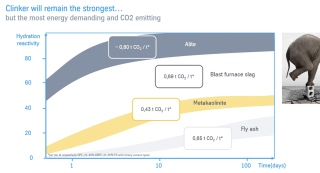
And the good thing is we are ready to give you product. So whoever has Cal and Clay raise the hand and then we can give you the product to start testing. Of course, even the best product from Switzerland will not work with your specific local product. We need to analyze it and adapt it a little bit to fulfill the expectations and the requirements from your raw materials. Second topic that we want to highlight, verify is still the use of SL is interesting. Those who have a SL want to use it and want to optimize even it a little bit more. And so whoever has it is still in the pipeline. we have big challenges here. The early strength is still a problem because the slack does not react.
So this will be the big challenge for everybody. And we have a request from specific countries, Brazil, Belgium, China Turkey so in these regions, whoever had the, the, the, the, the material is able to do that. Okay? One thing that we notice is that, and once we are analyzing the products in the market, we see that some of the products that you are actually using maybe are not really focused to the chemistry or to their, to the interaction with this slack. For that we are trying to be now a little bit more specific and not just taking the typical traditional pro product so far.
And based on some field tests, we are confident that you can go up to 20% clinical reduction with the actual available solutions, of course with the CO2 impact that it becomes here. As an example of laboratory test what we did is we took cement from different parts of the world. slack cement, we compared the early strength 1, 2, 3, 7, and 28 days. We compare the sources of the different cements all the time, same 2 42 0.5. And, and we see that there are of course some countries with a little bit difference, but in generally the average trend tends to be the same. Now, in field test, what we did is we took the reference, in this case, asem two, AL 42.5. This is the yellow line on the left.
And after doing the same with 20% clinical reduction to become it at SEM two C sl, we were able based on CA products, and this is the sample one, product two, product three products from Zika. With one of these products, we were even able to improve already the seven day strength and to improve the 28 day strength. So it shows that it's possible to replace 20% quicker, help a little bit with the chemistry and go, let's say in this direction that we want to have all together. Another topic is PU cements. It's coming more and more, eh, we see several countries asking for more solutions, okay? I have LANs, maybe I am not so far for the cal and clay, but what can we do?
So we see that this is a market which is already increasing a lot. And of course we try to give solutions that you are able to, to fulfill your expectations. Once again, eh, we see that there will be a problem with the demand. 'cause everybody's asking, asking, asking. there is still of course PU have some, let's say, a special performance. So sometimes the chemistry has to work to fulfill the expectations of the pu. For example, water demand. We notice that when we put some of the products, the PU socks, the product and the product cannot work in the way it should be. Okay? So we have to, we have to consider all these things before making the solution.
And once again, and similar as for the slack, we see that some products in the market for general use once put in AIC, cement, the PU socks, the additive, and it does not really make its job. So it's our task as a semi, as a chemical producer to give the product that does not be only sold by the pu, but really acts during the grinding process. Here again, some field tests. This is from one of the subsidiaries from Zika in Europe. Basically we took EM two al as a reference and trying to become 20% clinical reduction to a SEM two CPL. We got a reference on the left hand side.
And here, even with a specific product from Zika, we were able to even improve early and late stage by 20% clinical reduction. So it means you are saving clinical 20% clinical. You are reducing the CO2 footprint of your production. You only have to select the specific product, which is not always, maybe the one we thought at the beginning is not really the perfect one. That's why we see, and we always recommend to have a specific analysis of your solutions and not just taking one like that here. because some people ask, okay, you give me the product and that's it. No, we help you during the process to analyze the economical benefit.
And some point, for example, here in the graphic on the left, we tell you about which percentage you can start winning money because no, not always the solution. In this example from the beginning, you start being more competitive from the commercial point of view. On the left hand side, you have to do a little bit more before it becomes more interesting. But we are together to give this analysis with you. So if you got interested about this technologies and without talking about which is the perfect product for my cement factory, this is the, the, let's say the brochure, the homepage, the link.
If you want to visit us, we have a booth outside where you are able to, to go and, and place specific questions for the Carine clay, because we have been working already on this one, not only in the laboratory, also in the field test with cement producers from a specific region, then you can visit the homepage and the brochure. We are happy to give you samples. Whoever has a little bit of cals and clay, and we see many pro producers in South America and in Central Africa, of course the line with the, with the clay in the region, we can give you some samples and start trying to find the best solution for you. Okay? To conclude is basically we see a big increase on request of additional s cms.
This is, without that, we cannot survive anymore. We see a big issue considering early and latest strength. So we have to really focus on what you have and what you want to achieve. The perfect solution for everything is not so easy or probably not so cheap. Okay? We know that for or for cals and clay, there are some issues with the water demand. So we have to focus on that. And of course the radiological performance. And without making too much advertisement, depending on the Ika product, we are able to allow high er replacements. We are trying to optimize the production cost because it means less energy for the same amount of time. We are happy to be a part of this trip with less.
CO2 is a challenge that we have, but also an opportunity. And the big dream is that with the big idea is to have the traditional cement with even at least the same or even better performance with the new solutions. So that's it. Thank you very much for your time. Thank you very much, Alexandro. That's a very comprehensive presentation. Lots of optimism there for supplementary cementitious materials.
Video library
Browse 410 conference presentations, webinars, interviews and technical films from the modern CemNet video archive.
410 videos
2 September 2026

1 July 2026

1 July 2026

30 June 2026

30 June 2026

30 June 2026

30 June 2026

30 June 2026

30 June 2026

30 June 2026

30 June 2026

3 June 2026

13 May 2026
9 April 2026

1 April 2026

4 March 2026

27 February 2026

27 February 2026

27 February 2026

27 February 2026

27 February 2026

27 February 2026

17 February 2026

11 February 2026

7 January 2026

3 December 2025

5 November 2025

16 October 2025

8 October 2025

3 September 2025

2 July 2025

4 June 2025

7 May 2025

2 April 2025

18 March 2025

18 March 2025

5 March 2025
3 March 2025

5 February 2025

8 January 2025

4 December 2024

13 November 2024

6 November 2024

9 October 2024

4 September 2024

3 July 2024
10 June 2024

5 June 2024

8 May 2024

23 April 2024

23 April 2024

23 April 2024

23 April 2024

23 April 2024

22 April 2024

22 April 2024

16 April 2024

16 April 2024
11 April 2024

3 April 2024

11 March 2024

6 March 2024

7 February 2024

10 January 2024

10 January 2024
10 January 2024

6 December 2023

1 November 2023

4 October 2023
15 July 2023

15 July 2023

15 July 2023

15 July 2023

13 July 2023

24 March 2023
14 July 2022
13 July 2022
12 July 2022
12 July 2022
12 July 2022
12 July 2022
12 July 2022
12 July 2022
12 July 2022
12 July 2022
12 July 2022
12 July 2022
12 July 2022
12 July 2022
12 July 2022
12 July 2022
12 July 2022
11 July 2022
11 July 2022

11 July 2022
11 July 2022
11 July 2022
11 July 2022
11 July 2022
11 July 2022
11 July 2022
11 July 2022
11 July 2022
11 July 2022
11 July 2022
11 July 2022
11 July 2022
11 July 2022
11 July 2022
11 July 2022
11 July 2022
11 July 2022
11 July 2022
11 July 2022
11 July 2022
11 July 2022

6 July 2022
1 July 2022
1 July 2022

8 June 2022
12 February 2021
12 February 2021
12 February 2021
12 February 2021
12 February 2021

12 February 2021
12 February 2021
12 February 2021
25 September 2020
25 September 2020
25 September 2020
25 September 2020
23 September 2020
22 September 2020
22 September 2020
21 September 2020
20 February 2020
10 February 2020
10 February 2020
10 February 2020
7 February 2020
27 January 2020
23 January 2020
23 January 2020
23 January 2020
23 January 2020
2 May 2019
30 April 2019
18 April 2019
18 April 2019
18 April 2019
12 April 2019
12 April 2019
11 April 2019
10 April 2019
10 April 2019
10 April 2019
9 April 2019
9 April 2019
4 February 2019
17 January 2019
31 July 2018
31 July 2018
31 July 2018
27 July 2018
27 July 2018
27 July 2018
27 July 2018
27 July 2018
27 July 2018
27 July 2018
27 July 2018
27 July 2018
27 July 2018
25 July 2018
25 July 2018
25 July 2018
24 July 2018
24 July 2018
24 July 2018
23 July 2018
23 July 2018
23 July 2018
20 July 2018
20 July 2018
20 July 2018
20 July 2018
20 July 2018
20 July 2018
20 July 2018
20 July 2018
20 July 2018
20 July 2018
20 July 2018
20 July 2018
20 July 2018
20 July 2018
20 July 2018
20 July 2018
20 July 2018
20 July 2018
20 July 2018
19 July 2018
19 July 2018
19 July 2018
19 July 2018
19 July 2018
23 March 2018
23 March 2018
23 March 2018
23 March 2018
23 March 2018
23 March 2018
23 March 2018
23 March 2018
23 March 2018
23 March 2018
23 March 2018
23 March 2018
23 March 2018
23 March 2018
23 March 2018
22 March 2018
26 October 2017
26 October 2017
26 October 2017
26 October 2017
14 August 2017
14 August 2017
14 August 2017
14 August 2017
14 August 2017
14 August 2017
14 August 2017
14 August 2017
14 August 2017
14 August 2017
14 August 2017
14 August 2017
14 August 2017
14 August 2017
18 July 2017
18 July 2017
18 July 2017
16 June 2017
16 June 2017
16 June 2017
16 June 2017
16 June 2017
14 February 2017
14 February 2017
14 February 2017
14 February 2017
14 February 2017
14 February 2017
14 February 2017
14 February 2017
14 February 2017
14 February 2017
13 February 2017
13 February 2017
13 February 2017
19 January 2017
19 January 2017
17 January 2017
17 January 2017
17 January 2017
6 January 2017
18 August 2016
18 August 2016
18 August 2016
18 August 2016
17 August 2016
17 August 2016
17 August 2016
16 August 2016
16 August 2016
16 August 2016
12 August 2016
12 August 2016
12 August 2016
11 August 2016
11 August 2016
11 August 2016
10 August 2016
10 August 2016
10 August 2016
8 August 2016
8 August 2016
8 August 2016
6 May 2016
6 May 2016
6 May 2016
6 May 2016
6 May 2016
6 May 2016
6 May 2016
6 May 2016
6 May 2016
6 May 2016
6 May 2016
6 May 2016
6 May 2016
6 May 2016
6 May 2016
6 May 2016
6 May 2016
6 May 2016
6 May 2016
6 May 2016
6 May 2016
25 April 2016
25 April 2016
11 March 2016
11 March 2016
11 March 2016
11 March 2016
11 March 2016
11 March 2016
11 March 2016
11 March 2016
11 March 2016
11 March 2016
11 March 2016
11 March 2016
11 March 2016
11 March 2016
11 March 2016
11 March 2016
11 March 2016
11 March 2016
11 March 2016
11 March 2016
21 December 2015
15 December 2015
15 December 2015
15 December 2015
15 December 2015
15 December 2015
15 December 2015
15 December 2015
15 December 2015
15 December 2015
15 December 2015
15 December 2015
15 December 2015
2 December 2015
2 December 2015
2 December 2015
2 December 2015
2 December 2015
2 December 2015
2 December 2015
2 December 2015
2 December 2015
2 December 2015
2 December 2015
2 December 2015
21 August 2015
21 August 2015
21 August 2015
21 August 2015
21 August 2015
21 August 2015
21 August 2015
21 August 2015
21 August 2015
21 August 2015
21 August 2015
21 August 2015
21 August 2015
21 August 2015
21 August 2015
21 August 2015
21 August 2015
21 August 2015
21 August 2015
21 August 2015
20 August 2015
20 August 2015
18 August 2015
18 August 2015
18 August 2015
18 August 2015

30 June 2015
29 June 2015
29 June 2015
29 June 2015
29 June 2015
29 June 2015
29 June 2015
29 June 2015
29 June 2015
29 June 2015
29 June 2015
4 June 2015
4 June 2015
2 June 2015
2 June 2015
2 June 2015
2 June 2015
29 May 2015
29 May 2015
28 May 2015
28 May 2015
28 May 2015
18 February 2015
17 February 2015
13 February 2015
13 February 2015
Try searching for another title.