
2 September 2026
This transcript was generated automatically and may contain errors.
Well, good morning. Welcome back. My name is Peter Hona. I hope the remaining delegates are gonna join us presently, but this is a bit of a different session from the last one. The subject is still decarbonizing cement, but the subtitle for this session is The Cutting Edge Technologies for Low Carbon Cement Production. So, in some parts of the world, as you know, there's a pretty clear path for decarbonization and government policies moving the whole industry in that direction. So I'm talking about Europe, California some parts of Canada. It really is starting to look clear. But in Saudi Arabia, for example, I was at Neon last week. a few, a few factoids.
Number one the, the Crown Prince has said that by 2030, neon must be carbon neutral. 10 days ago, one of the requests for, for quotation, for one portion of the multiple projects at Neon relating to the spine was for 60 million meters, cubed of concrete with 375 kilos of binder per cubic meter, do the maths, and you end up at about 20 million tons of binder, most of which will be SEM one. OID number three about neon. I met probably 15 major EPC contractors. And one was seeking quotes for for Georgina, which is the ski resort at 2,100 meters asking him about sustainability and decarbonization.
What he told me was, Peter, the sustainability story here at Neum is, and I'm sorry about the language everybody, but this is what he said is b******t. So you've got this huge range in, in this region between what that guy said, what the Crown Prince said, what you heard from Tony Hadley about the African continent. It's a really different, different area to be considering decarbonization, but I think that it is coming big time. So, factoid number four, in Saudi Arabia, for years, you've had energy subsidies for cement manufacturers and very low cost diesel. January 1st, 2024. It's only a month and a half ago away.
the first step of reducing the subsidies for cement manufacturers was implemented prices of cement jumped by 60 reels per ton, which is something like 40%. And you had a whole series of, of announcements in the stock market about the increase in costs. Diesel prices also went up, subsidies were taken away. Ladies and gentlemen, it is not clear in this region, but I believe it is coming and it is coming fast. So today we are very, very lucky in having three thought leaders from the very major cement equipment manufacturers. They're gonna be leading us by the hand through some of the cutting edge technologies for CO2 reduction in cement manufacturing.
But it's not like the last session, everybody, I'm not allowing you to relax. So please, you've gotta pay attention because I, what I'm, what stands between you and lunch. And you're not leaving here, any of you, until every one of you has contributed to this session. You'll see how soon. But I really want to ask you, please. The whole idea is to have now a discourse, an interaction. The, the three senior members of this community of cement technology are here. They have very short presentations, and then it's over to you to really lead the conversation and to press them and me about these issues. So this is an interactive session. It's called a panel session.
I'm gonna now kick off by introducing the first one which is Mattea Massman. He is got a presentation, which is Mally called Copernicus. He's gonna tell you all about it in a second or two. but it's really a whole series of questions you'll see. Now, Mateo, many of you will know, he's the, the CTO, the, the Chief Technical Officer of KHD Humboldt, so, you know, a serious thought leader in our industry. he is a graduate from from university, a mechanical engineer and a process engineer. he joined KHD Humboldt Beda in 1995. He's had various roles, process engineer, director of research and development, VP of technology, and r and d. He had a period in Lutia as well, 2011 as technical director.
So he understands a little bit about grinding technology too. and he's now, he's had 25 years experience in, in our industry, in engineering the future for our industry. So we're really, really lucky. He's the first of three thought leaders, three powerhouses in this area. And so it's my real pleasure to ask Matteas to start asking you the questions. Thank you very much, Matteas. Alright, thank you very much Peter for that friendly introduction. Ladies and gentlemen, it's a great pleasure for me to be part of this discussion round in this panel here. I hope we are gonna have a very lively interaction.
and we will be talking about technology and we are here representing the OEMs, the technology suppliers to the cement industry. And we have ample opportunity to talk about the technology. But being involved in all this question for decades, I know that technology is not the limiting factor. I'd like to join hands with Jim and his optimism that he said, okay the cement companies will decarbonize and will reach their goals by 2030 and maybe even beyond. Technology will be there, solutions will be there. So I decided in my introductory presentation not to focus on technology, but to focus on something that is essential for making things happen. And that's motivation and understanding.
And it, it's, it doesn't take only technology to get things going. It takes business models. it takes the right spirit, it takes the entrepreneurial understanding of the transformation and what it does for us. And it takes also a sensitivity of what is climate change in total. So I'd like to give you some facts. Copernicus is the EU driven earth monitoring system. and they take satellite data and data from Earth and, and combine all that and do monitoring about what's happening on earth. And they published two very important reports recently. The first report in December, last year, December, 2023, they published that 2023 was the hottest year ever since documented history.
And even more worrisome in January, they published that first time in documented history in January. We had a period of consecutive 12 months with above 1.5 degrees centigrade temperature increment above the pre-industrial era. So all the talk we are talking about, we have to keep it below two degrees or below 1.5 degrees as it is given in the Paris Agreement. This is reality. In January, we had the first 12 consecutive months above 1.5 degrees. And what does it mean? What does it mean? I encourage everybody to read the IPCC reports. There are quite lengthy and quite complicated to read, but it contains a lot of valuable information. They punch down to the consequences.
What, what does it mean for us on earth? and again, it's not about saving the world, it's about saving the conditions for men to live on earth. And one extract of all that lengthy report I'm showing here, this is a map of the world and the color code you see refers to the days in a year of potentially lethal living conditions. If the temperature rises it 1.5 degrees centigrade does not mean we elevate the temperature of 1.5 degrees all over the place. It's gonna look very differently in different regions of the world.
And together with the impacts on humidity and water cycling and all this kind of stuff leads to situations where the temperature and the humidity grow to an extent that the human body can no longer transport its energy, its temperature to the outside. And that goes up to really potentially lethal living conditions. And you see the color code there, I'm not sure whether this now it doesn't work. Going, trying to go back, yeah. Alright. The laser pointer doesn't seem to be working alright. You see the color code from one day to 300 65 days of a year on potentially lethal living conditions.
And if you look at the region here, and especially India and Southeast Asia, you see that there's a big portion of the year where the weather conditions are potentially lethal to human beings. This looks quite dramatic, and this is for sure only one of the consequences of climate change, but maybe the one that is most tangible, that is most understandable. And it also shows that it's not about saving the world, it's about saving the living conditions of man on earth. So when it comes to our responsibility, what are we going to do in order to prevent this from happening?
We, as an equipment supplier, of course, we are in the role of providing technological solutions for our clients to produce demand and binders to satisfy the needs of the economy. and we see clearly a two step approach. First phase will be until 2030 where we are talking about the reduction of CO2 emissions. And then later on we are gonna have a second step from 2030 onwards where we talk about decarbonization, which means we will have to then capture the rest of the unavoidable remaining CO2 emissions. That's why we have started a campaign under the term cement beyond carbon.
that is a total sustainability initiative we are putting on the road in order to provide solutions for our clients after 2030 when we will have reduced our carbon emissions down to say, I don't know, 400 kilogram perton or something like that. Nobody knows exactly, and we've seen from Jim O'Brien's presentation earlier that there are also regional and company by company differentiable reduction plans and targets. But in the end, we will reach some level below, which we cannot reduce carbon anymore. Then we have to capture the rest. And this will happen after 2030. It will require totally different investment schemes.
It will reco require totally different business scheme schemes because you would have to find a solution on what to do with the captured carbon that calls for sector coupling. That calls for logistic optimization, business model integration and lots of difficult things. Now, what we are going to offer for the next five to 10 years in that first phase of carbon reduction I've shown here, and this is what we can do already today. We can talk about plant optimization reducing the specific energy consumption of plants with advanced technology incorporating ai.
We can talk about lowering the energy consumption for grinding plants with roller press technology with this highly efficient grinding process. We can talk about alternative fuels very massively. alternative fuels are one of the two major levers for this first phase, utilizing biogenic and waste derived fuels to lower your production cost and to also lower your carbon footprint. And we will talk about clay calculation, and I very much agree to the findings that, that have been presented here earlier. INE clay will come ine clay calcination is the big lever for reducing the clinker content in cement. So those are technologies which are available today. You can start working on it.
and also oxy fuel is listed here in this table. Oxy fuel is also ready. There are some projects already in going on. there are pilot plants rather than real scale, full scale industrial projects, but it is technologically ready to use. The advantage of oxy fuel is to concentrate the CO2 to make it easier to capture. capturing is already possible today, but it's not economically feasible because a regular amine scrubbing plant behind the cement plant cost as much energy consumption as the production of, of clinker itself. So you need to concentrate the CO2 in the off gas in order to make it feasible to capture it. So these are the technologies we can use already today.
The rest will be coming up after 2030 so far for the moment. Thank you very much. Thank you very much. So let me start off, thank everybody. If you've got some, any questions for Mattias. I, I mean, he's really posing the questions to you rather, I think, but what, what would you, what, what sort of things would you like to, to understand better? Amra? Would, could we have a a mic please for, for amra? Sorry, there. Thank you very much. thank you. the question is related to alternative fuel and slink. As we have seen in the numbers in the morning, alternative fuel is growing and this is understood. sems are falling behind, and the solution of Cals San Clay is being shown on the tip.
CALS San Clay is a great solution. There is no question about that. But from a feasibility perspective, countries like Saudi Arabia was mentioned and Egypt was mentioned twice. So we have those two countries have combined 160 million ton of clinical production per year. so I don't think that it's feasible or economical that they shift their assets or even change their assets to, especially that they don't have any very less, let's say, carbonite of more than 30% or even 20% concentration. So what's your view on that? And let's shed if you can shed the light on the Cal Clay variability in which areas and where it makes more economical sense. Yeah. thanks very much, AMAV. good question.
that, that relates to one specific I think we have to keep in mind. Generally, we are going to look at a very differentiated regional view. the ways for carbon reduction and decarbonization will be regionally different. availability of clay, availability of waste derived material, availability of biomass material will be different from region to region and other specifics as well. still, I believe the combination of possibilities will make it happen for each and every plant in each and every region, and each and every market to decarbonize. Some will be stronger in using alternative fuels. lots of requisites necessary as well for this.
There needs to be a collection system, there needs to be an infrastructure and especially in cases where you don't have access to calcine clay, you will go for using alternative fuels rather and other, other, you know, combinatory optimizational ways. Very good. Hope this answers your question at least a little bit. Yeah, thanks. Any answer from you is great. Matthias? Yes. You have another question there. If you just move the mic, could you please introduce yourself? Sorry, I should have said that about. Okay. my name is Mahmud Aine, Royal Cement Company sustainability Group Director.
my question is regarding the alternative fuel and when we started to calculate CBM, which is carbon border adjustment mechanism, I found that the calculation based on gross CO2, so it is not net net CO2, which means all the efforts and investment regarding the RDF utilization and cement is not considered in this CBM policy, which doesn't make any sense for all cement experts. And it is very strange that we saw in the presentation earlier that all the calculation and all the targets are based on net CO2 in Europe.
But when we, when Cbam came to us for non-European countries, we found that the calculation is based on gross, which means that we cannot decarbonize the industry with the use of RDF. So this is the, the question. And it's very strange for Maybe just a very short brief answer. the biogenic content plays a role here RDF from region to region also has a biogenic content. And if you use alternative fuels of biogenic descent, then of course this, this question changes. But if it's not biogenic your, your argument is valid I think, you know, everybody is trying to move in into the direction there are mistakes being made.
I wouldn't rule out that also in framework setting by the European Union and other political bodies, mistakes are being made and have, will have to be corrected. this also goes for norms and standards. Now, we, we cannot afford to, to live on norms and standards situations like they are today. we touched that briefly this morning as well. So definitely in framework setting, we also have to improve in order to reach our targets. Yeah, thanks very much. It's a, it's a great question. Tha thanks Mattias. I, I'm very sorry to do this to you.
Claude, can I put you on the spot to answer that so definitively, because that's a big, big question to make sure that we have clarity about about CVAM and biogenic net versus gross. Can we get a a thanks the club, perhaps just introduce yourself? Yes, maybe, maybe many people know me, but I'm Claude Gloria from the GCC, I'm the cement ESGA innovation Director at the GCC. I'm not sure we'll have a definite answer, Peter, I'm less optimistic than you on the fact that the EU will change. I mean, I was there when this was adopted. I think the EU has tried to regulate it, what we call direct emissions.
and so what comes out of the stack and we like it or not, that CO2 comes out of the cement plan stack. and if we look at what SBTI has developed, it's, it's the same. so SBTI has said targets have to be set for what is called scope one. So I don't want to be too technical, but it's scope one, two, and three. We saw it as, as well in, in Jim's presentation. and so scope one is what actually the ETS is regulated. And because the CAM comes with the ETS, it's logic that the cbam does the same as what the ETS has done.
And as BTI targets are set on scope one, which actually means that it's also on cross, but, and I've just written a paper because we're really working on how can we find this, this recognition, right? As an industry, this is essential. as you said, there are already benefits from the biogenic part as long as it's sustainability source biomass, right? So we shouldn't start to burn whatever kind of biomass either. so that's, that's one thing. Then we now have coming into play the fossil fuel substitution, which is something that we will have to do, whether it has an impact on scope one emission or not, it's an important factor as an industry.
And then we are working on recognitions through either scope three, because actually they are, and this is what SPTR recognizes, and they are avoided emissions done the value chain. And for example, EPDs on environmental product declaration, they do recognize this benefit of net because they are based on net, because from a war lifecycle perspective, the, the benefits is counted. So that, that's the shortest answer I can give. I'm happy to debate this with anyone, Amir, for today's. Thanks. Thanks Claude. And it's a great, great question. Very important. So thank you very much. Perhaps you can join up a bit later on. So some of you arrived late, you didn't hear the intro.
I said nobody was gonna get outta here for lunch without participating, and we are going to start that off right now. But just before that, for the, for the people at the back, could you please change around the the, the two presentations we're gonna do, Kiran Mai at the end, and the next one's gonna be Marcus. So how to get everybody involved, I want to ask you, you are the brains trust of cement in MEA. I want you to take out your mobile phones, please. And we're gonna have in front of us a barcode or a QR code. And what I want to do is I want you to get that QR code, please on your photographs, and click onto it when it arrives.
And we're gonna ask you a question about this region, but it's gonna, it is gonna come everybody lunch, lunch. I promise you, I won't keep you away from lunch There. Okay? So what you do is you put up your camera, you, you've all done this in restaurants. You click on the QR code and it asks you a question. And this question is important because what's happening in Europe as as Claud has said is governments have come together and they really put a fiscal incentive behind decarbonization. So there's not enough just to say, you know, I want to decarbonize.
Now there's hot money on this, and that is being driven by a carbon price a year ago in Europe, EUAs, were running at a hundred euros per ton of CO2. Today they're at below 60. So what I wanna ask you is, I want you to get your crystal balls out and to look in those crystal balls of what you think will be the CO2 price in MEA in 20, 40, 16 years from now. So please vote. And when you voted, you'll get instant gratification about your results. How Are you doing? Are they still voting, Tom? Okay, so those are the results. As you can see, I cannot possibly prepare for this, so I dunno what you're gonna say, but wow, look at that.
So looking to, looking ahead to 2040, it looks like, I mean, you, you're a very knowledgeable crowd. Very, very few of you think there'll be no carbon pricing in this region. Hmm, interesting. And still a quite small percentage. Think it'll be, you know, pretty marginal, 10, $10 a ton. But look at that. You've got this, you've got this great rump here between $25 and even up to $75 or even a hundred dollars of you believing that it's going to be very significant, probably just eyeballing it. It looks like, you know, the, the median number you believe in only 16 years is $50.
So ton of clinker, I just convert it without af and hydrogen and all the other things with 800 kilos of CO2 per ton of clinker. You are saying that your cost to make clinker is gonna go up by $40 on average. That is probably very similar to your total variable cost, maybe even more than your variable cost today. Everybody, that's a revolution happening in 16 years, and that's what you believe. So thank you. Well, it's now 32%. Wow. So thank you very much. I mean, I, I actually thought it was gonna be lower than that. So I'm really impressed that you've that you see a future where we're gonna be pricing carbon big time in this region of the world. So thank you very much for you for doing that.
What we're gonna do now is we're gonna go onto our next speaker, and we, we are just changing the order a bit. This is Marcus Sauer from em, crook Pius. so yet again, you know, very, very big OEM he's director of sales for the company. and he's the guy you go to when you want to get a proposal for an integrated plant. he's been in the company for some 15 years. he was in pro senior project manager and then in research and development as well, a bit like Mathias. and then he became a senior proposal manager in 2011, and he's held his current role now for the last two years. So, you know, this is the guy who can really build your ips all over this region. So Marcus, over To you.
Thank, thank you very much for the introduction. yeah, also warm, welcome to, to all of of you. So I just thought about what to explain to you, and it was well said already by Mathias that the, the pressure will come and what was the result of the, the vote that you are in the range of thinking 100 euro per ton of CO2 50 euro per ton. This might be the the level or the, the, the the way of how to decide how to move on in your way to decarbonize. And that exactly the, the, the guideline through my presentation, and I mean this slide you have seen I think already from the GCCA.
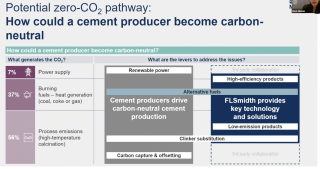
And if you take all these topics into account, let's say clinker production, energy efficient and concrete and so on, we are talking about the complete lifecycle of the cement and concrete where we have to take care of it. Not like having raw materials producing cement, and that's it. We have to take care of the complete lifecycle. but today I would like to focus on these three fields of action, huh? So we are talking about thermal efficiency and using of waste materials. The second big topic is scms, how to reduce the clinker factor.
But anyhow, if we have the first field done, everything we could do, and if we have done everything in the second field, we could do, there's still a certain margin because the CO2, all of the lime, so is not avoidable where we have to take care of. And there we are talking about carbon capture utilization and storage. And just to put, not to go in all the details, just to put some technologies, yes, they are available, but with a certain technical readiness level up to now. And the first field is let's say the thermal efficiency of touch plant. And I mean, we discussed that already, that people could be a solution.
I mean, we have several reference, but it depends on the waste you would like to feel. Is it treated as, as a benefit for CO2 reduction or not? What is the biogenic content? But this could be a solution. Second field clinker reduction as CM also well said, this morning we are talking about ca and clay calcination, thermal calcination, and what is quite new technology, which we launched last year. It's a, so-called mechanical activation. So we are not using primarily energy anymore, we are just using electricity to activate the clay. Next field can capture, as I said, if you have reached the, the limit by optimizing the plant with regard to thermal energy. With regard to SCM, no.
So also the, the clink effect is some limit. You cannot go to, to two zero. you finally have to capture the C two. And here we are talking about oxy, second generation from, from producers or so-called separate oxy car center. And there it depends. Would you like to capture a hundred percent or just partial capture? And as I said already, I don't want to just summarize it, that we have to take care of the entire lifecycle from, from A to Z, from from the, from the cement up to the concrete and further on.
now somehow a, a a step towards what do we have in, in TCorp, not only ERs, we are part of TCorp in corp, we have also other let's say sectors emitting a huge amount of CO2, like, like steel. And within TCorp we have several technologies available to, to couple, no, the sectors like example green ammonia green hydrogen, and therefore could be the, the cement plant, be a supplier of CO2 or take off for the oxygen. And within that new segment, we combined these, let's say green technologies like new like er green ammonia they are also in, in, in the project in and also water, air supplying bearings for the, for the wind farms. And of course, here police is where we, I would like to focus on.
Yeah. And this is combined in the, so-called decarb technology in the, in the segment, these four technology providers. So we can give not only for cement business, not only for the cement plant itself, it's could be even more the complete supply chain, whatever is needed to utilize or to to store this two, yeah, coming back to, to cement I said this could be an option, the PrepU. So we have reference in that double, double digit reference in that this plant is in, in Lagerdorf north of Germany, running six since six years. Clicker reduction. SCM. Here we have activated clay plant in Cameroon in the range of 700 tons per day.
Another one, because it went quite well with also with simple second reference with this under execution right now in the range of 1,280 tons activated clay per day. And as you see, we are using a flash consigner for ation of clay. Yeah. Also we have a, so-called booster mill for ultra fine grinding to optimize the cement or to optimize let's say s solana or other SCM materials. And this is also technology, which is available where we have a, and last but not least, for this SCM at this new technology, this mega clay here, we are talking really about shifting the thermal energy to electrical energy. No. So the process is mechanical chemical activation of clay.
And we are here as a partner, and this is our focus not to have this relationship like client and supplier. We are here developing this technology with, with shrink in Germany. And the next step would be to install a pilot plant to test this mechanical activation. The next step, if we have the pasture, you know, it depends what is the invest would you like to capture this? U2, two years, three years, 10 years? Finally. And this is of course, for sure, we need carbon capture technology, you know, and here we have this oxy second generation. I don't want to go in all the details or partial capture, separate al signer.
And also for this technology, we have we are working on respective references here on the left side, you see the, let's say, semi-industrial plant. Currently under execution, you will see a picture in, in one or two slides, four 50 tons per day to prove the concept that Oxford second gen generation will, will run. We be facing technical issues, of course, yeah, every day we are learning, gaining knowhow, even if the technology might be available. We are gaining everyday knowhow. And this is the DNA from politics to, to leave not the client alone. And we would like to be be a partner. Second project, industrial scale plant. This come to business 4,500 tons per day.
we are in an engineering phase, and most probably this plant, the operation might start in 2027. And another example where we are on the project in Croatia with Nexar, this is funded and this is not funded, a hundred percent done by the, by the client themself also as a, as a partnership. Last but not least, just signed a couple of weeks ago com and a com Yeah, and a relationship with Taiwan cement to, to set up this, so-called separate oxy carina to test it, to do a pilot plant, and another project regarding pure oxy fuel which is, which I cannot disclose yet. But anyhow, we see that we are on the right track having several projects in the pipeline and gaining knowhow day by day.
here you see the picture of the pilot plant we are seeing here the, the pre already, and so the, the equipment supplied and most probably will be go into commissioning phase end, end of this year. Yeah. And this come to business, won two prizes at the cup shortly before Christmas. And this is all I would like to, to say as, as a short introduction, and hopefully you have several questions on that. So thank you very much for your attention. Thank. Okay, so e everybody, there was a lot there. you have questions for, for Marcus? So we have a mic, please, would you mind introducing yourself and and placing the question? I I didn't mention that everybody who asks a question gets a prize.
I didn't mention that, did I? hello. I'm Mag Mustafa. I am Chief Operation Officer Ian Cement Company in Egypt. I would like to ask you about the Oxy Fuel Project. As I understand, it seems it'll be like a greenfields project, but I don't know if this can fit for an already installed project. also as I understand this will will help as it'll increase the capacity of the production for the existing plant, because this will reduce the volume of gases and then the capacity of equipment. But increasing the capacity now is not the, is not the main objective unless we make carbon capture. I think, I don't know if ex oxy fuel will help for the existing plants or not. Thank you.
well that, so you're right, this pilot plant is, is a greenfield plant. Yeah. And we try to gain the knowhow for this oxy fuel technology, second generation on that pilot plant. And of course, you're right this is why I said the separate ANA to have a revamp solution available. No, that, but that must be checked in, in detail in particular. But we think by, by having this pilot plant running, gaining no harm for the complete oxy fuel oxygen process to adapt that finally also to to breathe them solutions. No. And separate oxy cosigner could be an intermediate step to partially capture CO2.
And this, i, I forgot to mention, even in, in this decarb technology, we may have also tailored solution, like am mean scrubbing and so on. Of course, it's more on the cost intensive side, but in principle, we could also decarbonize, if you start with an SOC, finally have a tail end solution. No, but of course, you're right. we also have to adapt, take into account rhythm solutions for for sure. Yeah. Okay. Thanks very much. Ladies and gentlemen. Ah, yes, we've got two, two questions. Where's the mic, if you wouldn't mind bringing it here first please. Ah, sorry. Three. Okay. sha mohamed asic I want to ask about Mika clay.
It's the same as mi kalin in Es of sica amorphous and also in compressive strengths, positive compressive strengths. The so mechanical activation is we are putting a lot of energy in that now. We are calling that as a, a charger. And by, by that you are extremely, have high, high surfaces, no. And finally, the, the strength is comparable or even higher than, than, than flash cut science clear? No. So the strength is, is quite there. No, this Means silicone will be this mean, silicone will be amorphous sica, Yes. the, the difference is that compared to to normal calcination thermo calcination, you need a certain amount of cow it not to activate that, that's not needed for mega clay.
For mega clay. we tested several clays, and there is we can nearly activate each and every clay with this mechanical, chemical activation. Now it's a kind of grinding the material agglomeration and chemical reactions. Okay, thanks. Okay, thanks. I think we have one. Was it here please? Yeah. And there's one more across there, and then we have to move on after those two questions. Hi, good morning. maxi Al from Schneider Electric. Thank you very much for the presentation. I have a question for you, but I think it's also valid for Mathias and, and Kiran Ma here. at Schneider Electric, we believe that the best alternative fuel is electricity, right?
Because it can be fully decarbonized and it can support the reduction of your scope one and scope two emission. we hear a lot about alternative fuel substitution, which implies combustion somehow, which still limits CO2. As we, as we hear previously from GCCA we, we see some different initiative for electrifying the, the industry somehow to abate industry already move forward with a steel industry, glass industry, and even mining industry moving faster than, than cement in that specific field, right? Some startup and small companies and are doing some electrification in in the cement industry.
But we don't see it from the major three of you that I, I'm, I'm happy to have you in front of me today. So how can we accelerate this transition from coal to electrons and how can we help you to do it? Great question. I mean, the, as you said, the this is not for free, what we do here. No. So it it's based on a certain amount or, or even a high amount of renewable energy. And I mean, we see that in Europe, that the see the pressure is tremendously high and has an, has an impact on that net to put the pressure on that. So in Germany in the last year, the, the installation of renewable energy, solar plants, wind farms is very very high, more than in the last, last years before.
And that takes somehow some time. And the best would be if there's let's say the, the pressure to install even more renewable energy, you know, so really globally or locally to say, let's go that way because without renewable energy, we cannot manage that. And it's, it's for sure all the just technologies. Let's put this people c aside, but the principle, you need more energy. No, if you want to capture the CO2, that's not for free.
And this would be my, my personal view that there's a need to really push the industries to use more renewable energy and but to, to have a certain yeah, relation to the cost now, because if you do that, the, the cement price would increase, so it must be balanced. No, But how do you intend to electrify your process heat somehow? How do you intend to remove the coal and put electricity in Stuff? Yeah, for example, you need electricity for, for this purification unit, if you do oxy fuel. So you have this ation process, this make clay, where, where electrical energy is used a hundred percent.
So there you need this renewable energy, and also for this booster, fine grinding, you need electrical energy. So for all these technologies, this is a shift from, let's say, from primary energy to, to electrical energy. And if it's renewable, if it's CO2 free. Marcus, thanks a lot. It's a really hot question actually. Mateo, I think you want to have a quick word as well about this but's Great question. Yeah, Absolutely. Great question. Yeah. and I totally agree at the end of the thinking, we talk about electrification because electrification comes with a lot of benefits. it, it leverages on, on green renewable energies.
as soon as we get green renewable electricity we can electrify industrial processes. And, and we have a lot of advantages with it. the, the problem in the cement industry so far is that you don't achieve that energy flux density, which you have in combustion. You need that, for example, for centering. centering has been attempted to to be executed with concentrated solar power and all this, it didn't work out because we, you can create these temperatures, but you cannot create this energy release. and that is the problem. encapsulation, we are closer to it and centering it takes a while to get there. I can not disclose too much, but we are heavily working on it, Actually.
And then I think Caroline's got some points to make, but she'll do that in her presentation. Sure. But thank you for the question very quickly. I saw a hand o over there. There, there he was, sir. Yeah. Did, is that Tony Hadley? Yeah. Ah, okay. Shall I talk Hadley, before we, you talk Loud, a very simple question. Could you give some view on the difference between flash and rotary calcination for ing clay? Can all of us who would like to do that first? Well, whoever wants to go ahead. We, well, maybe I start. Well, it was just commented. There was, I mean, there was comment just now, but wherever do You want to start?
Do You So The, so the question everybody is views from the panel for calcining clay or de hydroxylate clay, either using a vertical flash calci or a conventional rotary kil? That's the, that's the question. Yeah. I mean, we, we prefer this, this flash gas signer because we think is that shows the calculation that it's more energy efficient. And the, the major advantage is also that it's quite compact. Now you are building in the, in the height and this flash gas signer, you can adapt our people a sea. No. So it's prepared for that. but, but anyhow, you, you are right. you have to think about if there's a krn, an old krn, which could be you reused, you have to think about it.
Does it make sense to, to reuse such, such a krn? No think about the total cost of ownership. But anyhow, our preference would be to have a compact version, highly efficient, prepared to use this people c to, to reuse alternative fuels or, or waste. Yeah. Okay. Thanks. Thanks, Marcus. Ate? Yeah, good question. and lots of discussions around this subject. and of course there are project specifics. if you have a decommissioned rotary kiln and you want to try out, and you have a limited capacity target, then of course you can economically reutilize that rotary kiln for clay ca nation.
But if it goes to, you know projected capacity production ranges like 3000 tons per day or something like on bit big scale, you will face the same limitation like you have in Portland cement after a certain you know production capacity, you cannot utilize rotary kils for calculation anymore. That's the same development that kicked in in the seventies in gray cement. so if you go for huge capacities, you will end up with flash calcination. And flash calcination has the, an advantage of homogenous temperature and reaction guidance. you have uniform temperature and, and controlled retention times that's good for your product quality.
whereas in rotary Ks you have a high te temperature gradients coming up, which is beneficial if you have some organic emissions coming from the clay. that can be handled with the surplus temperature in the gas phase of the rotary kiln, which you cannot utilize in a flash cut sign. So it depends very much on your clay deposit, on your, your organic compounds in the clay, on your production capacity, on your availability of existing decommissioned plant equipment and, and lots of other project specifics. Okay. Alright, Tony. Very good. Well, we have, we have now one, one final presentation to make it's going to be by Kiran, my RA from FL Schmidt.
so we have the three, three European big OEMs here on the stage, and they haven't fought yet, so that's really encouraging. what Meyer's gonna be talking about is n navigating the future of low carbon cement production, and she's gonna be talking about levers to achieve that. But before she starts, she wants a bit of help from you guys and the in the audience about what you think before she speaks. So what I'd like you to do is to get out your mobile phones again, and you should be getting a barcode sorry, a QR code up on the screen, please there. And it's asking by 2040, what do you think, what do you believe will be the main lever for decarbonizing cement?
So it's the main lever, and you've got here five options. You got C, CS and CCU low carbon s scms or supplementary cementitious materials like slag, ash, limestone, calcine, clay. You've got geo polymers, low carbon, alternative fuels like hydrogen electricity. You'll be glad to hear they're in the front row, sir, you've got electricity and then new materials and molecules still to be developed. So which do you think is gonna be the real, the real action area? Only one Choice. Only one choice. Sorry about that. But tell me, Tom, when you are ready to roll with the results, are they, are they still coming in? Okay, drum roll. Let's see what mima this is.
Now your consultants out here giving you a lot of advice. I'm So happy to get the help from crowd, Right? So, So not a lot of belief really in new molecules and somebody in a garage coming up with some wonderful new way of creating construction glue only 6%. But actually, you know, that's still pretty, still pretty big number. you've got pretty equal between CCSU and low carbon fuels like hydrogen and electricity. But the winner today, I dunno whether this works for you guys, is low carbon s scms at 44%. So that's really the sense here in in the room. And that's it. That's interesting. You know, you've got a, you've got a world where slag is arguably reducing in many parts of the world.
Ash is, is, is really disappearing in in Europe and parts of North America. So limestone and calcine clay, maybe that's where you are seeing the future. So thank you very much. That's very good input mite. I need to introduce you properly. I haven't done that. So, so mite iss gonna talk about this stuff now herself. she's project manager for clinker decarbonization, very, very key subject for FL Schmidt. she's been in FLS as a sales engineer working on upgrade projects. she's had a job also like some other members of the panel on a proposal engineer, a process design engineer in this industry, a global product manager for grinding products. Again, very similar career path.
And right now she's overseeing critical projects related to taking CO2 outta the out of the clinker chain and really showcasing sustainability for the industry. So really, MIMA has done it all. and now she's gonna be talking to you about, you know, sizing equipment, materials valuation, et cetera. So a big hand of applause for Mima. Thank you very much. I'm, you am usually told that I speak faster than the cement plants are changing, so if you did not guess my message through, please feel free to stop me. I'm Karen, my program manager for Clinker Decarbonization, and I'm with FL Schmidt Cement today.
My topic is sustainable foundations, and maybe I'll give you a short brief on how you can possibly navigate the future of low carbon cement production and you would think the pointer would work. Yeah, so this is my agenda. Like I said, I'll start with the possible decarbonization technologies with a slight focus on fuel substitution, clinker substitution, and CCUS. And when I say I did not have a more agreeing crowd to what I'm gonna present here it is. So we think the levers possible for decarbonizing cement are around those three pathways. Clink, clinker substitution, clinker decarbonization and efficiency improvements.
So thank you for a very supporting crowd today in leading this presentation. Right? And as we all know, even today, the type of cement produced is majorly carbon emission high. And we see that with these three pathways that you can possibly choose, you will get one step closer and probably many steps forward towards getting a net zero cement. And I did not want to talk about a lot of technologies because, I mean, let's say it, you hear a lot from a Phil Schmitz cement on a very regular basis, and you are as updated as I am probably in terms of what we offer, but still, I thought, you know, we will talk about a few technologies, give you a sneak peek on what's happening.
So the first one I chose is Calcine Clay. As you know, we have two reference sales for Calcine clay totaling to a production of about 1700 TPD. And we believe this is the next big thing. And I guess the presenters from earlier have also agreed with me on that aspect that Calci Clay is here to stay. So it's, it's only for you to pick and choose the pathway which works for you, right? And again, this is a global perspective. This is not a specific region based. And of course we understand that each of the perspectives that we present today are sometimes a bit But as such, with Calcine Clay, these are the typical savings we expect.
And we have a patent pending color control technology that we are working on. I mean I might sound very wrong when I say if ever color mattered. I think it was the gray color of cement that mattered to a lot of us, especially to the end users, right? So we have a color control technology as well. So your end user is not only believing the quality that they're working with, but also on the color of the cement that they would be working with. And you know what I'm sometimes a bit skeptical with, with the kind of clay I have to use if I were a cement producer?
So we have the picture here is from Dania, one of the world's leading laboratories when it comes to raw material testing, when of cement production. So in Dania, we have repurposed it even for SCM usage and also to work on several pilots in 2022. So in that we have a testing technology, which you can work with us on. if you have clay materials, we can tell you with some simple tests, whether it is suitable for your calci clay systems. it comes with several steps. We also have some customized tests where we do a high scale pilot studies with the pilot that we have at the Danielle lab. Moving on to fuel flex.
I would be surprised if we have left out anyone in this industry without telling the story. So I'm here again talking about fuel flex er, we think it's the evolving game changer and it rounds off what was spoken about with respect to fossil fuel usage or reducing the fossil fuel usage for that matter. It also kind of a side hustle, lowers the knots. this is something which we have seen in the Manock installation that we have our first reference installation as we speak. We are also gearing up for the next installation to start up. they have just shut down for tying in the final pieces of equipment. And probably the next time we meet you'll hear more about that installation as well.
And the third part, the carbon capture and utilization for which all of you have voted for. I guess for us, carbon capture utilization and storage are completely different things and we should accept that we do not as such, currently have one technology that we wanna work with when it comes to carbon capture. We are looking at a technology chess board, which has varied technologies that are out there available in the market at various TRL levels, that is the technical readiness levels. So we are shopping around, let's just say but we see a lot of synergies as the technologies developing. And we are also working with several partners in that space when it comes to carbon capture for us.
CCUS also means carbonation, mineral carbonation and also electrification maxim based on what you've asked. So we are working on a partnership called Eco Clay, which is electrification of the calcine clay. And yeah, I mean you can, you can read all about it. It's, it's a partnership which is there out in the website and all the news journals. I guess this is where we are working with renewable energy sources. I mean, you're electrifying it, but if you're still doing it with coal power, what's the point? Right? But I'm also coming from an Nordic country and their renewable energies is, is a very big thing.
So I would say it's, it has global application, but as of now it's a little more regional, local based project that we are working on. And each of these technologies, which have shown in all these slides, all of the pilots are in the Dania that I've shown earlier. And if you would like, you can visit us, right? So what am I getting at with whatever I've said until now is yeah, one size doesn't fit all. So explore the decarbonization solutions that are out there in the market. I mean, we are also doing that, right with the technology chess board that we have. So explore and find a way which suits you the best. Work with us on partnerships.
you know, we are, we are actively seeking a lot of co development partnerships and so on, but also recognize that there is a need for diversified approach. And my call out to everyone involved here is to expedite the approval processes, because I mean, to be fair, it's, it's not a very fair playing ground as of now. So maybe that's an approach that we should also look at. And of course, collaborate with OEMs to accelerate the development interruption and evaluate your carbon capture options, but also look at alternative strategies, because carbon capture, for me, at least based on what we hear from a lot of customers, is just a cool thing to be associated with.
But probably that's not what your company's strategy wants to work with. So explore not only carbon capture, but also other alternative strategies. And yeah, I think you'll get there faster than we imagine right now with that. Thank you. And of course we are available for any questions. Thank you, Miah. Very good, Very good. So team, have we got questions for Miah? I know you've given her a lot of advice before her presentation. Yes. Could we have the, the mic? Oh, sorry. And there what, where's the mic? We've lost the, we've lost the microphone. Could you put your hand up again just so that there. Okay, sir. Alright. If you be to kind, is just to introduce yourself. Okay.
My name is Hasan de ish. I am a performance and planning director of asic. I've been in several plants and company in the region middle East, Africa and even I've been in some plants in Europe and Canada. if you please, could you bring your first slide? Well, they should help me with that. Could, would you mind bringing back the first slide, please? There's a question about it. Thanks. Not this I don't think you mean the Page? No, the, the one after the one of the chart? Yes, this one. Okay. Yes. you know all we were talking about on this three presentation is bringing new technology, bringing decarbonization, bringing alternatives field, and you leave efficiency improvement at the end.
And I could tell you I've been in plants in Africa, in Middle East, in Turkey, in the region there is much more room than 5% or 10% for improvement. And it should come at the beginning. We should, we have some homework to do first in our plants before we start to think about new solutions. we have to optimize our operation. There is homework to be done. So why you are putting it at the end, why we don't think about it before 2040 or 2050? We have to think about this now. So I need to, to hear your opinion on that.
I know maybe this is not the sub subject that we are talking about here, but most of our plants in the, in the area need to work more and put more effort in efficiency improvement and we have to bring it in the beginning before that. Yeah. Just my opinion. Thanks And thank you for that question actually. And also in helping me clarify this slide once again. So this is not a representation of what Hel Schmidt's priority is. That's not the case. What we are trying to say here, is you can only get so far with an efficiency improvement and after you hit that point, you have to go for new technologies, is more of the message here.
But yes, when it comes to importance, I'm not giving efficiency, import improvement, any less importance than I am giving to the newer technologies. Yeah, quite Right. But Mathias, if you wanna see it any differently, right? I'm sure Tony Hadley would would, would back up what you are saying about performance Delta. Yeah, sorry, Mateos, I think It, I think it's just not chronic logically, it's just the, the the volume is decreasing. Yes. And whether it's five or 10%, there are plants that can go up to 20%. I'm, I'm sure you, I'm sure I agree to what you say. And it's a low hanging fruit. Yeah. And it's a way to reduce your carbon footprint and to reduce your cost at the same time.
Yeah, absolutely. Very good. Thank you for that. Great question. There's another, another question there. Can we move the mic please? Ah, alright. Sorry. I've logged, I've logged you Amra. Go ahead. Oh, Okay. I'm CEO of a Cuban K great presentation and to, Mr has Sam's question and to actually all the panels, and there was a lot of reference to the GCCA roadmap at the point. And let's agree that as Ms said, operational excellence and efficiency should come at the beginning. According to a lot of other roadmaps outside of GCA and I understand what we're talking about solutions.
So Cal Clay as a clink replacement, when we took clink replacement impact, it's, I would, my opinion, and I would like to hear the whole panel's feedback on that, is 70% natural SMS utilization, or let's make it 40% and 30% activation of novel and byproduct sems and the remaining good vehicle, frankly, in countries that have already clinker production, I'm not talking about countries that was buying clinker and because they don't have limestone, because this is a brilliant solution for them. So I'm talking about the 90% remaining. So not being country specific, I'm being globally specific, that the SEM utilization mainly is utilization of novel sems. 'cause this comes without investment.
Straightforward. There is a standard for it. We don't need any discussion between cement and concrete. Second goes byproduct, which are already still in production. So the byproducts are there activation of them, or activation of normal material coming to meta clay, coming to whatever the carbonation process were used. Then we go for calci clay. So in your presentation on the second, the clinical reduction was only calcine clay. So I just want to clarify that and get the feedback of all, of, all of the panel on this. Thank you.
They, they can add on to it, but I, I agree with your point that I have shown only calci click, but I'm not saying that all of you have to limit it just to that, because I have said it and I also said no one solution fits all. So I'm not saying that's the only solution that needs to go forward. I'm saying explore everything that is possible. And like I said, we ourselves as a Phil Smith are also looking at a technology chess board, and we are seeing what is peaking at a certain point in a certain region.
And we are working with those in those regions of course, due to, I mean, I, I usually joke that if anything is getting captured in carbon, it's probably the NDAs in patents on it, but not so much of a technology. So similarly, you know, there are a lot of NDAs that we have signed, which stops me from giving a lot more details here. But we are looking at several technologies that work across regions at different points. So I agree with you. Yes. But you wanted to answer. Thanks Ammar. Yeah. Now Marcus, Yeah.
I mean I fully agree and that's where said, and also regarding the, this should be the first step before thinking about further technology, but we also need, we as a OEM, we need you as a, as a client, huh? What, what is available, huh? For example, you might be select available for a couple of years. So the question is, what is a available in your region, what kind of cement could be used? What about norms? So we need also your input. What are your demanding to really guide you through the, through the next decade or through the next couple of years? Where to start, no, start efficiently, start with clay.
So this is really, we have to balance what is available in that or this region to really apply for the best technical solution. No, regarding the total cost of ownership. No. Yeah. Yes. Not only one. Yes. It could be so as, as Baia said, the low hanging fruit efficiency. Yes. Then it could be the next step. Like if, if Clay is available, you would use that. Of course, it's stepwise a way to decarbonize that. Okay. For planning very quickly, because we, we should, we should not, we should not look only for one year, two years. Yes, of course. So efficiency improvement should be one or two years plan. But we are talking about 16 years here. All most of the questions Yes.
that stop us for lunch is about 2040. Yeah. Yeah. So, so we have to plan for, for 2040. So we have to look for all the solution. Of course we have to consider it, but we have first to have at least one or two or three years short term, improving our efficiency. And then we see, and during this time, we study what will come else, what will come after improving our, when, when we will touch the ceiling of the 10, 15, 20% of room for it. Then we will go further by what having consign clear, having some cementitious solutions, having some alternative fuel, having some renewable energy, which didn't take a lot.
Like the question comes from here, it didn't take a lot in your presentation, but renewable energy is a solution which should take, take a place. Maybe it'll come later in one in tomorrow or afternoon. I dunno. I mean, what you said, you as a client have to prepare your roadmap Yes. For the next two years, five or 10 years. No. Alright. Can we just, can we just cur tell that one there. I have two more. Claude is got the, I'm afraid Claude's got the I have the mic and then it'll, sorry. And then, and then it'll be lunch. Okay. No, but I, I just want to, to give an important clarification and I hope it helps because the GCC roadmap is referred all the time.
And I want to clear up one, I think misunderstanding for some GCCR roadmap says we need all levers and there is no priority of one lever over the other. Okay. and we also insist low hanging fruits first. but the low-hanging fruits are the one that requires maybe work by the companies at plant level. This is not where we can help. so, and, and the percentage have nothing to do with the importance, right? It's by how much it'll contribute to, to getting all the CO2 done. So I think we all agree we have to work on all levers and on the low cost one first, and we need to prepare for the one that require much more work, much more technology development, and much more enabling policies. Great.
Thank you very much. Thank you. Would you be surprised to give the, the mic there? Right. Hello? will Baer, CEO Colin Baer, we are based in the Netherlands, five minutes from Germany, 10 minutes from Belgium. I want to talk about the 2040, 2050 electrification. we all know by then, waste will not be available for our alternative fuel because waste will be recycled and all the storages for carbon will be full. So electrification will be the future. then again where do we get our power? Where do we get our electricity? When I look at Europe now we have the big problem of the wintertime. We don't have sun. And on windstill days, we don't have the energy. So that's a, a, a, the a, a problem.
But the biggest problem is the electricity grid. There will not be an electricity grid within 20 years to supply all the heavy industries or even trucks or small industries. It's just not possible. In my opinion. You will see a huge import within 10 years, maybe 15 years from Africa, in the Middle East, from clinker alternative ated, clay, clay and limestone to Europe. But my main question is, how do you think for Europe, the electricity problem, the electricity grid problem will be solved? Wow. That's a, that's a great question before lunch. Thank you very much. So I'm glad I'm not having to answer it, But I'm looking at, Mathias, do you wanna take it first? Yes. I thank you very much. Yes.
But by, I, I totally agree. but I, first of all, I'd like to come back to one of the, the presentations early morning. we are talking about 20 years from now. That's a long stretch. It's a real long stretch. And honestly, at the dynamics of the, of the developments as we have witnessed for the last five years, if we project it into the future and we talk about something 20 years from now, any prognosis we're doing here will be totally wrong. That's number one. It's number two. you have been talking about shortage of, you know, grid capacities for electricity. I, I will say there will be shortages of infrastructures in many ways, not only grid capacity.
and you have been talking about imports from, from Africa. Yes. my personal feeling is we will be importing electricity from Africa because solar power, concentrated solar power, all these sun driven things will whether they will be transformed into hydrogen in between and then released into electricity in, in Europe, or not still a different story, but I do believe at the end of all the thinking there is electrification for many reasons. because it's, it's leveraging the, you know, it's it's taking the benefit of having green electricity.
And specifically when we talk about the production of clinker, if you can electrify your clinker production and you don't combust any fuel anymore alone, the capacity, the CapEx reduction for the gas cleaning alone is worth two or three digit million investments. You don't have to ox ox devox, nothing of that. You just have to compress it, dewater and compress it. And that's a huge CapEx saving. the, the problem is providing the electricity grids. And the problem is to materialize the high energy density flow, which you need. it's not enough to create just a thou 1,500 degrees centigrade in the rotary kiln. In order to to center, you need to have that energy density.
And that's, that's technologically a challenge at this moment. Some people are working on it. We are among them. but it's too early. And I, I believe there will be a synchronicity once we are ready with the technology we'll have a clearer picture on the electricity supply. Very good. Yeah. You want to Where it Just one, hold on. We've got one more comment. Don't blame me for lunch. It's this gentleman here in the front. I want you to say who you are before you start. Hi, I'm Maxim from Schneider Electric. I'm just joking. Okay. to reply the, I mean, the question and comment here, you can see there is a lot, a lot of initiative going for energy, autonomy of of the industry.
Not only cement, but you can see, you could, you can see that, and we are active in different project that involve the implementation of solar panels and solar farm on an existing let's say mining quarry limestone quarry. You could see, you could take the example of lafa in Morocco in which are 70% relying on their own wind turbines. So these are kind of initiative that, that can be deployed to support the, the electrification. It's, it's not about the grid, it's about doing it yourself, right? Technology exists. You have like all the ol stuff. We, we've seen all the, this gas solar waste recovery and so on, right? So the solution are here in the market already. Great. Thank you very much.
Well, I think in maybe Tom, for the future, we need a panel on electrification. It sounds like there's a lot of interest in the, in the community and it's a really hot subject. So everybody, it's lunchtime. I've got two votes of thanks and one thought for you to take away. So vote of thanks. Number one is for our three panelists who've been absolutely great. Please, a big round of applause. Second vote of thanks. Really heartfelt from me is to you all because it, I really wanted to get you involved. You were tremendous. I love the feedback from the questions and I really appreciate the the questions that you asked. So thank you very, very much for that to you all. Thank you.
And for those of you who are expecting a prize for asking a question, I can tell you now that prize is a free lunch. And the thought to take away with you is just that, that last poll about what you see as the carbon price is only 16 years from now at $50 a ton of CO2. I am prepared to bet if we'd done the same poll only three years ago in this region, probably we ended up something like $10 with a lot of people thinking this is never gonna happen. The tsunami of change is coming and it's coming fast. So for that, I leave that for you to talk about over lunch. That is right now on the terrace and Cafe Boud. We are back in here at two o'clock sharp. You're glad it's not gonna be me.
and I think that's everything, isn't it, Tom? And we must also give a round of applause to Peter for hosting this panel session so brilliantly. Thank you. Well, Thank you very much. That's an excellent, thanks all the participants and to you. yeah, lunch is down the stairs, across and up the escalators. Very short walk away, back in here for two o'clock. Thank you.
Video library
Browse 410 conference presentations, webinars, interviews and technical films from the modern CemNet video archive.
410 videos
2 September 2026

1 July 2026

1 July 2026

30 June 2026

30 June 2026

30 June 2026

30 June 2026

30 June 2026

30 June 2026

30 June 2026

30 June 2026

3 June 2026

13 May 2026
9 April 2026

1 April 2026

4 March 2026

27 February 2026

27 February 2026

27 February 2026

27 February 2026

27 February 2026

27 February 2026

17 February 2026

11 February 2026

7 January 2026

3 December 2025

5 November 2025

16 October 2025

8 October 2025

3 September 2025

2 July 2025

4 June 2025

7 May 2025

2 April 2025

18 March 2025

18 March 2025

5 March 2025
3 March 2025

5 February 2025

8 January 2025

4 December 2024

13 November 2024

6 November 2024

9 October 2024

4 September 2024

3 July 2024
10 June 2024

5 June 2024

8 May 2024

23 April 2024

23 April 2024

23 April 2024

23 April 2024

23 April 2024

22 April 2024

22 April 2024

16 April 2024

16 April 2024
11 April 2024

3 April 2024

11 March 2024

6 March 2024

7 February 2024

10 January 2024

10 January 2024
10 January 2024

6 December 2023

1 November 2023

4 October 2023
15 July 2023

15 July 2023

15 July 2023

15 July 2023

13 July 2023

24 March 2023
14 July 2022
13 July 2022
12 July 2022
12 July 2022
12 July 2022
12 July 2022
12 July 2022
12 July 2022
12 July 2022
12 July 2022
12 July 2022
12 July 2022
12 July 2022
12 July 2022
12 July 2022
12 July 2022
12 July 2022
11 July 2022
11 July 2022
11 July 2022
11 July 2022
11 July 2022
11 July 2022
11 July 2022
11 July 2022
11 July 2022
11 July 2022
11 July 2022
11 July 2022
11 July 2022
11 July 2022
11 July 2022
11 July 2022
11 July 2022
11 July 2022
11 July 2022
11 July 2022
11 July 2022
11 July 2022
11 July 2022
11 July 2022

6 July 2022
1 July 2022
1 July 2022

8 June 2022
12 February 2021
12 February 2021
12 February 2021
12 February 2021
12 February 2021
12 February 2021
12 February 2021
12 February 2021
25 September 2020
25 September 2020
25 September 2020
25 September 2020
23 September 2020
22 September 2020
22 September 2020
21 September 2020
20 February 2020
10 February 2020
10 February 2020
10 February 2020
7 February 2020
27 January 2020
23 January 2020
23 January 2020
23 January 2020
23 January 2020
2 May 2019
30 April 2019
18 April 2019
18 April 2019
18 April 2019
12 April 2019
12 April 2019
11 April 2019
10 April 2019
10 April 2019
10 April 2019
9 April 2019
9 April 2019
4 February 2019
17 January 2019
31 July 2018
31 July 2018
31 July 2018
27 July 2018
27 July 2018
27 July 2018
27 July 2018
27 July 2018
27 July 2018
27 July 2018
27 July 2018
27 July 2018
27 July 2018
25 July 2018
25 July 2018
25 July 2018
24 July 2018
24 July 2018
24 July 2018
23 July 2018
23 July 2018
23 July 2018
20 July 2018
20 July 2018
20 July 2018
20 July 2018
20 July 2018
20 July 2018
20 July 2018
20 July 2018
20 July 2018
20 July 2018
20 July 2018
20 July 2018
20 July 2018
20 July 2018
20 July 2018
20 July 2018
20 July 2018
20 July 2018
20 July 2018
19 July 2018
19 July 2018
19 July 2018
19 July 2018
19 July 2018
23 March 2018
23 March 2018
23 March 2018
23 March 2018
23 March 2018
23 March 2018
23 March 2018
23 March 2018
23 March 2018
23 March 2018
23 March 2018
23 March 2018
23 March 2018
23 March 2018
23 March 2018
22 March 2018
26 October 2017
26 October 2017
26 October 2017
26 October 2017
14 August 2017
14 August 2017
14 August 2017
14 August 2017
14 August 2017
14 August 2017
14 August 2017
14 August 2017
14 August 2017
14 August 2017
14 August 2017
14 August 2017
14 August 2017
14 August 2017
18 July 2017
18 July 2017
18 July 2017
16 June 2017
16 June 2017
16 June 2017
16 June 2017
16 June 2017
14 February 2017
14 February 2017
14 February 2017
14 February 2017
14 February 2017
14 February 2017
14 February 2017
14 February 2017
14 February 2017
14 February 2017
13 February 2017
13 February 2017
13 February 2017
19 January 2017
19 January 2017
17 January 2017
17 January 2017
17 January 2017
6 January 2017
18 August 2016
18 August 2016
18 August 2016
18 August 2016
17 August 2016
17 August 2016
17 August 2016
16 August 2016
16 August 2016
16 August 2016
12 August 2016
12 August 2016
12 August 2016
11 August 2016
11 August 2016
11 August 2016
10 August 2016
10 August 2016
10 August 2016
8 August 2016
8 August 2016
8 August 2016
6 May 2016
6 May 2016
6 May 2016
6 May 2016
6 May 2016
6 May 2016
6 May 2016
6 May 2016
6 May 2016
6 May 2016
6 May 2016
6 May 2016
6 May 2016
6 May 2016
6 May 2016
6 May 2016
6 May 2016
6 May 2016
6 May 2016
6 May 2016
6 May 2016
25 April 2016
25 April 2016
11 March 2016
11 March 2016
11 March 2016
11 March 2016
11 March 2016
11 March 2016
11 March 2016
11 March 2016
11 March 2016
11 March 2016
11 March 2016
11 March 2016
11 March 2016
11 March 2016
11 March 2016
11 March 2016
11 March 2016
11 March 2016
11 March 2016
11 March 2016
21 December 2015
15 December 2015
15 December 2015
15 December 2015
15 December 2015
15 December 2015
15 December 2015
15 December 2015
15 December 2015
15 December 2015
15 December 2015
15 December 2015
15 December 2015
2 December 2015
2 December 2015
2 December 2015
2 December 2015
2 December 2015
2 December 2015
2 December 2015
2 December 2015
2 December 2015
2 December 2015
2 December 2015
2 December 2015
21 August 2015
21 August 2015
21 August 2015
21 August 2015
21 August 2015
21 August 2015
21 August 2015
21 August 2015
21 August 2015
21 August 2015
21 August 2015
21 August 2015
21 August 2015
21 August 2015
21 August 2015
21 August 2015
21 August 2015
21 August 2015
21 August 2015
21 August 2015
20 August 2015
20 August 2015
18 August 2015
18 August 2015
18 August 2015
18 August 2015

30 June 2015
29 June 2015
29 June 2015
29 June 2015
29 June 2015
29 June 2015
29 June 2015
29 June 2015
29 June 2015
29 June 2015
29 June 2015
4 June 2015
4 June 2015
2 June 2015
2 June 2015
2 June 2015
2 June 2015
29 May 2015
29 May 2015
28 May 2015
28 May 2015
28 May 2015
18 February 2015
17 February 2015
13 February 2015
13 February 2015
Try searching for another title.