
2 September 2026
This transcript was generated automatically and may contain errors.
Hello and welcome to this Cemtech webinar. thanks for joining us. it's great to be back after a very successful conference in Warsaw. so this is part of our 2024 live webinar series. today we're gonna be talking about conveying and storage. just a quick word about international cement review. we're a monthly publication. Hopefully you've seen us. if not there's lots for more information on our website, simnet.com. as well as a monthly magazine. all subscribers receive a free cement plant operations handbook. really an invaluable reference for anyone working in the cement industry or interacting with cement plants in any way whatsoever. This is a a fantastic reference.
it'll guide you through all the stages of cement, plant manufacture. We also have the cement plant environmental handbook, very popular compendium of papers really analyzing best practice from the perspective of decarbonization and low carbon cement manufacture. As I said, we've just come back from Poland. we were there for Ctec Europe and this year discussing all things around carbon capture very interesting developments in the European cement industry, which of course is subject to the emissions trading system. it's it's focusing cement producers on carbon reduction and especially carbon capture which is now getting to the stage where large projects are being engineered and executed.
of course, there's the Breck Project Heidelbergs carbon capture project in Norway, which is just coming on stream to be followed by projects by wholesome Cemex and others in Europe. So we'll be more about that in the pages of international spend review. but do follow us. we'll be back in Europe next year. of course, before then we will be in Dubai. CEC Middle East will be taking place in February, 2025. there's a URL, we'll send these slides around later, but if you want to join us that's that's the place to be for all things Middle East and Africa. And onto today's webinar. I'm delighted to be able to present presentations on optimizing, conveying and storage in cement plants.
we've got a couple of speakers. One of them has had technical problems, so we're gonna hopefully bring him to you a little bit later. That's Ahmed Ben Ban from Claudius Peters. but before that it's my pleasure to introduce our first speaker from FL Schmidt. se fl Schmidt cement in the USA senior sales engineer for pneumatic transport systems. Eric Aguila. he's gonna present re the reducing energy consumption in pneumatic conveying using high pressure rotary air locks a very popular products and also a very critical subject for anyone in pneumatic conveying a little introduction for Eric.
he has a 12 years experience within pneumatic transport and is one of the driving forces behind FL Schmidt cements efforts to provide customers with tailored pneumatic conveying solutions, improving processes, increasing plant and equipment reliability, and maximizing efficiency and energy savings. During his time at FL Schmidt, Eric has successfully led multiple pneumatic transport projects in the Americas, serving both the cement and mining industries, reducing power consumption and making pneumatic conveying systems more efficient are key elements in Fl Schmidt's mission to help cement producers meet their sustainability goals.
so if you'd like to put your size up, Eric, let be The floor is yours now. Thank you. so thank you for that great introduction, Thomas, and thank you everyone who's joining this seminar webinar today. good afternoon to those of you in the UK or European time zone and wherever you may be in the world. Thank you for joining us today. So yeah, so I'd like to talk to you today about reducing energy consumption in pneumatic conveying so we're gonna go over some alternatives to the most common pneumatic convey methods. So pneumatic vein is very useful and it's very flexible method of transporting dry pulverized materials, implants. So you can see the picture I have on my cover slide at this moment.
that shows you the flexibility. You have to guide the route of the system almost anywhere with the use of straight sections of pipe, horizontal sections elbows going at different angles, 90 degrees, 45 degrees diverters, so you can hit many places, many destinations with one system. So it is a very common method to transport material in a plant. So with pneumatic conveying, we know all the great things about it. pneumatic convey has its place in many plants because of many benefits. so including the installation flexibility, basically what I covered before, you can guide it through the plant and up in the air, down at the ground level. You can guide it around obstacles or structures, silos.
So it, it gives you that flexibility. And compared to other conveying methods, typically a patic conveying system has a lower CapEx investment when you compare that to a mechanical system that uses screw conveyors, for instance, or bucket elevators or inclined conveyors or drag chain conveyors. So it's starting the, the initial investment of a pneumatic transport system tends to be lower. also during the ownership of the system, pneumatic convey systems tend to be easier to maintain and quicker to repair. There are a few things that can go wrong. I mean, of course you got moving parts and moving equipment.
So in the case of a the screw pump technology, for instance, you got the screw, you got your bearings. if the lubrication is not correct to the bearings and to the seals, you can get some catastrophic damage or failures in certain cases. But if the maintenance procedures are followed, then you greatly reduce the chances that something may go wrong. And when they do go wrong, if you have enough spares in the shop or in the, in the plant, in the warehouse it's basically swapping out the damage component and putting the new one in. So that reduces the downtime a lot. So it's not like it's gonna be down for days. It could be fixed in a matter of hours in many cases. So that's another benefit.
reliability. These systems are designed, they have a rugged design. They're meant to be used 24 or seven in most cases. So they tend to be reliable. And as long as you supply the lubrication that's required, and you are attentive to upset conditions. so to notice when there's a blockage in the system, or take preventive measures to, to avoid going down or, or failures in the system, it, it's highly reliable. And over time, considering everything, the capital investment in the beginning and the cost of ownership.
So the, the spares that you're gonna spend on the money you're gonna spend on repairs over time, the actual operating costs the electricity, the power that you're gonna use, it has a lower cost of ownership over the life of the system. So with all these great benefits, I mean, American Bay is a great solution and we promote it highly. So with all these benefits, there's still one caveat or one concern that is brought up frequently when we're designing the systems. And that is when pneumatic vein is not chosen, is because of one objection and that objection, it's always power consumption. So that's when we think about the installed power on the systems.
So a typical system may look like what you see next. On the next screen, a typical system can be composed of a material bin. So you're holding a certain amount of material, then you drop down through a rotary feeder that's gonna have a motor installed on it. And then you could feed to a, an air gravity conveyor an air site that's a NE Schmidt brand, or a ne Schmidt technology first designed by us. And then that material will be fed to a NFK pump, in this case, a screw pump or maybe a rotary air lock.
And then to supply the necessary convey air for the system, you'll need some kind of positive displacement blower or an air compressor, depending on the the pressure differential that we want to accomplish. And then material will be blown out of the system or through the pipeline to the destination. And to keep the system running well and not prevent any plugs. We want to include a de dusting system like what you see here. So that hopper on the pump is vented off to this filter. So to keep the system free of dust and running properly. So each of these pieces of equipment is gonna have a some power consumption because of the the motor that's installed on them.
So we're gonna see how that compares to between the different pneumatic and pain technologies. So hel Schmidt and Fuller Company here in the us were known for this product on the screen. That's what we call a Fuller Kenyan pump. we've had it in service for over a hundred years in the industries in cement and mining, and it's the most common mode of natic convey technology. it is well suited to handle primarily fine powdered material. The screw pumps have their limitations because the material has to have it specific properties or a specific mix of fine and coarse particles for that material to be a candidate or a good candidate for pneumatic conveying.
But it's very flexible and it allows us to move different kinds of materials, different particle size, distributions, even temperatures. And with these systems, we can push material several hundred feet away, even we get two kilometers in some cases, depending on how far the system is going. And we, we can push hundreds of tons per hour of transport rate. So it is the most flexible type of conveyance system, both in capacity and layout. So most of you who are in the industry will be familiar with the faces of conveying. So we have three phases that we consider. One is dilute phase. That's when the particles are bouncing up and down in the pipeline. And the pipeline is mainly empty.
I mean, not quite empty, but the particles that are suspended and they're bouncing around. then we add a two phase conveying, which is what I'm showing on the screen now, and that's a combination of particles and suspension and some particles that settle to the bottom of the pipe, and they move in waves as a slog. And then the most dense conveying is actually what we'll call a dense phase conveying. That's when the particles in suspension are limited, and most of the material is pushing through in plugs or slugs going through the pipe. So pumps can handle all three phases of conveying, depending on the proper engineering sizing. So in a, in a typical system, where is the power used?
so as an example, based on that slide before if we focus only on the air sites that feed the pump, the pump itself, the filter receiver fan, and the convey compressors, you can see the pump has an installed power of about 350 horsepower. The compressor is about 700 horsepower, filter receiver about 20 and airside fans at 10. So everything combined is about 1,080 horsepower that translates to 805 kilowatts. That's typical for a system with the parameters that you see below.
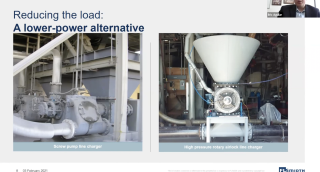
So it's a system designed for to convey 442 metric tons per hour of raw meal in a cement plant conveying or lifting the material 135 meters to the destination, and with a bulk density of the material of 900 kilograms per cubic meter. so that's something that you might expect for a system of this size and capacity. So if we are thinking of reducing the load, we want to find a lower power alternative, something that may be more economical to run in the long term. so the pump is the main piece of equipment for pneumatic ba, but we have come up with new design in recent years for a high pressure rotary airlock line charger.
So the line charger, its function is to put the material into the line and allow it to be conveyed out. So it's gonna have a similar concept. So on the right hand side, you see a bin that holds certain amount of material, then the rotary airlock has a body vent. So this vent is takes, you know, the leakage air back to the, to a, to the hopper or or to a dust collector. So that prevents the over pressurization of this rotary air lock. And then material is fed to this pickup tee that takes it with the force of the compressed air to the destination. So what is the value of the new design? The value of the new design lies on its high efficiency.
So for every rotation of the airlock, so if you imagine an airlock, if you're familiar, it's a rotor that is inside that rotor with multiple veins. So in this case, to increase efficiency, this airlock is designed with a 10 vein design. So for each rotation of the airlock, those pockets in the rotor are being filled. So the fill efficiency is higher than in previous iterations of rotary airlocks because of the design and the way material is gonna flow. So for every rotation, you're passing more materials, allowing us to load the transport line with more capacity in a shorter amount of time. So does increase in the, the transport rate.
So the high performance comes from the design of the seals on this unit. So the seals make use of a labyrinth seal and a mechanical seal. It's a graphite seal that allows us to have this unit seal against higher pressures than before. So previous generations of feeders were limited to a differential pressure of about 15 PSI, whereas this one is a capable of going up to two bar, so about 28 29 PSI. So the more capacity, the, the more ceiling capacity in the unit, we can get more powerful air supply.
So compressed air at a higher pressure in a smaller pipeline, allowing us to convey more material pushing a longer distance and being overall having a higher performance than previous rotary airlocks. So where may you find rotary airlocks or feeder applications in our industries? So in cement plants, you may find them at trans in the transport of cement, kiln dust in the transport of cement, fly ash, pulverized coal and petco among others. And it's also highly used in cement terminals to transport from the barges or the ships that are being unloaded up to the storage silos. so, or certain terminals receive material via rail cars.
So rail cars come into the terminal and it, they need to be taken to storage, then material needs to be stored. And then when it's time to use that material to move it to the next destination or load it onto other rail cars or trucks for local consumption, then we have systems to discharge from storage silos to day bins for daily use, or for loadout for any other applications. So the benefits of the high pressure airlock is its ability to seal against up to 29 PSI, like I mentioned before, that may vary depending on the abrasive traits of the material. And, but we have a solution or we can come up with a design internally with engineering, depending on what is required.
'cause we do have an abrasion resistant version of the same unit. So it's the same construction, but it has ceramic tiles on the inside of the bore of the feeder and tungsten carbide coatings. So these treatments are meant to extend the life of the unit and prevent premature failure. And there are a great power saving alternative for screw pumps. So there are certain considerations in conveying for existing systems. So you have to keep in mind that an airlock is gonna have more leakage through the airlock, then through the pump. 'cause the pump, when it compresses the material, it allows for the creation of a seal of a material seal that's stronger than with an airlock.
So an airlock will let more air through, so that has to be taken into account in the design of the system. And more leak leakage through the airlock translates to reduced conveying velocity with the same air supply. So the existing system velocity must be checked based on this reduced flow, but as long as the parameters are taken into account and the proper calculations are made, we can adjust the parameters to, to make it work and basically provide a, a better alternative with power savings. So I'll show you some of the, the features. there are many features to this unit, but again, we highlight the main one. the ability to seal against that two part differential.
So a 29 PSI differential that allows us to feed smaller pipelines to achieve the same rate. we got multiple sizes. We got certifications such as NFPA or atex and flan drillings to match, you know, imperial units like installations in North America, or worldwide installations where NC or the standards may be used. And we have other features to prevent jamming or to prevent or to, to increase the efficiency of the filling and the feed rate to the rotary airlock. another great benefit of this unit is the fact that it has a a direct mounted drive. So the motor unit is mounted directly with BFD. So that BFD allows us to change the speed between five and 30 RPM.
So it can be slowed down or sped up to adjust to the conditions. Some, some of the processes may require higher speeds or lower speeds and has a body vent and other features that make it quite useful. So I wanna get into the comparison of the systems. So I showed you the system before, same parameters, 442 metric tons per hour, lifting 135 meters for raw meal. And you can see on the screen the, the comparison between the power. So the airside fans remain the same between the two alternatives.
The filter receiver fan is the same, convey compressors, we're gonna use the same air supply to push the material in the system, but the huge difference you're gonna see is between the screw pump and this V series feeder, which is the high pressure airlock. So you see the comparison between three 50 horsepower on the pump versus six horsepower on the feeders. So that's a big savings just looking at the numbers like that. But it's even more apparent when we translate that to dollars, dollars and cents or euros, wherever you may be. so the reduction in power consumption is about 344 horsepower. So 256 kilowatts.
Translating that to monetary numbers considering a cost of 8 cents per kilowatt hour and a usage of about 7,000 hours per year, we're talking about annual cost savings of $160,000, about 132,000 euros. So that's something that may offset the capital investment or the changes that may be required in the plant. And it's gonna keep on giving over the life of the system. So every year you're gonna realize those savings and you're basically not losing any performance compared to a, to a screw pump, a more traditional method. So that was a case study number one for raw meal transport. the next case study is a replacement of fuller Canyon pump screw pump.
And our goal was to transfer red mason res cement and prevent product contamination. And we had to provide an airlock stackup that would fit under a 12 by 24 rotary cutoff valve, which is the piece of equipment you see on both photos. The overall height we had to play with was 55 and a half inches. so that's, that's the space we had to fit in to design the, the rotary airlock. And the goal was to replace the old screw pump that was unreliable old. And and you see this pump was mounted on platform and with you, you can see the, the rail tracks. So this pump was meant to be used and to be indexed. So that pump was moved from silo to silo to, to the conveying.
So we wanted the same solution in a more compact version and with the same functionality and the, the power savings that come with it. So this is the, what I'm showing you is the before and after photos. You see the after photos here, the capacity was matched achieved with a B 500 airlock, which is the second to largest size. The largest size in this line is a V 600. So we achieved it with a V 500 running at 12 RP, and the same air supply was maintained. Their supply that was used for the pump was 1400 SCFM at 18 PSI. And the airlock had the variable speed drive set to operate between five and 30 RPM with the BFD option to allow for adjustment of that speed at any time.
So the stackup was made of this transition piece to go from the rectangular flan of the cutoff valve to the round inlet flange of the feeder. And then under the, the airlock, we got the pickup T to connect to the convey line and take material away. So from here are other photos, different angles of the same installation. That's the body vent, and that's the convey system, the convey line. And same thing, you can see on the right hand side how it's located directly under that silo. So it's a direct feed into that unit. So now let's take a quick look. I mean, that's the, how it looks before and after and if fits in the same space. But let's take a look at the power comparison.
So we went from a pump that had about 200 horsepower motor to a rotary airlock with a three horsepower motor. So that's a huge savings over time. So in summary, we have an advanced design line charger suitable for a variety of applications that allows for significant power reduction compared to a screw pump. and the range goes a comparison. A rotary airlock may have a between one and three horsepower motor. And compare that to a typical pump. That pump may use a hundred to 300 horsepower. And these airlocks can replace a pump in many applications. We have to analyze it on a case by case basis.
But as we saw in the case study we achieved a 32% reduction in power consumption in that particular case. So these units have a higher pressure capability than a conventional rotary valve. They can seal against 20 to 25, even 29 PSI, compared to the most common airlocks, which are in the range of six to 10 PSI. And then we do have an, an abrasion resistant version that is suitable for some abrasive materials. So certain grades of cement, fly ash, or cement kill and dust and other abrasive materials may require the use of a ceramic line unit. So that was in short a quick introduction to the rotary airlocks. I hope you found it useful and you found the benefit of it.
And if you need any assistance from our end to analyze your systems and your installations, my contact information is in the card on the screen. And I think this presentation will be shared with all participants. So we'll be happy to, to assist you any way we can. thank you for your attention. Thank you very much, Eric. That was a, a superb presentation of what is a a really important, very simple, but fundamental, a basic building block of pneumatic transport in cement plants. And as you mentioned, it's been, you know, many, many years in usage. And it's it's all over the world. It's a, it's a very, very well known product. we've got some questions very practical ones.
I'll, I'll start with the first. maybe you'd like to answer can the airlock be used to convey kiln dust over a distance of 400 meters, including 350 meters horizontally and a 50 meter vertical lift? Absolutely, yes. So that's that's your first question. yeah, we just have to take the, the right considerations for the design. So depending on the temperature and the abrasiveness of that material I would say we would need the abrasion resistant version with ceramic tile covering the, the bore of the unit and the tungsten carbide coating in many of the contact surfaces.
but as long as the pipeline is designed correctly and with the correct fittings like elbows, elbows tend to take a lot of the damage and of the impact. So every time you're changing direction, if you're hitting a 90 degree bend coming from a horizontal to go to a vertical, then there's high abrasion and high impact in that zone. So, but as long as everything is taken into account, we'll be happy to look into that application for you. If required, you can contact me and we can get you some, some options, some calculations and some pricing and availability for sure. Okay, thank you very much. That's a very straightforward question and answer.
a few questions here from from someone who's asking, what are the most important design criteria for rotary airlock, especially for dust with higher moisture such as slags with 10% moisture. he's asking how to avoid blockage in the rotary valves. mm-Hmm. And, and how the flow is controlled. is it by the speed only or are there other factors? do we change air supply accordingly as per the quantity of flow during operation? well, ma many answers to that question. the feed rate to the airlock can be controlled in many ways. So if, like in in the diagram I showed, if there is an air site or some other conveyor before that's gonna control the rate.
So you may have a rotary feeder, or you may have a flow control device upstream that's gonna control the amount of feed to the rotary airlock, although that is not required in all cases. 'cause you saw in that photograph from the Tennessee cement terminal, it was a direct feed. So the, the airlock was directly below the bin and it was just a gravity feed going in. so it depends on, on the application, we can certainly review all of that. And pertaining to the question about moisture, moisture is a big obstacle in these cases. I mean, as the person who asked may be aware, moisture doesn't do well in pneumatic conveying, 'cause everything gets sticky inside the pipeline at all.
So for applications that go above 10% moisture, I would say we wouldn't be, or this solution wouldn't be optimal because it, it would still cause blockages and stick it would stick inside the pipe and probably on the airlock. So we want to limit moisture content to about 5%. Okay. temperature, we can handle a wide range. We can go up to maybe 800 degrees Fahrenheit, so we can handle hot material. That's not an issue. And other properties of the material must be particle size. So if we have particles or pebbles that exceed, let's say 10 millimeters in diameter, that may cause a jamming of the, the veins of the rotor as if they're turning inside.
So we want to keep a good mix of particle sizes, but when we have large chunks like that, they can be problematic. so air supply is gonna be the same. it would be a fixed value and the, the throughput through the unit will be controlled by the feed rate into the airlock and by the speed at which the rotary airlock operates. I don't know if I missed another part of that question. No, I think that's that's quite comprehensive. And yeah, the moisture is a, is a big deal. something we watch there's a couple of questions both asking about replacing FK pumps with this rotary feeder for coal firing in the kiln or cal signer?
certainly doable depending on the, the capacity that we want to achieve and the distance. but we have done it in the past, yes, have done it. That's a possibility. The unit, the, the rotary air locks are, have all the ratings. The NFBA here in North America, that's a fire protection rating. And the one that's most common in Europe and Northern Africa and the Middle East and Asia is the ATEX rating, which is more an international standard. So both can be met and pulverized fuels can be conveyed for sure. Okay. and what is the compressed air pressure required for conveying? I assume that's in relation to the coal, but I'm not sure.
that's a tough question to answer without the actual numbers in front of us, because the, the pressure rating of that compressed air is gonna depend on how far we're pushing. So if we're pushing, you know, 20 meters, it's gonna require less pressure than if we're pushing a hundred meters. So depending on the, the rate that we want to accomplish and the distance basically through the pipeline, it's, it's a pressure drop. So at the, at the feed point of the system where the pump is or where the airlock is, that's where you need your higher pressure. I mean, that's where you hook up directly to the compressor. So that can give you 22 or 25 PSI.
And as the material moves through the pipeline towards the destination, so let's say you can be a quarter of the way or halfway through the pipe, then the pressure is almost half at that point. So by the time you get to the destination where it discharges into the bin, that's like a zero pressure condition. So all that has to be built up to the destination. So depending on the rate and the distance that we want to cover, that'll determine the, the pressure differential. Okay, thank you. and a question about reliability. How reliable is pneumatic conveying compared with mechanical conveying bucket, elevated screw conveyors, aerosolized, et cetera?
I would say, I mean, airside, we still consider a form of pneumatic conveying. So yeah. Okay. Yeah. Compared to a screw conveyor or bucket elevators or drag chain conveyors? I would say more reliable. I mean, 'cause I've seen it firsthand when a, when a screw conveyor goes down or a, or a bucket elevator fails it can take days if not weeks, to get that replaced. but you saw the unit in the Tennessee terminal, that's a maybe that's a V 500 unit. So it's I think maybe two feet tall, flinch to flange. So it's, it's a, it's a dimension. So it's like a little cube, so maybe two by two by two, which you can have spares in your, in your shop or in your warehouse at the plant.
So it's an easy replacement if, if need be. but all in all, they're reliable and they work pretty well as long as the maintenance is performed according to the schedule and you don't exceed the, the, the ratings. So as long as the seals and the bearings are in good shape it tends to be more reliable in what I have seen. And if a failure occurs, it's a lot quicker to recover from. Very good. that makes sense. And that's that's a great way to, to round off your presentation a great sort of insight into pneumatic conveying a great product. thank you for sharing that with us. pleasure.
Your based in the us but I guess hel Schmidt Cement has offices worldwide and one person was asking about Europe, but inevitably you are covered in Europe too. Yes. And just so everybody knows yes, I'm located in Americas handle projects, mainly in this area, but the world, the Global Center for Pneumatic Transport is here in Allentown, Pennsylvania. So any of those requests anywhere in the world will end up coming through this office and through our team. So feel free to reach out directly. That's great. Thank you very much, Eric. that's a, a fantastic presentation. that's that's it for now. we are really sorry that our other speaker was not able to join.
so we've had technical problems that side and as a result, we won't be able to share stockyard technology for cement plants this time. So we will try and bring it to you at one of the next webinars. We've still got a couple ahead plant maintenance next month and Green Cements in December. that will be rounding off the year. but for now and that, that's all we have time for, I'd really like to thank Eric for fantastic presentation. Thank you, Thomas. And thank you to all the audience for your attention. Don't forget to catch up with our other events, in person events in the Middle East. We'll be back in Dubai in February. But for now, that's all.
Thanks for joining us a very short webinar this month. do connect the first Wednesday of every month for EC webinars. thanks Eric ever, Schmidt. have a good morning or evening wherever you are. and we'll see you shortly, hopefully at the beginning of November. All the best. Thank you. Thanks.
Video library
Browse 410 conference presentations, webinars, interviews and technical films from the modern CemNet video archive.
410 videos
2 September 2026

1 July 2026

1 July 2026

30 June 2026

30 June 2026

30 June 2026

30 June 2026

30 June 2026

30 June 2026

30 June 2026

30 June 2026

3 June 2026

13 May 2026
9 April 2026

1 April 2026

4 March 2026

27 February 2026

27 February 2026

27 February 2026

27 February 2026

27 February 2026

27 February 2026

17 February 2026

11 February 2026

7 January 2026

3 December 2025

5 November 2025

16 October 2025

8 October 2025

3 September 2025

2 July 2025

4 June 2025

7 May 2025

2 April 2025

18 March 2025

18 March 2025

5 March 2025
3 March 2025

5 February 2025

8 January 2025

4 December 2024

13 November 2024

6 November 2024

9 October 2024

4 September 2024

3 July 2024
10 June 2024

5 June 2024

8 May 2024

23 April 2024

23 April 2024

23 April 2024

23 April 2024

23 April 2024

22 April 2024

22 April 2024

16 April 2024

16 April 2024
11 April 2024

3 April 2024

11 March 2024

6 March 2024

7 February 2024

10 January 2024

10 January 2024
10 January 2024

6 December 2023

1 November 2023

4 October 2023

15 July 2023

15 July 2023

15 July 2023

15 July 2023

13 July 2023

24 March 2023
14 July 2022

13 July 2022
12 July 2022
12 July 2022
12 July 2022
12 July 2022
12 July 2022
12 July 2022
12 July 2022
12 July 2022
12 July 2022
12 July 2022
12 July 2022
12 July 2022
12 July 2022
12 July 2022
12 July 2022
11 July 2022
11 July 2022
11 July 2022
11 July 2022
11 July 2022
11 July 2022
11 July 2022
11 July 2022
11 July 2022
11 July 2022

11 July 2022

11 July 2022
11 July 2022
11 July 2022
11 July 2022
11 July 2022
11 July 2022
11 July 2022

11 July 2022
11 July 2022
11 July 2022
11 July 2022
11 July 2022
11 July 2022

6 July 2022
1 July 2022
1 July 2022

8 June 2022

12 February 2021
12 February 2021
12 February 2021
12 February 2021
12 February 2021

12 February 2021
12 February 2021
12 February 2021
25 September 2020
25 September 2020

25 September 2020
25 September 2020
23 September 2020
22 September 2020
22 September 2020

21 September 2020
20 February 2020
10 February 2020
10 February 2020

10 February 2020

7 February 2020
27 January 2020
23 January 2020
23 January 2020
23 January 2020
23 January 2020
2 May 2019
30 April 2019
18 April 2019
18 April 2019
18 April 2019
12 April 2019
12 April 2019
11 April 2019
10 April 2019
10 April 2019

10 April 2019
9 April 2019
9 April 2019
4 February 2019
17 January 2019
31 July 2018
31 July 2018
31 July 2018
27 July 2018
27 July 2018
27 July 2018
27 July 2018
27 July 2018
27 July 2018
27 July 2018
27 July 2018
27 July 2018
27 July 2018
25 July 2018
25 July 2018
25 July 2018
24 July 2018
24 July 2018
24 July 2018
23 July 2018
23 July 2018
23 July 2018
20 July 2018
20 July 2018
20 July 2018
20 July 2018
20 July 2018
20 July 2018
20 July 2018
20 July 2018
20 July 2018
20 July 2018
20 July 2018
20 July 2018
20 July 2018
20 July 2018
20 July 2018
20 July 2018
20 July 2018
20 July 2018
20 July 2018
19 July 2018
19 July 2018

19 July 2018
19 July 2018
19 July 2018
23 March 2018
23 March 2018
23 March 2018
23 March 2018
23 March 2018
23 March 2018
23 March 2018
23 March 2018
23 March 2018
23 March 2018
23 March 2018
23 March 2018
23 March 2018
23 March 2018
23 March 2018
22 March 2018
26 October 2017
26 October 2017
26 October 2017
26 October 2017
14 August 2017
14 August 2017
14 August 2017
14 August 2017
14 August 2017
14 August 2017
14 August 2017
14 August 2017
14 August 2017
14 August 2017
14 August 2017
14 August 2017
14 August 2017
14 August 2017
18 July 2017
18 July 2017
18 July 2017
16 June 2017
16 June 2017
16 June 2017
16 June 2017
16 June 2017
14 February 2017
14 February 2017
14 February 2017
14 February 2017
14 February 2017
14 February 2017
14 February 2017
14 February 2017
14 February 2017
14 February 2017
13 February 2017
13 February 2017
13 February 2017
19 January 2017
19 January 2017
17 January 2017
17 January 2017
17 January 2017
6 January 2017
18 August 2016
18 August 2016
18 August 2016
18 August 2016
17 August 2016
17 August 2016
17 August 2016
16 August 2016
16 August 2016
16 August 2016
12 August 2016
12 August 2016
12 August 2016
11 August 2016
11 August 2016
11 August 2016
10 August 2016
10 August 2016
10 August 2016
8 August 2016
8 August 2016
8 August 2016
6 May 2016
6 May 2016
6 May 2016
6 May 2016
6 May 2016
6 May 2016
6 May 2016
6 May 2016

6 May 2016
6 May 2016
6 May 2016
6 May 2016
6 May 2016
6 May 2016
6 May 2016
6 May 2016
6 May 2016
6 May 2016
6 May 2016
6 May 2016
6 May 2016
25 April 2016
25 April 2016
11 March 2016
11 March 2016
11 March 2016
11 March 2016

11 March 2016
11 March 2016
11 March 2016
11 March 2016
11 March 2016
11 March 2016
11 March 2016
11 March 2016
11 March 2016
11 March 2016
11 March 2016
11 March 2016
11 March 2016
11 March 2016
11 March 2016
11 March 2016
21 December 2015
15 December 2015
15 December 2015
15 December 2015
15 December 2015
15 December 2015
15 December 2015
15 December 2015
15 December 2015
15 December 2015
15 December 2015
15 December 2015
15 December 2015
2 December 2015
2 December 2015
2 December 2015
2 December 2015
2 December 2015
2 December 2015
2 December 2015
2 December 2015
2 December 2015
2 December 2015
2 December 2015
2 December 2015
21 August 2015
21 August 2015
21 August 2015
21 August 2015
21 August 2015
21 August 2015
21 August 2015
21 August 2015
21 August 2015
21 August 2015
21 August 2015
21 August 2015
21 August 2015
21 August 2015
21 August 2015
21 August 2015
21 August 2015
21 August 2015
21 August 2015
21 August 2015
20 August 2015
20 August 2015
18 August 2015
18 August 2015
18 August 2015
18 August 2015

30 June 2015
29 June 2015
29 June 2015
29 June 2015
29 June 2015
29 June 2015
29 June 2015
29 June 2015
29 June 2015
29 June 2015
29 June 2015
4 June 2015
4 June 2015
2 June 2015
2 June 2015
2 June 2015
2 June 2015
29 May 2015
29 May 2015
28 May 2015
28 May 2015
28 May 2015
18 February 2015
17 February 2015
13 February 2015
13 February 2015
Try searching for another title.