
2 September 2026
This transcript was generated automatically and may contain errors.
So we're gonna change it up now we're gonna invite our next speaker, Tony, Tony Hadley of Tony Hadley African Advisory. he rents his own independent consulting company specializing in the cement sector, mainly in Africa, but also globally. Tony advises on issues relating to strategic analysis m and a, due diligence, technical audits and board strategy sessions to name but a few. The company was also an early developer of practical expertise in Caine Clay projects and other CO2 reduction initiatives. Prior to his current role, Tony was instrumental in building the highly profitable African cement business for Blue Circle and Lafarge later as CEO of Dan Gotti Cement.
He helped lay the strategy for what is now Africa's biggest and most profitable cement company. and today is gonna address the small topic of understanding global cement, macro trends risk and reward, why it's different this time. So, over to you Tony. Thanks Storm. And good morning. It's a pleasure to be here. And it's rather a big title and it's rather a big topic. So we'll try and keep it within some constraints. It's got all the material here, so I'm not gonna go through everything in detail. I'm gonna touch on the things which I think are important in our world and where they're going, and to give you food for thought, which you're gonna find re relevant to your, to your business.
Listening to Jim's presentation there, I always look what I call below the curve. There is so much left on the table. It is incredible the difference between best in class and worst in class in our industry. It shocked me for decades and it continues to, to shock me just how bad the performance is of some, some businesses. And you only had to look at that, those gym slides to see, to see that. So we're gonna look, we're gonna look at the, this global macro. Now, obviously, we we're all here to make money, so I think what's actually been incredible is the way that some businesses have been making a lot of money over the last few years, making hay where the sun shines.
So we're gonna talk through the majors, what's happening there. Carbon cup chips already been discussed. I think it's a big large white elephant, but we'll go into that. We're gonna talk about China, that this is a Middle East Africa conference. So we're then gonna move into China. In Africa, we're gonna drill into some of the markets in Africa, what's happening, come back to decarbonization at the end, and then look at a few conclusions and a bit of forecasts of what, what might happen. So again, we're gonna run through it fairly quickly and see how we get on. So the first thing is the Western majors are making a lot of money. They're very focused, they're exiting markets.
Some we agree on, some, we disagree on a lot about carbon capture. But above all, the big trend over the last year has been all the majors wanting to get the US premium, which does it make sense? Let, let's have a lower look. So what we can see is the, we can see the trends in the top right hand side there. That is the price of number of European markets in the last four years. You can see the prices have almost doubled in many areas, partially 'cause of partially 'cause of everybody behaving intelligently. No more price, war reducing volumes, increasing prices, costs increasing. But now those costs are mitigating a bit. So the share prices are up.
You can see the, the, the, the margins, the EBITDA margins. E of ebitda, which is the, the classical measure for our industry have in increased significantly. So let's just look at four companies first. C-R-H-C-R-H has always been a bit different. So Jim, but it's, it's CRH has been heavily us for a long time that move their listing to the US 12 times earnings. So the investors love CRH and in, in general, the investors love this industry at, at the moment. So we then they move their listing, it's gonna be, it's gonna go on the s and p. So that valuation is gonna increase. So again, don't forget, we all ultimately work for the investors and they wanna make money in this industry.
Whole sim wholes sim have been transforming enormously. They've now made this, I think, rather bizarre decision to split their businesses. They're gonna explain it all to us in March and it, it will go ahead. They're already trading on a premium because of the fact that they're gonna have a, an American listing. Doesn't make much sense. But that, that, that is the fact. So they've been diversifying that beautiful portfolio in Africa is gone. It has been been given away at incredibly cheap prices. And wholesome are being rather vague on their investments and not releasing much information on what they're buying, on the valuations of what they're buying.
And they've still got a very big position in Qin, the Chinese company who we're gonna come back to later Heidelberg lot in the news. They're big, big, big on carbon capture. I think that's gonna be a mistake. Their valuation is seven times earnings, which is more or less median, partially a US premium. They're desperately eyeing the us How do we get more of that premium? 'cause again, they, their CEO his biggest job is to keep his investors happy. And then you've got a company like Bootsy Fa, family controlled, much more conservative.
And I, I think they're a bit the tur fall, but I, I feel they might win the decarbonization race at the end because they're, they're waiting, they're watching, they're being very cautious and and the market is not rewarding them. So again, we have to make money. Everybody needs to make money, invest for the future, position for the future. So I think that's a little picture of how the evolution of the profitability of, of the big companies have gone. So they all are focused on decarbonization. There's been quite a lot of greenwashing and we could give some examples, but I don't think we need to. Trump is changing the landscape and the investors are changing the landscape.
We've heard in the last two to three weeks, oil companies typically cutting their, their green investments by 50% over the last, we haven't heard that yet from cement. I think it's coming. And I think there'll be a big, big pushback against carbon capture, which is the big thing. And we'll come back to a little bit of that. So lot of change, I think a lot of change coming. And again, self-help in taking Jim's information and saying, where are the dollars on the table? Each one of you can look at his presentation and see how many dollars are you leaving on the table, because that's ultimately what improving your business is all about carbon capture.
This came from an old colleague of some of ours, John Klein in the US summary of the cap carbon capture. I'm gonna go into it, I don't understand it at all, but it's incredibly complex, huge power and the power, there's no point in this. It's green. And as you know, most, most green is not really green. 'cause when you put it green, you're replacing it with something else. And, but in the US it's a billion dollars for carbon capture project. $1 billion. US brev, half a billion of CapEx and a hundred million a year of operations in China. It's 30% of that. So I think that's the, the wild carb. What are the Chinese can do about carbon capture?
They can do everything quicker and more effectively than any anyone else and so much cheaper. So I think I'm personally, I wouldn't touch car carbon capture if I had anything to do with the business. And I think Ian, Ian Riley who was until very recently, the CEO of the World Smiths Association, he put out a paper recently and you can challenge it, doesn't it? It's conceptual more than absolute numbers. But he forecast that the actual amount of clinker gonna be needed in 2050 is gonna be much, much less.
And again, if you go back to Jim Jim's stuff and you extrapolated that out, you could get, and if everybody behaved and if everybody invested intelligently, you could reduce your carbon dramatically. And if you are reducing your carbon dramatically, you're either doing it through carbon capture or you're actually just using a lot less clinker. So I think that will be where our world will, will be going. So, and you can see the quote you made for the cement industry. The worst option to reduce carbon emissions is CCS, expensive energy intensive, complex, blah blah blah. So I'll leave, I'll leave carbon capture there. It's gonna be a debate, but I think it's toast.
I saw this chart the other day and it's not totally relevant to our discussion, but I think it is. That is the kills in the us. This is around about a hundred kilns in the us. A hundred million tons of capacity. Is it stunning? The biggest one is 12,000. The top 40% of capacity is 4,000 tons per day and almost 20% less than 2000. The little red ones are still wet. Kils, tiny, tiny, tiny. And you think China went from thousands of floods to 2.5 billion tons in 20 years. They built everything new, everything large. This is, this is America. So I'm interested to listen to Frederick's presentation on Calcine Clay.
How much of that old stuff is gonna get converted into very cost effective calcine clays? It was my question when I looked at that. Look at the age profile, you know, everything. 50 years old, absolutely stunning. I mean if you're an Asian, you probably think madness, but you can't do anything in the us. It's too costly, too complicated. So I think again, these things are about thinking where you are in your industry, what have you got? How can you, how can you evolve? And I've been a long time, and when I say a long time, at least 15 years, saying we just have to do what we do better. We look at the benchmarking, set a clear strategy. Define your priorities.
If the strategy makes no sense, go home. If you haven't got enough good people and enough dollars go home. Don't even start then if you're gonna do it, execute well. Focus on performance, innovate and mix your industrial excellence and your commercial excellence. We're gonna see standards change. They've started to change to allow cowain clay. We're gonna see them change to reduce the clinker factor. There's people telling us, no problem to have a calc clay cement with 35% clinker factor. Let's see if that comes in reality. But I think we're quite close to that. So play with all of these things and put money on your bottom line.
Reduce your CO2 better performance just by doing what you do today much better. And starting with getting clear on what is your strategy, what are your priorities? So that's my sort of macro message. Focus on what you can control and what you can afford. So clearly the majors are making hay while the sun shines. They're making a huge amount of money at the moment and their shareholders are very, very happy. Is their bubble gonna burst? You kind of look at, and I'm talking mainly Western Europe. US prices are super high, profitability is very high, governments are pretty much all, let's call it bankrupt in in the western world.
I wonder if there's gonna be some big pushback on prices in the future with a discipline, which means that people reduce volume proactively rather than try and grab a bit of market share stability in markets. Will that change? I don't know. I, this presentation always ends up in Africa. So Africa, the majors are out of Africa, there's a few little bits and pieces gonna be left and there's a new dynamic going there. In five years will we see all the majors say, oh we must be in Africa 'cause it's the best growth market. Let's see. And decarbonization focus on what you can do. Forget the carbon capture stuff is my recommendation. But before we go off to Africa, we have to go to China.
China's just too important in this picture in many, many respects. And that graph shows you a few facts. The incredible ramp up in China. So they built in 12 years about 1.8 billion tons of capacity of plants. And when they do it, they do it fast, they do it efficiently, they do it so much cheaper. We learn that in the, in the in in the western markets. Peter and I, Peter was building one on Ecuador. I was building one in, in Africa back in about 2003 or something. So was the first expirations into Chinese. So they are very efficient, they've got massive capacity. But look at the drop, the, the, the market peaked at about 2.4 2.3, 2.4, and it's off 27% since it's peak.
And it's gonna keep going down like that. It's got a long way further to go. So that domestic situation in China on the cement industry is leading to consequences. So all have they done? They've come to Africa and increasingly China is, and Chinese semi is the dominant player across Africa. And we'll see that in a minute. Hu yep, Hal installed control. 42% of that company. But they don't, they, they, they, they fight a bit and I think they, they will exit, exit as soon as they possibly can. West China, phenomenal journey in Africa. How they do it, we don't understand. You'll see West China West investment holdings and Mr.
Zang, the chairman, it's all totally obscure about who owns what in that organization. Sonoma CMBM, they are starting to get back on the road into buying in Africa. There's a whole few things happening at the moment, which I won't go into, but they're desperately trying to increase their positions. Then you've got some smaller ones, some niches, but big presence coming in Africa. But why do you wanna go to Africa? It's a busy place. There's an awful lot happening. There's a huge population and there's a lot of potential. So last year we looked at this concept of how much cement do you need to build a nation?
We've done a bit more work on it over the, over the last year and we, we've kind of changed a little bit. The way we look at it, we were looking previously at the amount of cement when it hit a peak. Now we're just saying the amount of cement absolute to build a nation. So you can see in the 1970s there was almost no, no cement in Japan, or I'm sorry, this is starting in the 1970s, but before that it wasn't huge. But you look over the last, what is it, 50 years? China has put in 44 tons per current capita of cement into its infrastructure. Korea, even higher 38 Japan has been, has had started this road before. So since that point it's 27.
But just from redmont, those numbers about 30 tons to build a nation, China's gone from nothing to covered in high-speed trains, 40,000 kilometers of high speed trains in 20 odd years. Phenomenal. So why, if you're an investor or you're interested in where you're taking your equipment, why, why are you interested in Africa? Look at those figures. You remember 30 tons or more of infrastructure, same starting point South Africa. Eight. And if you go back in South Africa to to 1900, that total becomes 9.5. So eight Kenya where I just come from two Nigeria, 2.4.
That's why from a market point of view and the potential growth, if you're involved in any of that stuff, Africa needs to be on your radar screen. Years ago, 10 years ago, we did some work on trying to understand growth in markets, how to plan well I was with Dan Gochi, how did we, how much capacity should we have so that we'd never have a shortage of cement. So we did a study of North Africa, Egypt Morocco, Algeria, Tunisia at the time. And we said, well let's look by decade 'cause there's lots of volatility. So we looked, we looked by decade and that is the history of Egypt since 1950. Growth, heavy growth for the last 10 years. No one's believed me.
I've said it's gonna be flat and it's been flat at 50 million tons for the last 10 years. But if you look here in each one of those decades, there was basically a hundred percent increase per decade and massive volatility plus 25, plus 38 plus 14. And it's the same for those other countries. So if you're an investor in Africa, you've got to think you're gonna get years when suddenly your market goes 25% and then it flattens off for five years and then it goes again. So a lot of volatility, but it means it's good. Should you invest, should you be focusing on North Africa?
I think not Morocco's at a peak, 500 tons per capita, very stable, but there's still some more capacity being added are in Africa. And we look at the Chinese, if you looked at that map 10 years ago, there would've been pretty much none of those dots. And those dots are not complete. Those are the main things of interest. So question and West China, the two most dominant Sonoma Juong, just a few little points. We got some mining companies who are in cement, all producing slag. There's a new one just started up in Zimbabwe. Big, big. And then you've got a few local Chinese investors who take a few positions where they see an opportunistic.
So China is the replacement of the majors in Africa, China is there, they operate in their own way, they appoint Chinese leadership, they run very efficiently. The and West China's model are quite different one from another. But if you're gonna be in Africa, you've gotta understand China. And for those of you who are equipment supplier in this room, that is something which means a lot to you. I'll, I'll let you work out what it means. I don't know, but it's, it's traumatic. So how's all this funded? West China, we dunno how it's funded. It doesn't make sense the net debt ovary, but Dove keeps going up. They claim their capital commitment to low, but it's impossible.
They just bought Heidelberg in in western DRC. That must be 80, a hundred million dollars investment. It, it doesn't make sense. And if you look at that top left where the red highlight is 85% of West China's profit is now declared out of Africa, which is incredible. You look a few years ago it was zero, in fact it was a loss at first, but so West China, very, very aggressive all over the place. Very aggressive Hu Chin, much more focused but also spending a lot of money. They've just announced they're buying NI Nigeria from Lafarge 1 billion US so big transactions. So they've obviously got bigger commitments than than they declared in their most recent results.
So they're also gonna be a bit stretched. But these guys get the money from somewhere. But these are two mega dynamics on the continent and the performance is very, very efficient. You look at the way the HIN has come into Zambia and in no time they've increased their capacity, reduced the cost base repositioned in a year they put a put a put a mill in in Zimbabwe so they can pump up their spare linker. Very, very impressive performance from these guys. So let's have a little look at east and west. West Africa is highlighted by what I call limestone deserts. There's a lot of places where there is no limestone. So the, the Calcine clay plant in Ghana, we're gonna hear about it in a minute.
Ivory Coast, Cameroon places where there is almost no limestone is is quite common. There's not much botella in West Africa. Huge crazy grinding over capacities. Generally the industrial performance is poor and we'll come to that. What's gonna happen in Nigeria, we'll come to that in a minute. And above all, I think we're gonna see a lot happening in Calcine Clay in West Africa. East Africa it's a bit different. Limestone is is spotty. Lots of lan all down that RIF Valley fly ashy SL in Zimbabwe, South Africa. There are some places where there's very, very good clay or kaine clay. We've seen huge m and a over the last few years. I think that's pretty much gonna slow down.
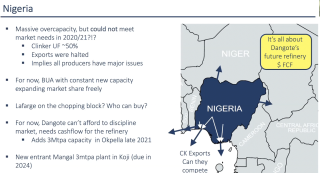
And Calcine clay will, will come less, less quickly. Teddy, we, we gave that, okay, we gave that chart last year is basically saying that we see West Africa becoming self-sufficient in clinker and in calcine clay more and more and more. And so that obviously squeezes out the exporters out of out, out of the med Nigeria you can see the margins there. Very, very different company by company. 70 million tons of capacity, 32 million tons of demand. They're operating at 50%. Something's gonna break there. There's a new entrant man coming in and the when wash in come in owning lavage. I think we're gonna see some real change in Nigeria, east, southern Africa, lot of dynamics.
And we've got the Chinese others and entrepreneurs. So basically it's becoming a China, an entrepreneurial market and a few local players. So big dynamics, some stress areas. Very, very interesting. and again, a lot of detail to go into, but lots of change happening there. So Decarbonization Africa was already a leader in modern calcine clay. Four countries basically with with operational projects. And I think that's gonna push and we're gonna see exports coming out of that area. Standards changing lower clinker. There's other s scms which can be pushed and used and alternate raw materials. And again, we come back to my favorite cal carbon capture.
It's not gonna happen in Africa for a long, long time if it ever, I think the majors are getting it wrong in exiting Africa, but that's done. and the winners will be the ones who focus on performance, who focus on decarbonization for economic reasons and be benefit from CO2 as opposed to doing it because of CO2. a lot of poor performance. These were our forecasts we we put out last year. I've only changed one cement command will go down to half a b, half a billion tons in the, probably in this timeframe. And otherwise I know we bit of time, those were our forecast last year and may remain valid in my view. and I think we're gonna see change. I think the very, very interesting.
But the companies who win are the ones who are gonna focus on strategy, where they're gonna be great team enough money to do what they need and focus on performance. So there we go. Thank you. A quick run around any That can achieve so much in terms of profitability, carbon reduction altogether and like say stressing on on kept things like cal signs clay, which we're about to, to hear more about. just on the strategy of the majors and, and China in Africa, I mean one they, they exited on the basis of lower profitability expectations due to the, the entrance of quite a lot of Chinese payers. I think that was one of the major DRI drivers. Would you agree?
what, what is the profitability like for these Chinese players or was it just too difficult to I think the, I think the ch Chinese in general are going to be very profitable because they're better than the entrepreneurs. 'cause the entrepreneurs either leader who thinks he's God and the performance tends to be rather poor. So I think, I think the Chinese will do very well hu much better than West China certainly to start with because they're, they're just better operators. again, I think the, the majors made a mistake in exiting because if you run a business well you can, you can compete with the Chinese.
I think the majors were more, were less concerned about the Chinese, they were more concerned about reputational risk. Particularly Hals in with the Syria story. They just, oh, we don had to operate in Africa. There's too big a risk. and the other excuse was, well, we can't focus on everywhere. So I think the, I think the discipline of focusing on a smaller portfolio does make sense. but I think, I think they left for the wrong reasons and I think good performance will always win. and again, there's always a lot of meat on the bone. Whenever you go in the cement plant, you see millions of dollars just being dropped on the ground and, and and wasted. So.
And, and where does that lead Dan Goi given the, the, the footprint and what ambitions do they have and what firepower do they have now that they're building a a refinery? Well they built the refinery. The refinery is operated as you know, it took a much longer than expected, much more money. I think the debt gained was huge. And also, I know Nigeria very well. It's a difficult place and he was treading on a hell of a lot of big feet. And so he had problems getting raw material oil, partially because people were, didn't want him to get it. And partially because he didn't enter into long-term con contracts and the Nigerians had long-term contracts with other people.
So I think, I think the refinery is dominating his whole life 'cause he's gotta, he's got to finance it and he's gotta make it work and keep it working without blowing the thing up. And the utilization you saw there is less than 50%. I mean, the Chinese are just buying a Shaka, which was a wholesome business and was running at 35% utilization in a niche market. They wholesome, were just incapable of running it. So a lot of, there's a lot of over capacity, but at the moment not all of that capacity is laden 'cause they just can't run it, which is it, life is just a cultural thing. It's not putting the, it's not putting the best leadership and the best resources into the business as well.
So I think Dan Gotti's on the back foot, there's been like, yeah, I mean it's more or less public rumors noise that he's been trying to sell Some businesses it hasn't happened because he can't get the price he wants. we'll see, we'll see, we'll see what happens. I think, I think he's so focused on digging out of his oil hole then and the cement is still the cash cow, but if the Chinese come in aggressively into Nigeria, those margins are gonna come way down. Yeah, we'll see. Interesting, interesting times. Well thanks for that snapshot. We're gonna move on now quickly..
Video library
Browse 410 conference presentations, webinars, interviews and technical films from the modern CemNet video archive.
410 videos
2 September 2026

1 July 2026

1 July 2026

30 June 2026

30 June 2026

30 June 2026

30 June 2026

30 June 2026

30 June 2026

30 June 2026

30 June 2026

3 June 2026

13 May 2026
9 April 2026

1 April 2026

4 March 2026

27 February 2026

27 February 2026

27 February 2026

27 February 2026

27 February 2026

27 February 2026

17 February 2026

11 February 2026

7 January 2026

3 December 2025

5 November 2025

16 October 2025

8 October 2025

3 September 2025

2 July 2025

4 June 2025

7 May 2025

2 April 2025

18 March 2025

18 March 2025

5 March 2025
3 March 2025

5 February 2025

8 January 2025

4 December 2024

13 November 2024

6 November 2024

9 October 2024

4 September 2024

3 July 2024
10 June 2024

5 June 2024

8 May 2024

23 April 2024

23 April 2024

23 April 2024

23 April 2024

23 April 2024

22 April 2024

22 April 2024

16 April 2024

16 April 2024

11 April 2024

3 April 2024

11 March 2024

6 March 2024

7 February 2024

10 January 2024

10 January 2024

10 January 2024

6 December 2023

1 November 2023

4 October 2023

15 July 2023

15 July 2023

15 July 2023

15 July 2023

13 July 2023

24 March 2023

14 July 2022

13 July 2022
12 July 2022
12 July 2022
12 July 2022
12 July 2022
12 July 2022

12 July 2022
12 July 2022
12 July 2022
12 July 2022
12 July 2022
12 July 2022
12 July 2022
12 July 2022
12 July 2022
12 July 2022
11 July 2022
11 July 2022
11 July 2022
11 July 2022
11 July 2022
11 July 2022
11 July 2022
11 July 2022
11 July 2022
11 July 2022
11 July 2022
11 July 2022
11 July 2022
11 July 2022
11 July 2022
11 July 2022
11 July 2022
11 July 2022
11 July 2022
11 July 2022
11 July 2022
11 July 2022
11 July 2022
11 July 2022

6 July 2022
1 July 2022
1 July 2022

8 June 2022

12 February 2021
12 February 2021
12 February 2021
12 February 2021
12 February 2021

12 February 2021
12 February 2021
12 February 2021
25 September 2020
25 September 2020
25 September 2020
25 September 2020
23 September 2020
22 September 2020
22 September 2020

21 September 2020
20 February 2020
10 February 2020
10 February 2020
10 February 2020
7 February 2020
27 January 2020
23 January 2020

23 January 2020
23 January 2020
23 January 2020
2 May 2019
30 April 2019

18 April 2019
18 April 2019
18 April 2019
12 April 2019
12 April 2019
11 April 2019
10 April 2019
10 April 2019
10 April 2019
9 April 2019
9 April 2019
4 February 2019
17 January 2019
31 July 2018
31 July 2018
31 July 2018
27 July 2018
27 July 2018
27 July 2018
27 July 2018
27 July 2018
27 July 2018
27 July 2018
27 July 2018
27 July 2018
27 July 2018
25 July 2018
25 July 2018
25 July 2018
24 July 2018
24 July 2018
24 July 2018
23 July 2018
23 July 2018
23 July 2018
20 July 2018
20 July 2018
20 July 2018
20 July 2018
20 July 2018

20 July 2018
20 July 2018
20 July 2018
20 July 2018
20 July 2018
20 July 2018
20 July 2018
20 July 2018
20 July 2018
20 July 2018
20 July 2018
20 July 2018
20 July 2018
20 July 2018
19 July 2018
19 July 2018
19 July 2018
19 July 2018
19 July 2018
23 March 2018
23 March 2018
23 March 2018
23 March 2018
23 March 2018

23 March 2018
23 March 2018
23 March 2018
23 March 2018
23 March 2018
23 March 2018
23 March 2018
23 March 2018
23 March 2018
23 March 2018
22 March 2018
26 October 2017
26 October 2017
26 October 2017
26 October 2017
14 August 2017
14 August 2017
14 August 2017
14 August 2017
14 August 2017
14 August 2017
14 August 2017
14 August 2017
14 August 2017
14 August 2017
14 August 2017
14 August 2017
14 August 2017
14 August 2017
18 July 2017
18 July 2017
18 July 2017
16 June 2017
16 June 2017
16 June 2017
16 June 2017
16 June 2017
14 February 2017
14 February 2017
14 February 2017
14 February 2017
14 February 2017
14 February 2017
14 February 2017
14 February 2017
14 February 2017
14 February 2017
13 February 2017
13 February 2017
13 February 2017
19 January 2017
19 January 2017
17 January 2017
17 January 2017
17 January 2017
6 January 2017
18 August 2016
18 August 2016
18 August 2016
18 August 2016
17 August 2016
17 August 2016
17 August 2016
16 August 2016
16 August 2016
16 August 2016
12 August 2016
12 August 2016
12 August 2016
11 August 2016
11 August 2016
11 August 2016
10 August 2016
10 August 2016
10 August 2016
8 August 2016
8 August 2016
8 August 2016
6 May 2016
6 May 2016
6 May 2016
6 May 2016
6 May 2016
6 May 2016
6 May 2016
6 May 2016
6 May 2016
6 May 2016
6 May 2016
6 May 2016
6 May 2016
6 May 2016
6 May 2016
6 May 2016
6 May 2016
6 May 2016
6 May 2016
6 May 2016
6 May 2016
25 April 2016
25 April 2016
11 March 2016
11 March 2016

11 March 2016
11 March 2016

11 March 2016

11 March 2016

11 March 2016
11 March 2016

11 March 2016
11 March 2016
11 March 2016
11 March 2016
11 March 2016
11 March 2016
11 March 2016

11 March 2016
11 March 2016

11 March 2016

11 March 2016
11 March 2016
21 December 2015
15 December 2015
15 December 2015
15 December 2015
15 December 2015
15 December 2015
15 December 2015
15 December 2015
15 December 2015
15 December 2015
15 December 2015
15 December 2015
15 December 2015
2 December 2015
2 December 2015
2 December 2015
2 December 2015
2 December 2015
2 December 2015
2 December 2015
2 December 2015
2 December 2015
2 December 2015
2 December 2015
2 December 2015
21 August 2015
21 August 2015
21 August 2015
21 August 2015
21 August 2015
21 August 2015
21 August 2015
21 August 2015
21 August 2015
21 August 2015
21 August 2015
21 August 2015
21 August 2015
21 August 2015
21 August 2015
21 August 2015
21 August 2015
21 August 2015
21 August 2015
21 August 2015
20 August 2015
20 August 2015
18 August 2015
18 August 2015
18 August 2015
18 August 2015

30 June 2015
29 June 2015

29 June 2015
29 June 2015
29 June 2015
29 June 2015
29 June 2015
29 June 2015
29 June 2015
29 June 2015
29 June 2015
4 June 2015
4 June 2015
2 June 2015
2 June 2015
2 June 2015

2 June 2015
29 May 2015
29 May 2015
28 May 2015
28 May 2015
28 May 2015
18 February 2015
17 February 2015
13 February 2015
13 February 2015
Try searching for another title.